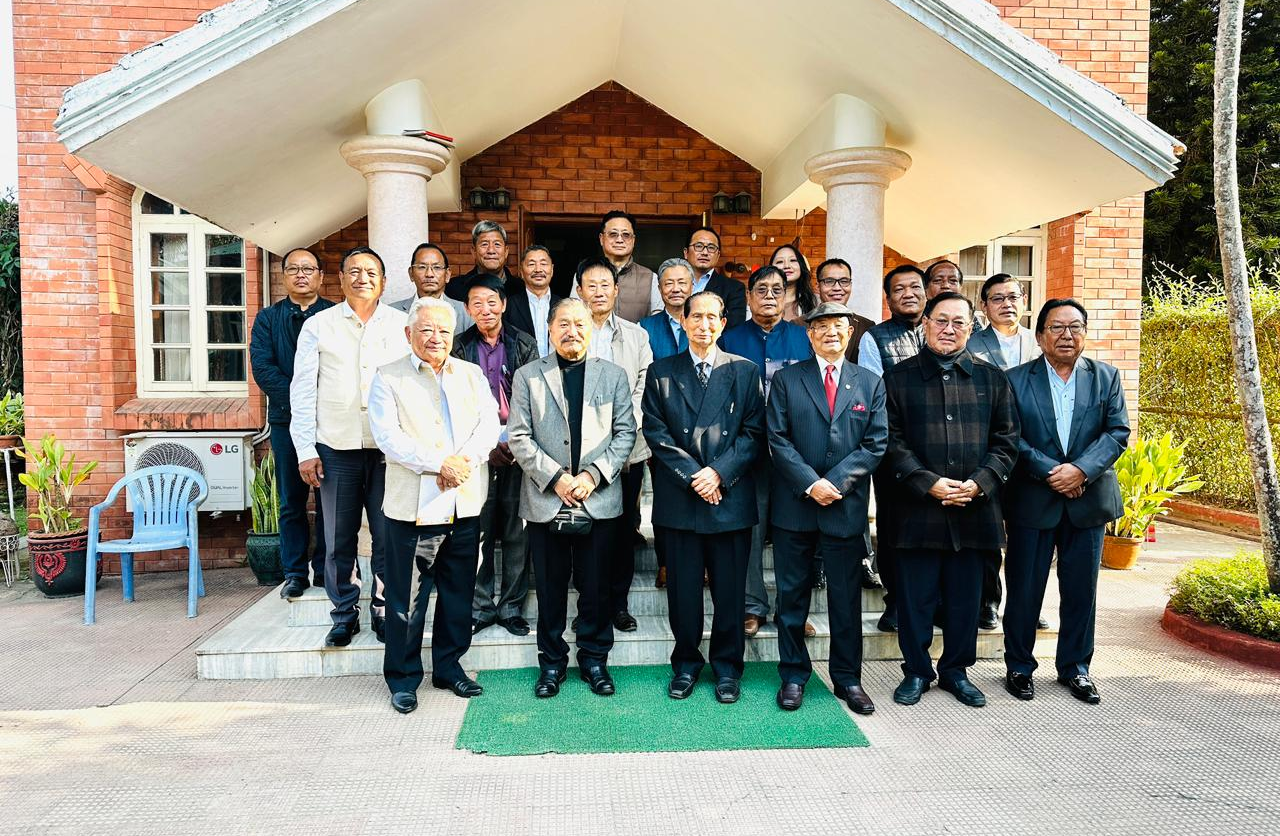
Like-minded leaders or like-minded elders of Nagaland today held a consultative meeting on the prolonged delay in solving the Indo-Naga political issue with a honourable solution, despite two agreements have been signed with the Government of India.
Around 24 like-minded elders deliberated on the issue and decided to urge the Government to India to deliver a solution to the Naga people, which has been kept pending for long.
Talking to media persons after the meeting, former Minister and former NPCC President, K Therie said that the prolonged delay in implementing the concluded Naga political agreements has pushed the youth of Nagaland into a future filled with uncertainty, unemployment, and despair, and urged both the Government of India and the Nagaland state government to demonstrate political will to bring lasting peace to the state.
Therie said the gathering was convened in view of the critical time Nagaland is facing. He said this was the second such meeting, aimed at finding ways to facilitate the implementation of the negotiated agreements, noting that talks had concluded more than six years ago.
“It appears that no solution is a solution for many — including the Government of Nagaland, the Government of India, and even the Naga national workers. In between all this, the Naga public, especially the youth, are the ones suffering,” Therie said.
Expressing deep concern over the plight of Naga youth, Therie said thousands have been forced to leave the state in search of livelihood, working as security guards, salon workers, call centre employees, or remaining unemployed without hope or opportunity. “We cannot breathe. We cannot smile when we see our youth rotting on the streets without a future,” he said, adding that this was the reason elders and concerned citizens could no longer remain silent.
He said the group also plans to appeal to the Nagaland Joint Christian Forum (NJCF) to come forward and help salvage the people of Nagaland, stressing that responsibility must be shared by the entire society, particularly the youth.
Therie maintained that there are no unresolved issues left in the negotiations, as talks have officially concluded and the agreements are already in the public domain. He said repeated demands for additional negotiations have no basis, as the Government of India has itself stated that the talks are over.
“Then what is delaying the implementation? What is stopping the opening of opportunities for our people to live in peace and prosper?” he questioned, adding that the group has no agenda against any political party or government, but believes it is the duty of the state government, citizens, and the media to collectively push for implementation.
He clarified that the group, formally known as the “Like-Minded Leaders of Nagaland,” comprises elders and concerned citizens who subscribe to the idea of implementing the negotiated agreements at the earliest, and aims to work together to help create the political will required for execution.
Responding to questions on the formation of common platforms, Therie said he was unaware of other proposed platforms but stressed that any group willing to work towards implementing the agreements would be welcome. “If the state government has the will, who can stop them?” he asked.
Download Nagaland Tribune app on Google Play

On the issue of responsibility, Therie said both elders and youth are accountable, but emphasized that the future belongs to the youth, and they must take the lead with the support of elders. “We may be concerned, but we no longer have the strength the youth have. They have a future to fight for,” he said.
He further stated that regardless of the number of Naga political factions, once called to the table, they must come together for a solution, failing which the issue would degenerate into a mere law-and-order problem. He added that NNPGs are not the obstacle, and that the idea of a Pan-Naga solution has already been ruled out by various sections of society.
Therie asserted that no solution can be imposed without the consent of stakeholders, including the people of Nagaland, and dismissed fears of unilateral decisions by the Government of India.
Rejecting the notion that neutrality is the problem, Therie said silence for six years after the conclusion of talks was enough. “Now we must urge and press the Government of India and the state government to perform their duty. Agreements have been signed. They are honourable and acceptable. Implement them,” he said.
He also questioned why issues related to Naga groups outside Nagaland should delay the solution for Nagas within the state, stating that no group has the right to dictate the future of others.
“Both governments have made commitments. They cannot go back on their own words. We do not want to fight, but they must perform their duty,” Therie asserted.
Z Lohe blames Centre, signatories and state Government for delay in Naga political solution
Senior leader, Z Lohe has attributed the prolonged delay in the Naga political settlement to failures on three fronts — the Government of India, the signatory group NSCN-IM, and the Nagaland state government — stating that the people of Nagaland have continued to suffer despite repeated assurances that a solution had already been reached.
Responding to a question raised by a youth participant, Lohe said the most critical issue confronting Nagaland today is the continued delay in implementing the political agreement, despite public announcements by the Centre that the matter had been resolved.
Lohe recalled that the Government of India had once announced that a political solution would be delivered within 18 months, a timeline that expired many years ago. He said that despite such commitments, the Centre has remained inactive. He also pointed out that the Prime Minister had publicly announced in Dubai that the Naga political solution had been reached, yet implementation has not followed, leaving the people waiting indefinitely. According to Lohe, as the principal partner in the negotiations, the Government of India has failed to fulfill its responsibility to the Naga people.
He further accused the NSCN (IM) of deliberately delaying the process, despite being a signatory to the Framework Agreement. Lohe alleged that the group had gone to the extent of seeking the removal of former interlocutor RN Ravi, who, he said, was determined to bring the issue to a conclusion. “If a signatory does not respect its own signature, then there is nothing more to say,” he remarked.
Turning to the role of the state government, Lohe said that while the government has publicly urged for a resolution, recent reports indicated that the Political Affairs Committee failed to arrive at any decision, resulting in what he described as an “impasse.” He said the absence of a resolution reflects a lack of determination and sincerity in the state’s role as a facilitator of the peace process.
Lohe also observed that ordinary citizens continue to bear the burden of the unresolved issue, particularly the downtrodden and marginalized sections of society who have suffered for decades. He said that meaningful change would have come earlier if Nagaland had a more assertive younger generation ready to demand accountability.
“Had Nagaland truly produced a strong Generation Z, this problem would have been resolved by now,” Lohe said, expressing hope that the youth would rise to take ownership of the state’s future.
Former bureaucrat, K K Sema also addressed the media.