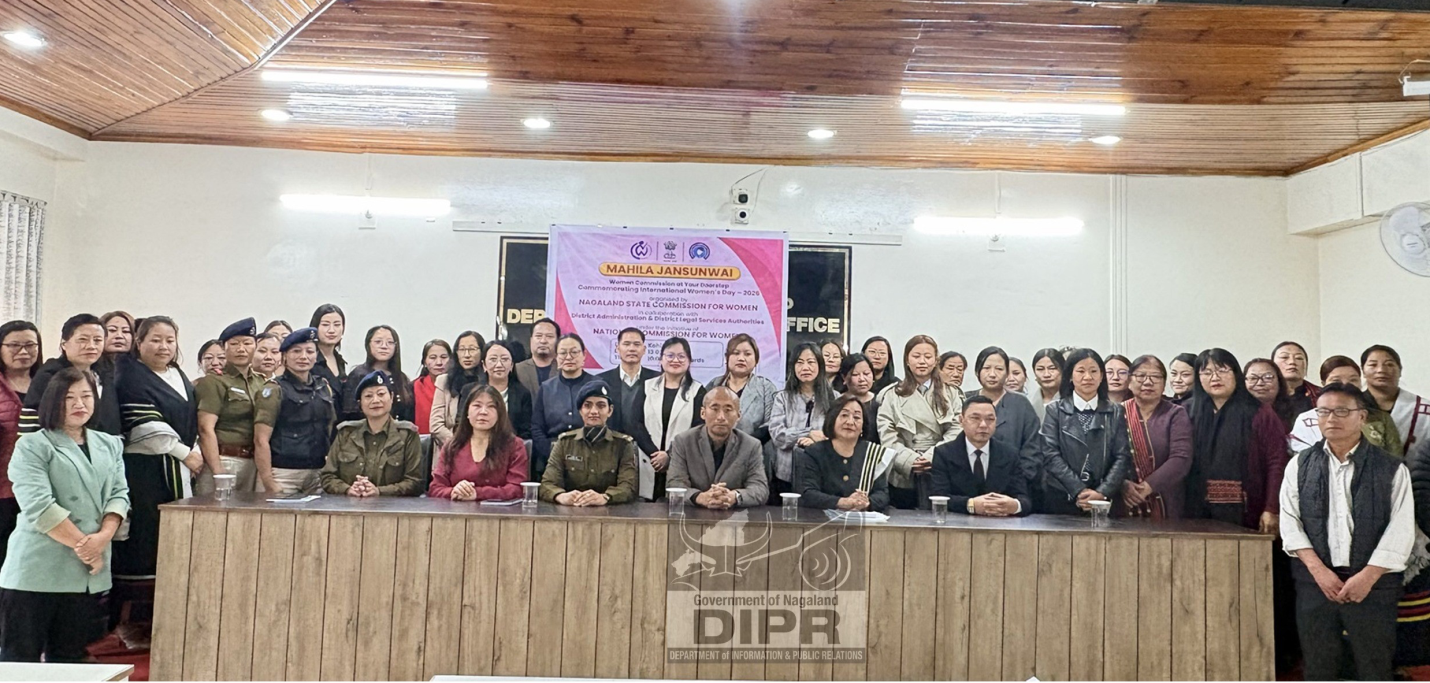
A Mahila Jan Sunwai in commemoration of International Women’s Day 2026 was held at the Conference Hall of the Deputy Commissioner’s Office, Kohima on March 13. The programme was organized by the Nagaland State Commission for Women (NSCW) in collaboration with the District Administration, District Legal Services Authority and the Department of Social Welfare, Kohima, as part of an initiative of the National Commission for Women, New Delhi.
Delivering the keynote address, ADC Kohima, Ruopfukuotuo Noudi said the Mahila Jan Sunwai campaign was being organized across the state in commemoration of International Women’s Day. He stated that the initiative seeks to provide a platform where women can directly bring forward their grievances and have them addressed without unnecessary administrative delays.
He observed that delays in the settlement of cases and grievances remain a challenge within the judicial system, with many individuals having to wait for long periods before their cases are resolved. In this regard, he said the campaign aims to create an alternative forum where issues can be heard and addressed more promptly.
Noudi further stated that while Nagaland is often regarded as a comparatively safe place for women, there has been a noticeable rise in cases of domestic violence and other offences in recent years. He stressed the need to strengthen institutional mechanisms that ensure the protection and safety of women.
He also informed that the district administration has written to various departments regarding the constitution of Internal Complaints Committees (ICC) in offices and institutions. These committees, he said, have now been made mandatory in both government and private establishments to address workplace harassment and ensure a safe working environment for women.
Centre Administrator of Sakhi One Stop Centre, Kohima, Vimenu Richa, spoke on the services provided by the centre for women in distress. She informed that the Sakhi One Stop Centre was established in Nagaland in November 2016 following the Nirbhaya incident to provide integrated support and assistance to women facing violence.
Download Nagaland Tribune app on Google Play

She stated that the centre provides a range of services including emergency response, medical assistance, psychological counselling, legal aid, temporary shelter, and facilitation with the police and other agencies providing services free of cost. She also highlighted that violence against women is not limited to physical abuse but can also include emotional and psychological distress. Women facing any form of violence or trauma are encouraged to approach the centre for assistance. Since its establishment, the Sakhi One Stop Centre in Kohima district has registered 192 cases and has assisted several women and families through counselling, shelter support and legal intervention.
Sunjib Rana, Advocate & Retainer Lawyer, Kohima District Legal Services Authority (KDLSA) highlighted the role of legal services authorities in ensuring access to justice, particularly for vulnerable sections of society such as women and children. He stated that although many women face various forms of grievances, social stigma and fear often prevent them from coming forward to seek help.
He noted that a growing number of cases handled by legal services authorities involve family disputes, domestic violence and divorce-related matters. According to him, a significant number of divorce cases in recent years have also resulted in children being left without stable family support, which has long-term social implications. He emphasised that unresolved family conflicts can have serious consequences not only for women but also for children and society at large.
He further stressed the importance of addressing disputes at an early stage, pointing out that when victims approach authorities at the initial stages of conflict, there is often a higher possibility of reconciliation through counselling and mediation. However, when matters reach an advanced stage, it becomes more difficult to restore relationships or resolve issues amicably.
Rana underscored the importance of family counselling and community involvement in resolving such disputes. He stated that counselling should not be limited to the couple alone but should also involve family members where necessary. He added that community institutions such as mothers’ associations, churches and local organisations play an important role in providing support and creating safe spaces where women can openly share their concerns.
UBSI, Vikuobinuo Nisa from the Women Police Station, Kohima spoke on crimes handled by Women Police Stations and the procedures followed while dealing with complaints from women in distress. She explained that the police respond to such cases with sensitivity and confidentiality by ensuring a safe and supportive environment for victims, promptly registering complaints, providing medical assistance where required, and coordinating with counsellors, NGOs and legal aid authorities. She also highlighted the importance of public cooperation in preserving crime scenes and assisting victims.
The Jan Sunwai interaction session was chaired by Member, Nagaland State Commission for Women, Kekhrienuo Meyase. Speaking during the session, she stated that the Mahila Jan Sunwai serves as a platform for women to voice their grievances and directly interact with concerned authorities. She said the initiative is being conducted across states to strengthen grievance redressal mechanisms for women.
Meyase emphasised that addressing issues faced by women requires the collective efforts of multiple agencies including the police, legal services authorities, women’s commissions, civil society organisations and community institutions. She also highlighted the importance of spreading awareness about legal provisions, government schemes and institutional support systems available for women.
She further pointed out that many cases involving crimes against women rely heavily on forensic evidence. However, one of the major challenges faced in the state is the absence of adequate forensic laboratory facilities. In most cases, samples and evidence collected during investigations have to be sent outside the state for forensic examination.
She stated that this often results in delays in receiving reports, which in turn slows down the investigation and prosecution process. There is also the risk of evidence deteriorating or being compromised during transit. She stressed that the establishment of a well-equipped forensic laboratory within the state would greatly strengthen investigations and ensure timely delivery of justice in cases involving crimes against women.
Meyase called upon the government and concerned authorities to take steps towards strengthening forensic infrastructure and improving investigative support systems in the state. She added that such facilities would help expedite investigations and ensure that victims receive justice without prolonged delays.
She also expressed concern over the increasing instances of cyber harassment and online abuse, particularly affecting women and young people using digital platforms. She emphasised the need to strengthen awareness, safety mechanisms and legal enforcement to address emerging forms of cybercrime.
The programme was chaired by Extra Assistant Commissioner, Kohima, Imtiyenla K.