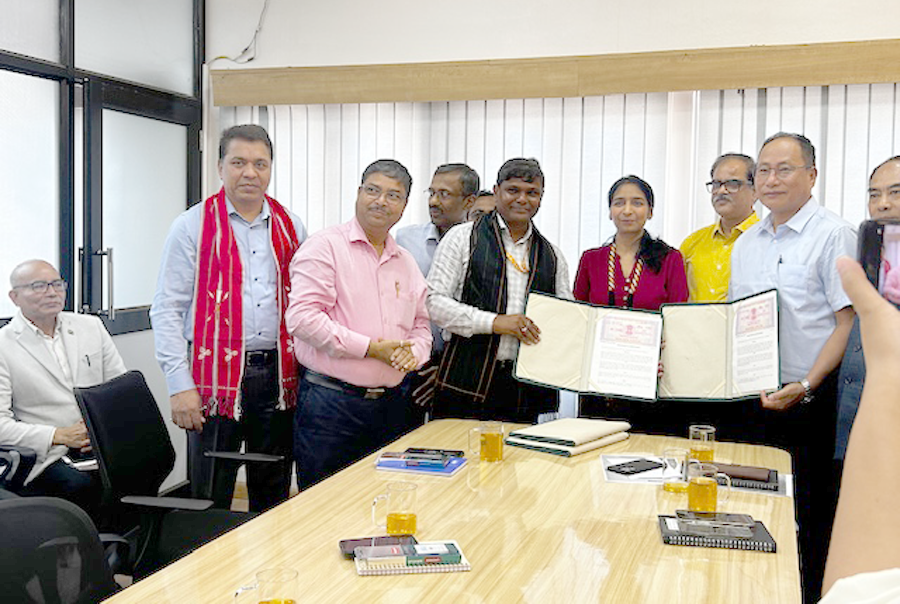
In a significant step towards promoting jute cultivation and improving farmer livelihoods in Nagaland, the Directorate of Agriculture officially signed a Memorandum of Understanding (MoU) with the Jute Corporation of India (JCI) on September 26 at the Agricultural Production Commissioner’s Conference Hall, Kohima. The agreement, facilitated by the National Jute Board (NJB) under the Ministry of Textiles, aims to promote large-scale jute farming, ensure better market linkages, provide technical support, and enhance income generation for farmers across the state.
Viwheto Thorie, Joint Director of Agriculture and Mission Director (NFSM), said that under the jute programme, the department had earlier conducted demonstration projects through the National Food Security Mission (NFSM). Currently, the programme covers seven districts—Peren, Chümoukedima, Dimapur, Niuland, Wokha, and parts of Mon and Mokokchung. Describing jute as a highly promising crop for the state, he recalled that in 2023, during a national workshop in Kolkata, the department showcased its efforts in jute cultivation, which received appreciation from the Ministry of Textiles. This recognition eventually led to the signing of the present MoU.
Thorie noted that the collaboration with JCI will enable the department to channelize both production and marketing, ensuring farmers get the maximum benefit.
“According to the potential and the capacity of the farmers and also those who have the desires the department select the farmers. In collaboration with Jute Cooperation of India, the department will create awareness programs if the farmers are interested they can give consent to the District Agricultural Officers of Sub Divisional Agricultural Officers after which the program will be implemented,” he added.
He further highlighted that while Nagaland has the potential to cultivate around 3,000 hectares of jute, only 350 hectares have been recorded under JCI as of 2024, with more yet to be registered. Jute is mostly cultivated in the foothill regions, requiring warm temperatures and sufficient water for retting, a process in which the plant is submerged under water to allow fibres to be separated.
The Joint Secretary said that retting is a process where the plant is kept under submerged water so that it gets decayed and its fibres are collected .
Thorie also pointed out that earlier, middlemen offered farmers only ₹25–₹30 per kg, but with JCI’s support price interventions, the rates were revised to ₹41.50 in 2024 and further to ₹56.40 in 2025. The intervention has forced even middlemen to increase their rates, now offering up to ₹60 per kg, thereby bringing substantial benefits to the farmers. He announced that training and awareness programmes would begin from November 2025, ensuring farmers are fully prepared for the new cultivation cycle.
Shahshi Bhushan Singh, Secretary & CEO of the National Jute Board, emphasized that the MoU represents a collaborative effort with the State Government to expand jute cultivation in Nagaland. Calling the agreement a “blessing” for the farmers of the region, Singh said that jute cultivation would not only generate better income for farmers but also create a new economic avenue for the state. He stressed that the signing of the MoU assigns specific responsibilities to all stakeholders and ensures accountability.
Download Nagaland Tribune app on Google Play

“The process of Jute cultivation is already taken care of by the MoU but the market linkage part must be taken care of. The industries and commerce has helped us in a better way and because of the various skill development and the artisans helping and supporting us. From the National Jute Board perspective we have also various schemes related to market, promotion of Jute products and with the collaboration of state government and industries and commerce we will definitely try to converge the schemes with the state,” he added.
Singh said that the basic idea is that they are trying to start cultivation in collaboration with department of agriculture and in due course start training the farmers regarding jute cultivation. Singh said that they have already identified where the work will begin.
“We are all on the same platform to provide support to the farmers. We would also like to engage ATMA for all extension activity. Hope that through this arrangement and with collaboration and cooperation with the state government we will definitely achieve something which will be beneficial for the farmers and the whole jute sector. This initiative will generate additional remuneration for the jute farmers in Nagaland. This MoU will help benefit jute farmers regarding agronomic practices , model cultivation practices and all the mechanisation part and we are going to take care of all these things,” Singh noted .
Padmini Singla, IAS, Joint Secretary (Fibre), Ministry of Textiles, also described the MoU as a strategic partnership to promote jute fibre cultivation. She said Nagaland, with its rich agro-climatic zones, biodiversity, and resilient farming community, has immense potential to embrace sustainable agriculture and significantly increase farmers’ incomes.
“Our people have gone into the field and they have seen that the farmers are practising jute but it’s a primitive practice, the best practices are not there in the field. Along with jute the entire cycle, jute rise influx can be practiced Jute cultivation is done in the month of February but from November month we will start giving training to farmers so that they are on board with the understanding of what is to be done. It is also very important in the initial months. We give a lot of hand holding In initial year,” she cited.
The Joint Secretary further said that under their scheme, farmers would receive subsidised jute seeds, financial support for construction of retting bonds, mechanisation assistance, digital training, and forward linkages to markets. She expressed confidence that with such comprehensive support, jute and other allied fibres will take strong root in Nagaland and emerge as a sustainable and profitable crop.
The MoU was signed between the National Jute Board (NJB), an entity established under the National Jute Board Act, 2008; the Jute Corporation of India Limited (JCI), a Government of India undertaking; the ICAR-Central Research Institute for Jute and Allied Fibres (ICAR-CRIJAF); and the Agriculture Department, Government of Nagaland.