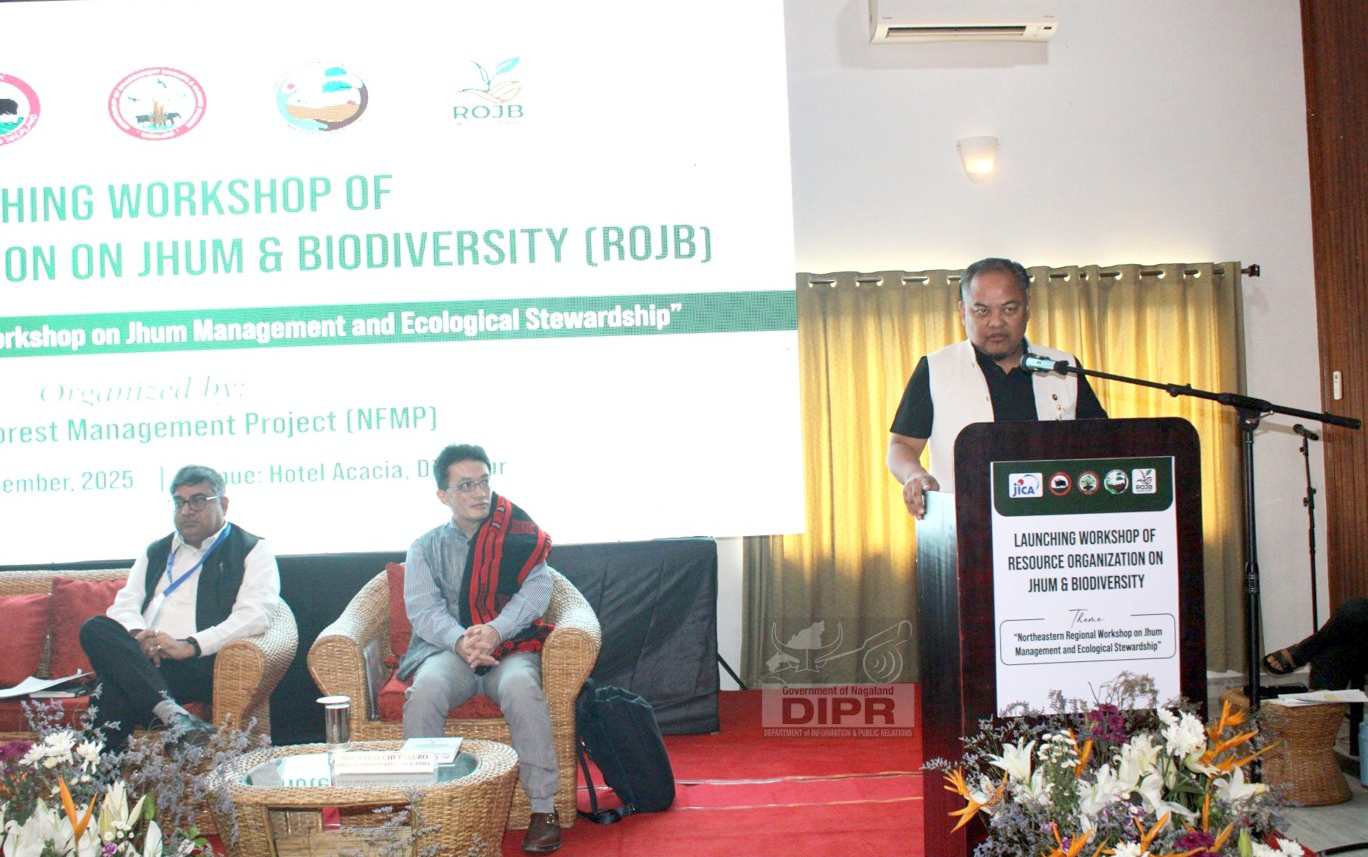
Nagaland took a major step towards integrating traditional farming with modern ecological practices as the Resource Organization on Jhum and Biodiversity (ROJB) was formally launched today at a two-day workshop supported by the Japan International Cooperation Agency (JICA) at Hotel Acacia, Dimapur. The programme, which concludes on September 24, is designed to create a knowledge hub for sustainable jhum cultivation, biodiversity conservation, and policy innovation in the state.
In his address, Takeuchi Takuro, Chief Representative of JICA India, described the initiative as a “milestone for Nagaland’s forestry sector.” He highlighted the achievements of the NFMP, including the creation of over 38,000 hectares of plantations and the formation of 429 self-help groups to strengthen community livelihoods.
Takuro said ROJB would serve as a knowledge hub to integrate scientific research, indigenous practices, and innovative policy approaches, reaffirming JICA’s commitment to a long-term partnership for a resilient and ecologically sound future.
He reaffirmed JICA’s long-term partnership with Nagaland in building a resilient and ecologically sound future.
Special Guest, MLA and Advisor for Tribal Affairs & Election, Tovihoto Ayemi formally launched the official website and logo of ROJB, marking the initiative’s public unveiling.
In his address, Ayemi lauded the Department of Environment, Forest & Climate Change and the project team for their dedication, describing jhum cultivation as “a way of life that sustains food security and community bonds.”
Acknowledging its cultural and ecological importance, Ayemi warned of pressing challenges such as shrinking fallow cycles, declining soil fertility, and biodiversity loss, and called ROJB a “centre of excellence to generate knowledge, strengthen community action, and ensure coexistence between jhum and biodiversity.”
On the occasion two Memorandums of Understanding (MoUs) were also signed with partner institutions to foster research, policy development, and community engagement.
Presenting the Project Management Consultancy perspective, Jayesh Bhatia, Managing Director of Intellecap, underscored the importance of evidence-based strategies, collaborative partnerships, and sustainable livelihood models to address the ecological and social challenges of the Northeast. He stressed ROJB’s role in promoting policy advocacy, knowledge management, and institutional networking.
Download Nagaland Tribune app on Google Play

The workshop features four technical sessions with keynote addresses by Dr Vincent Darlong (Environmental Scientist and Deputy Chief Technical Advisor, Indo-German Development Cooperation), Supong, IFS (Chief Conservator of Forests – Environment, Biodiversity & Research), policy and development stragetist, Amba Jamir, and Jayesh Bhatia, Managing Director of Intellecap.
Panels include eminent experts such as Dr David C Vanlalfakawma (Mizoram University), Nagato K Aye (NEIDA), Dr Sachin Sharma (ICFRE-Arid Forest Research Institute), Dr. Jayanta Choudhury (Nagaland University), Prof John Zothanzama (Mizoram University), Subrata Kumar Singh (Foundation for Ecological Security), Dr Amit Kumar (Wildlife Institute of India), Dr Selim Reza (bamboo livelihoods expert), Dr Aditi Tailor (ICFRE), Dr Ramendra Barman (Fisheries Department, Assam), Pravin Agarwal, IFS (Tripura cadre), Dr Oinam Sunanda Devi (Assam State Biodiversity Board), and Van Shanborlang Buhphang (MegLIFE).
Discussions will cover a wide range of themes, including carbon sequestration, bamboo ecosystems, biodiversity conservation, shifting cultivation, community-led wetland and forest management, policy frameworks, and sustainable rural development.
With Jhum cultivation continuing to sustain rural livelihoods while posing ecological challenges, the ROJB aims to be a living laboratory for innovation and community-driven solutions. By bringing together scientists, policymakers, and indigenous knowledge keepers, the initiative is expected to serve as a model for integrating traditional practices with modern conservation strategies across the Northeast.