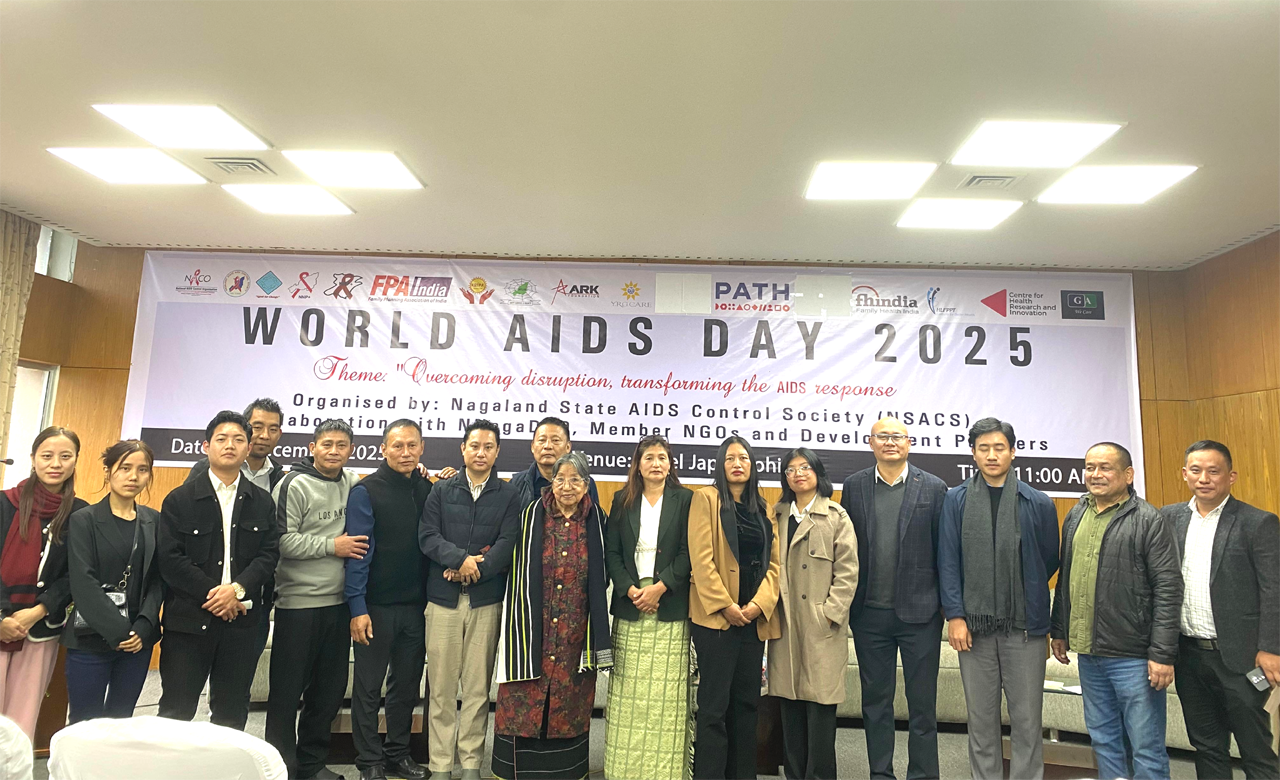
World AIDS Day 2025 was observed on Monday in Kohima under the global theme “Overcoming disruption, transforming the AIDS response,” organised by the Nagaland State AIDS Control Society (NSACS) in collaboration with NNagaDAO, member NGOs and development partners at Hotel Japfü.
The programme emphasized the need for renewed commitment, stronger systems and community-driven interventions to address the evolving challenges surrounding HIV in the State.
Abou Mere, president of NNagaDAO, expressed concern over persistent funding constraints and the rise in substance use and new HIV infections, especially among young people. He highlighted that Nagaland continues to hold the second-highest adult HIV prevalence rate in the country at 1.37% among individuals aged 15–49, a figure six times higher than the national average of 0.22%.
What began as a localized epidemic, he cautioned, has now spread across all districts and is affecting the general population. This situation, he stressed, calls for urgent, coordinated and innovative strategies to expand prevention, testing and treatment services.
Mere further noted that addressing the issues demands strong political leadership, sustained awareness, capacity building, advocacy and well-implemented intervention programmes. Any complacency, he warned, could undo the progress made in combating substance use, HIV and viral hepatitis.
Project Director of NSACS, Dr Ahu Sekhose stated that eliminating AIDS by 2030 is not merely a target but a moral obligation, and acknowledged health workers and civil society organisations for their consistent efforts in strengthening the HIV response over the years.
Recalling that the first HIV case in Nagaland was detected in 1991, Dr Sekhose said at that time, the Government of India estimated that HIV prevalence among Injecting Drug Users (IDUs) could be as high as 50%. However, a survey carried out in 1994 revealed a lower positivity rate of 39% among IDUs.
“Today, we stand at 2.54%, which is a significant achievement, considering where we began,” he said.
Dr. Sekhose highlighted the global 95-95-95 target—which mandates that 95% of HIV-positive individuals know their status, 95% of them receive treatment, and 95% of those on treatment achieve viral load suppression. He said Nagaland is on track to meet this goal, and is among the six states identified by NACO as capable of achieving it if the present momentum continues.
He further informed that the National AIDS Control Organisation (NACO) evaluates the performance of all states on a regular basis based on 50 indicators. While Nagaland earlier ranked 19th before 2023, the State has now risen to 8th position since 2024–25, reflecting marked progress, he said adding recently, 38 ICTCs in Nagaland were awarded Five-Star Quality Certification by NACO, which he termed a major accomplishment.
Despite being the second-highest in adult HIV prevalence, Dr. Sekhose noted that Nagaland has successfully maintained a flat trajectory since 2003–04, avoiding any further spikes—unlike many Northeastern states that continue to show upward trends. Citing HIV statistics 2023, he said Nagaland has managed to stabilise its epidemic curve for two decades, a sign that “we will be able to achieve an environment in Nagaland where HIV will no longer be a threat to the society.”
Speaking on behalf of the People Living with HIV (PLHIV) community, Lanu Aier, president of NNP+, called for the urgent revival of the Legislator Forum on AIDS (LFA)—a political body of lawmakers in Nagaland which was dissolved in 2020.
Download Nagaland Tribune app on Google Play

He noted that the LFA had played a significant role in advancing the HIV response in the State and that its sudden discontinuation has created a noticeable gap in programme support and advocacy.
Aier highlighted that legislators have the unique ability to influence policy, mobilise resources and bridge gaps where official departments and organisations may not reach effectively. He urged the State Government to reconsider and reactivate the Forum, stressing that political leadership and ownership are essential to moving closer to a HIV-free Nagaland.
Vilo Naleo, Secretary, Social Concerns, NBCC, stated that AIDS today is no longer just a physically devastating disease, but a social, psychological, emotional and financial burden, making it a complex issue that demands a multi-pronged, collective approach.
Speaking within the context of Nagaland, a predominantly Christian State but with the second-highest HIV prevalence in the country, he admitted that finding solutions is not always straightforward. While stigma and inadequate healthcare systems remain major challenges, he stressed that there are still ways to deal with the high rates of HIV/AIDS.
He emphasized that if drug users are engaging in unsafe sexual behaviour, there is a need to understand how they are engaged. “If AIDS in Nagaland spread through IV drug users, we must tell educate them,” he said
Naleo urged stakeholders to identify the key reasons behind the continued spread and to critically assess past strategies and also learn from states that have achieved better outcomes.
Touching on the sensitive subject of prevention, he acknowledged that the promotion of condom use has often been viewed as conflicting with Christian beliefs. “If encouraging the use of protection (condoms) in our context is against Christian ethics, what are some other ways we can creatively emphasize. If the government is convinced that using condoms can prevent spread of AIDS in Nagaland 100% by providing database, the church should listen and we will help,” he affirmed.
He observed that many harmful behaviors persist within institutions, including the church, because “confronting them openly simply is not done”.
He said the Church would collaborate and partner with organizations who are in the field doing the work, but sadly many times “we have to first fight the lack of political will instead of the virus”.
“We face indifference attitude in churches, instead of encouragement, we have to overcome stereotypes. Instead of relying on database research and modern medical science, these are some of the realities we need to overcome. But with upcoming together we can do better,” he further stated.
Vimeyiekho Vitso, Vice President of NSF, shared several suggestions towards strengthening HIV prevention efforts in the State. He emphasized the importance of regular family testing, stating that such a practice could help normalize open conversations around HIV and encourage individuals to avoid behaviours that increase the risk of infection.
Given Nagaland’s Christian-majority context, Vitso proposed that churches could play a more active role by encouraging members to take pledges to abstain from pre-marital sex, avoid extra-marital affairs and remain away from drugs. He also cautioned against over-sensationalizing the disease, noting that fear often leads to stigma rather than understanding and behavioural change.
While acknowledging that condom use has played a major role in reducing HIV transmission, Vitso expressed concern that it may have also contributed to rising trends of pre-marital and extra-marital sexual activity. He said this is an issue that the community must collectively and responsibly address.
Alice Yhoshu, President of the Kohima Press Club, highlighted the crucial role of media in the fight against AIDS, stressing the need for increased reportage on public education and awareness. She noted that social ignorance and prejudice against people living with HIV/AIDS must be fully eliminated, and for this to happen, the media must be well-informed, trained and updated so that accurate information reaches the public.
Underscoring the importance of partnership, Yhoshu said a strong and sustained collaboration between the media and NSACS is essential to ensure that the right message is amplified and the stigma surrounding HIV continues to diminish.
Rosemary Dzuvichu, Co-Convenor of the Nagaland Global Forum, noted that while positive changes have taken place under NSACS, the struggle of the PLHIV community remains far from easy. “Let us not think that the PLHIV community is living in a luxury because they are not,” she stressed, calling for a strong focus on skill development and employment opportunities to help build self-reliance.
Dzuvichu emphasized that PLHIV require a high-protein diet to strengthen immunity and live healthier, longer lives, a reality she said Nagas must acknowledge with seriousness. She further cautioned against complacency, pointing out that HIV cases continue to rise.
Neidonuo Angami, Padma Shri awardee, senior citizen leader and former president of the Naga Mothers Association (NMA), reflected on the organisation’s origins, recalling that it was formed in the mid-1980s in response to the unprecedented influx of drugs in Nagaland that pushed many young people into addiction.
She said the NMA was driven with a deep sense of mission “to save our children’s lives,” despite knowing little about the crisis at the time. What they did know, she said, was that they had to act — by collaborating, consulting and joining hands with various stakeholders, while also seeking spiritual strength, realising early that the struggle was not only physical but one of the spirit and soul.
Drawing from her experience, Angami stated that grants and funded projects alone cannot transform society. The real strength of drug and HIV intervention, she emphasized, has always been the teamwork and coordinated work happening at the grassroots.
However, she expressed concern over rapidly changing funding landscapes, with constant reports of donors cutting support, government health budgets being reduced, and states being expected to generate their own resources for healthcare.
“These are catastrophic news for a state like ours where we depend almost entirely on central budget allocation. This new reality requires us to urgently reason together how to manage in this situation,” she said.
Angami urged the government to frame policies and programmes suited to the present situation, while calling on churches to step forward in care and support, civil society to organise community participation, affected communities to lead advocacy, and educational institutions to promote life skills and healthy living.
KP Ezung, Assistant Director of Kripa Foundation Nagaland, underscored the need for stronger state support and coordinated action, stating that while stakeholders gather every year in solidarity to observe World AIDS Day, the scale of observance this year was intentionally kept small due to rising concerns over the HIV epidemic and the lack of active involvement from key stakeholders — particularly the government.
He noted that Nagaland is currently implementing National AIDS Control Programme (NACP) Phase-5, which would conclude in March 2026, and highlighted with concern that the programme is entirely funded by the Government of India, with no financial contribution from the state. The state, despite having the second-highest adult HIV prevalence rate in the country and the highest ANC prevalence, is supported mainly through central-funded infrastructure and manpower placement under NACP, he stated.
Ezung pointed out that donor support has also declined, adding that funding through MFA stopped in 2020, leaving the future uncertain. “If there is no NACP-VI, we will be left without support,” he stated, stressing the urgency of preparedness.
He presented a historical overview of transmission trends — noting that HIV was initially detected predominantly among Injecting Drug Users (IDUs), with prevalence recorded at 39% in 1994, now reduced to 2.53%, compared to the national IDU average of 9.03%. However, he warned that the epidemic has now shifted to the general population. Nagaland’s adult HIV prevalence stands at 1.37% — nearly 6.3 times the national average of 0.22%.
“HIV is now present in every nook and corner of the state,” he stated, questioning what tangible interventions are currently being undertaken by the state government to reduce the spread.
Referring to the annual Sankalak report by NACO, Ezung highlighted that Nagaland records about 2,000 new infections a year, and approximately 214 HIV-related deaths annually — calling it a matter of grave concern. He reminded that the shift from punitive strategies, such as past bans on needles and syringes, to harm-reduction models helped reduce prevalence among IDUs, and suggested that similar evidence-based approaches must guide policies moving forward.
He emphasized that 90% of HIV transmission in Nagaland is now through heterosexual contact, signalling the need for intensified awareness and prevention strategies beyond high-risk groups. Drawing reference from Thailand’s successful intervention model, where even traffic police were involved in condom distribution, he pointed to the need for direct leadership, visibility and commitment from authorities.