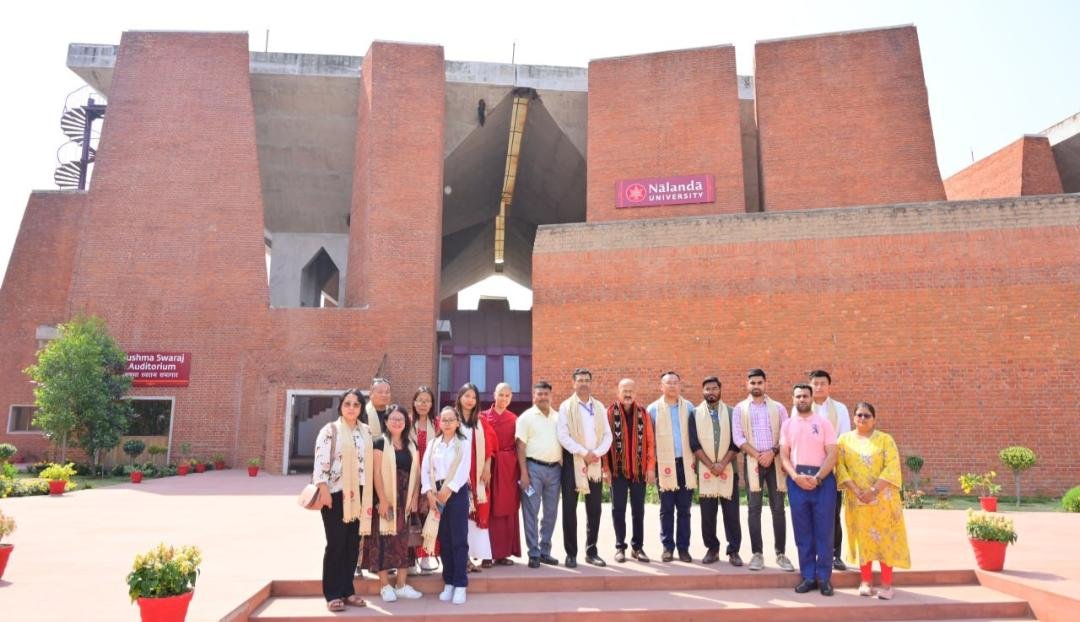
A seven-member media delegation from Nagaland, currently on a press tour to Bihar organised by the Press Information Bureau (PIB) under the Ministry of Information and Broadcasting, undertook a series of visits to key educational and heritage institutions in Nalanda district on Day 3 of the tour.
Led by P. Sophie, Head of Office, PIB Kohima, the delegation visited the Nalanda Archaeological Site, the Bhimrao Ambedkar Residential School, and Nalanda University. The district administration extended logistical support, ensuring seamless coordination throughout the engagements.
At the Nalanda Archaeological Site, the team was guided by Anil Kumar, a long-associated tour guide, who elaborated on the structural and academic significance of the ancient university complex. The site, a UNESCO World Heritage location, once accommodated nearly 10,000 students and 1,500 teachers from across Asia, including regions such as China, Sri Lanka, Korea, and Southeast Asia.
The delegation observed the remains of monasteries, temples, lecture halls, residential quarters, and the prominent Sariputra Stupa, all of which underline Nalanda’s historic role as a global centre of learning in disciplines like philosophy, medicine, astronomy, and logic. The site continues to attract international visitors, particularly from Buddhist-majority nations, reinforcing its legacy as a hub of cultural and intellectual exchange.
The visit to Bhimrao Ambedkar Residential School offered insight into contemporary grassroots education. The all-girls residential institution emphasises holistic development, with students presenting a robotics exhibition featuring innovative, self-designed projects. The showcase reflected a strong focus on experiential learning and practical application of scientific knowledge.
Nagaland Tribune app on Google Play

Later, at Nalanda University, the delegation was briefed on the institution’s revival and current academic framework. Re-established in 2010 and operational since 2014, the university aims to rekindle the interdisciplinary ethos of the ancient Nalanda.
The university presently houses six academic schools covering areas such as historical studies, Buddhist studies, management, international relations, sustainability, and languages. With approximately 650 residential students, including a significant number of international scholars, the campus fosters a diverse academic environment.
Officials highlighted the university’s commitment to sustainability through its net-zero campus design, which incorporates rainwater harvesting, minimal fossil fuel usage, and eco-friendly construction. The campus is further characterised by its expansive green cover and water bodies.
Engagement with local communities through education and skill development initiatives also forms a key component of the university’s outreach. Additionally, efforts are underway to strengthen ties with India’s Northeast, with students from states like Assam and Meghalaya already enrolled.
University authorities noted that expanding collaborations, increasing student participation, and encouraging region-specific research remain priority areas in fostering deeper engagement with the Northeast.
The delegation is scheduled to continue its tour on Day 4 with visits to Rajgir, Bodh Gaya, and other significant locations across Bihar.