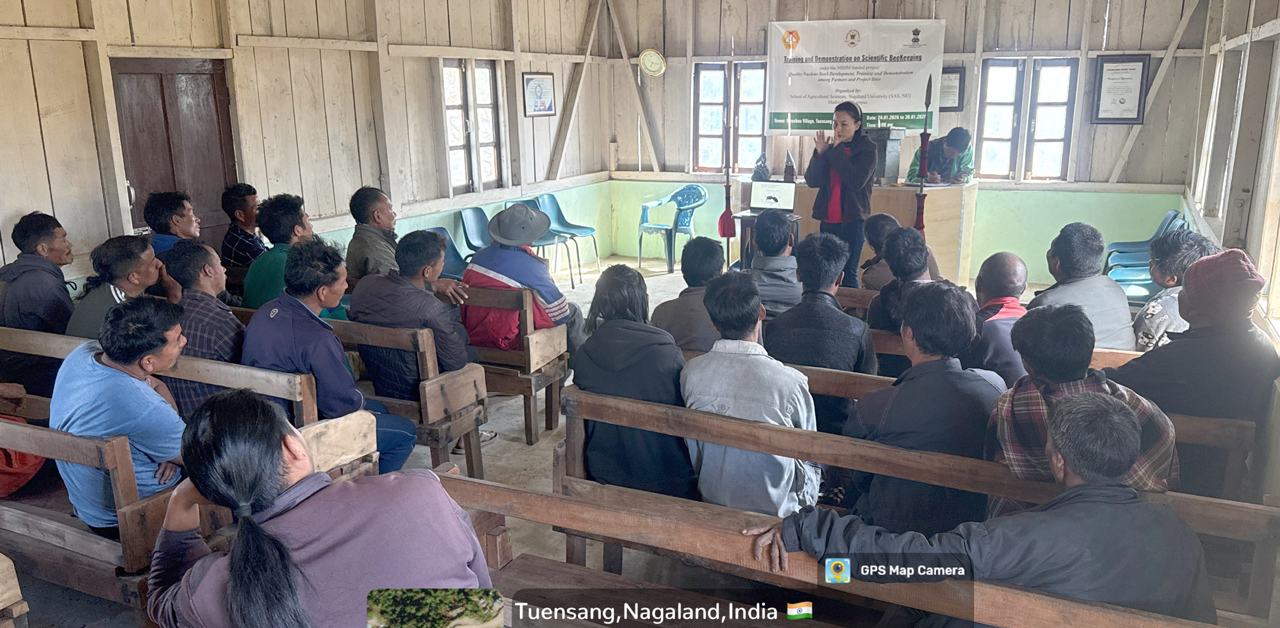
An intensive scientific beekeeping training and demonstration programme integrated with oilseed-based cropping systems was conducted at Washou village, Tuensang district, from January 24 to 30 under the ongoing implementation of the National Beekeeping and Honey Mission (NBHM).
The programme focused on strengthening scientific beekeeping practices and enhancing the role of honeybees in crop pollination, particularly for oilseed crops. Mongu Cholen, Sub-Divisional Agriculture Officer (SDAO), Tuensang District, participated in the programme and addressed the participants on the importance of honeybees in improving crop productivity and supporting oilseed-based farming systems.
The programme highlighted the role of peer-to-peer transfer of knowledge in the adoption of scientific beekeeping practices. In 2016, Ayin, from a neighbouring village, shared his practical experience in scientific beekeeping with interested farmers of Washou Village, who were earlier practising beekeeping using traditional methods.
Ayin had acquired formal training in scientific beekeeping through a block-level training programme conducted in 2008. Through this farmer-led peer learning process, Koma, a resident of Washou Village, received his first scientific bee box and gradually adopted scientific beekeeping practices.
At present, Koma, 78 year old, maintains 65 bee boxes, kept both in his apiary and forest locations, comprising a mix of Apis cerana and stingless bees. He harvests honey once annually and earns an estimated ₹4–5 lakh per year. During the training programme, he noted that learning about queen cell division and the use of nucleus boxes for developing quality nucleus stock was particularly useful for further strengthening his beekeeping enterprise.
The training emphasized practical, field-oriented learning through demonstrations and hands-on sessions. Practical demonstrations were conducted on hygienic honey harvesting to maintain quality, proper use of smokers, artificial feeding techniques and general care and management of bee colonies. Participants were also sensitized on the importance of planting and conserving bee-friendly flora in and around agricultural fields and village surroundings to support colony health and sustainability.
Download Nagaland Tribune app on Google Play

They expressed appreciation for organizing it at village level and conveyed their interest in adopting scientific beekeeping practices in a more organized manner. The participants also requested continued technical guidance and similar capacity-building interventions to support sustainable livelihood generation through beekeeping.
The programme is funded by the National Bee Board (NBB), Ministry of Agriculture and Farmers Welfare, Government of India, under the National Beekeeping and Honey Mission (NBHM) and is being implemented by the School of Agricultural Sciences, Nagaland University, Medziphema Campus. The project is led by Dr Mary N Odyuo, Associate Professor and Principal Investigator (PI) and Dr Avinash Chauhan, Scientist, AICRP on Honey Bee and Pollinators, as Co-Principal Investigator (Co-PI). Both also served as the Course Directors of the training programme.