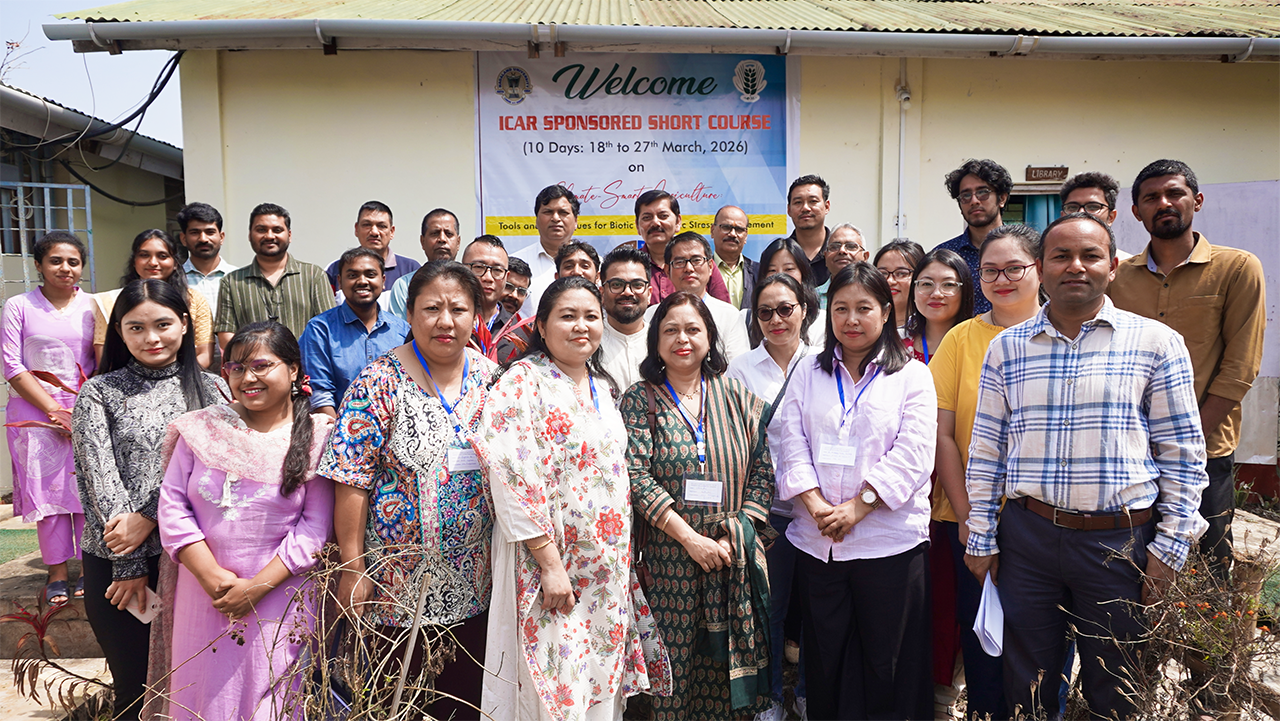
The 10-day ICAR-sponsored short course on “Climate-Smart Agriculture: Tools and Techniques for Biotic and Abiotic Stress Management” was inaugurated on March 18 at the Medziphema Campus, Nagaland University. Organized by the Department of Genetics and Plant Breeding under the School of Agricultural Sciences (SAS), the programme is being conducted from March 18 to 27, with support from the Agricultural Education Division of the Indian Council of Agricultural Research (ICAR).
Emphasizing the urgency of addressing climate change, Course Director Prof HP Chaturvedi highlighted the objectives of the 10-day ICAR-sponsored short course and stressed on the importance of climate-resilient agriculture.
“Climate change is a burning issue, and this programme is designed to equip agricultural professionals including Scientists, Assistant Professors and Associate Professors, working in Agriculture and Allied Sciences with the latest tools and techniques to effectively cope with its challenges,” he said.
He noted that the course focuses on three key aspects of climate-smart agriculture: Productivity, adaptation, and mitigation. “We are working towards enhancing productivity through improved practices, building resilience in crops against stresses like drought, heat and floods, and reducing greenhouse gas emissions for sustainable development,” he added.
Prof Chaturvedi further stated that the course combines both theoretical and practical learning, including field visits, to provide participants with hands-on exposure to climate-resilient agricultural practices.
The programme began with an invocation, followed by the ceremonial lighting of the lamp by the dignitaries.
A felicitation ceremony was held for the Chief Guest, Prof VK Vidyarthi, In-charge Pro Vice-Chancellor, SAS, Nagaland University, along with Prof KK Jha, In-charge Dean, SAS; Prof HP Chaturvedi, Head of the Department of Genetics and Plant Breeding and Dr Anthony, Deputy Registrar, SAS, Nagaland University.
Speaking during the programme, Prof KK Jha highlighted the role of such training programmes in strengthening the knowledge of students and researchers.
Download Nagaland Tribune app on Google Play

Chief Guest, Prof VK Vidyarthi, underscored the need to adopt climate-smart agricultural strategies to address biotic and abiotic stresses. He appreciated the initiative and encouraged active participation.
Technical sessions followed with a series of expert lectures. Prof Bireswar Sinha spoke on integrated disease management for climate-resilient agriculture, highlighting sustainable approaches. Dr Amod Sharma discussed the impact of climate change on agricultural productivity and food security in India. Dr S Naresh Kumar, Division of Environmental Science, IARI, elaborated on climate change and the need for adaptive strategies in agriculture.
The course aims to equip participants with advanced tools and techniques to enhance agricultural resilience and sustainability in the face of climate variability. The programme witnessed active participation from students, researchers, and professionals, fostering an enriching platform for knowledge exchange and academic interaction.
