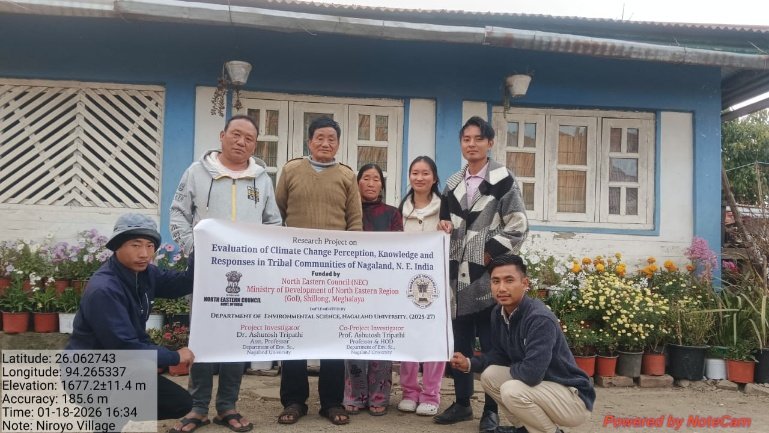
An ongoing research project funded by the North Eastern Council (NEC) is being carried out by the Department of Environmental Science, Nagaland University, on the theme “Climate Change Perception, Anticipation and Responses among Naga Tribes.” The project seeks to document indigenous knowledge systems and examine how tribal communities perceive and respond to emerging climate challenges.
As part of the field activities, the research team lead by the project investigator Dr Ashutosh Tripathi Assistant professor in Department of Environmental science, NU, and research assistant Sediba K Sangtam recently visited Wokha and Tseminyu district during January 18 to 25 and February 8 to 12. During the visits, extensive interactions were held with village elders, farmers, women’s groups, and youth representatives from various tribal communities, including the Lotha, Rengma, Tikhir, and Yimkhiung tribes.
Download Nagaland Tribune app on Google Play

Community members shared their observations regarding changing rainfall patterns, delayed monsoons, rising temperatures, prolonged dry spells, and increasing pest incidences affecting jhum cultivation and horticultural activities. The project places strong emphasis on integrating traditional ecological knowledge with scientific analysis to develop locally grounded and culturally appropriate climate adaptation strategies. By systematically documenting community perceptions and anticipatory responses, the study aims to support evidence-based climate planning and strengthen resilience in the hill ecosystems of Nagaland.
Dr Tripathi informed that further field visits, stakeholder consultations, and knowledge-sharing workshops are scheduled in the coming months. The ongoing NEC-supported initiative highlights the growing recognition of indigenous wisdom as a critical component in addressing climate change impacts across the Northeastern region.