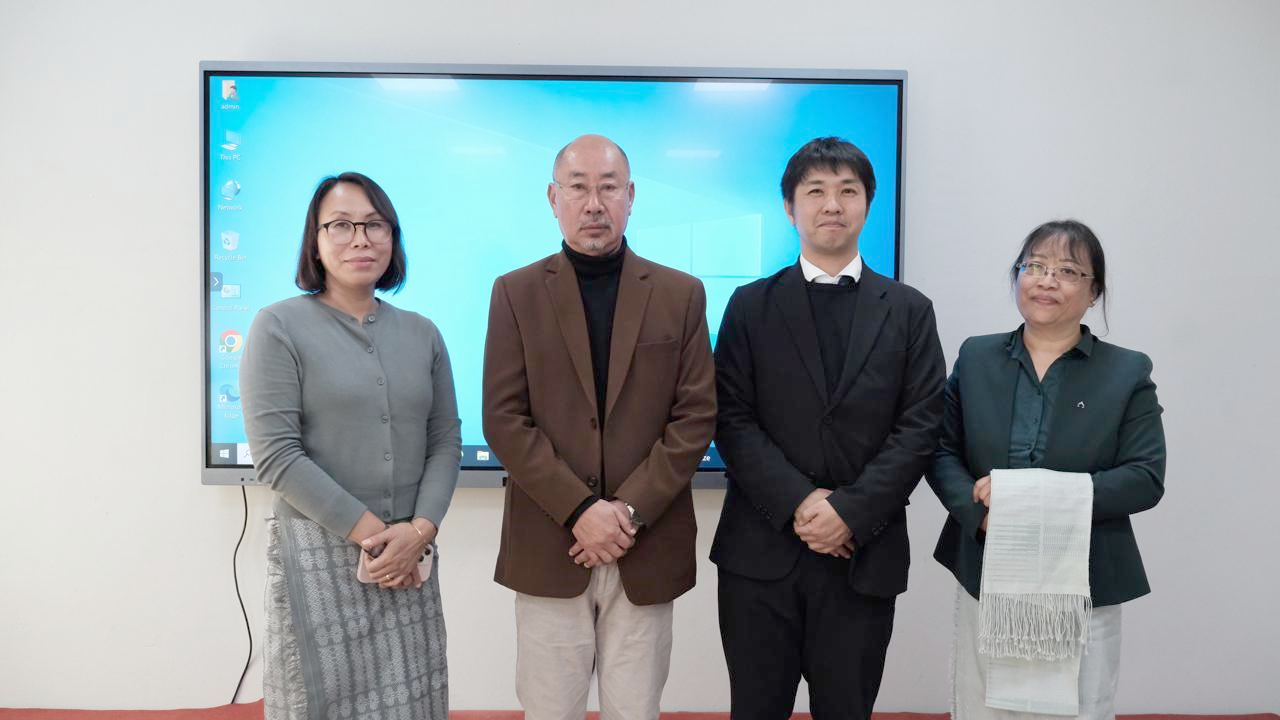
Nagaland University’s Kohima Campus welcomed a distinguished delegation from Japan on February 11, 2026. The interactive session marked a significant step forward in strengthening academic collaboration and people-to-people ties between Nagaland and Japan.
The programme was graced by Prof N Venuh, Pro Vice-Chancellor, Nagaland University Kohima campus, Atsushi Tsujimoto and the team from the Sasakawa Peace Foundation Japan, Sesino Yhoshu, Director and Producer of TakeOne, along with her team, officials from IDAN, Prof Jano, Dean of the School of Humanities and Education, Metsizolie Medoze, Deputy Registrar, faculty members, scholars, and students of Nagaland University.
In the welcome speech Prof Pangersenla Walling, Head, Department of Linguistics expressed delight in hosting the Japanese delegation and reaffirmed the University’s commitment to international academic engagement. She added that Nagaland University has been actively encouraging students to look beyond national boundaries and embrace global opportunities for learning, skill development, and cultural exposure.
The University hoped that this visit would not remain a one-time engagement but will evolve into a long-term and meaningful partnership, she asserted.
Prof Venuh, in his address, highlighted the historical relationship between the Japanese and the Nagas, tracing back to the period of the Second World War. He recalled memories of how Naga villagers shared their limited rations with Japanese soldiers during that time, reflecting compassion and humanity even in the midst of conflict. He noted that beyond similarities in facial features, the Japanese and the Nagas share many cultural values and a long-standing sense of mutual respect, which continue to strengthen the bond between the two communities today.
Download Nagaland Tribune app on Google Play

Thejatseizo, a PhD scholar of Nagaland University, presented a paper on ritual symbolism in the peace-making traditions of the Nagas, highlighting the cultural and symbolic practices that sustain harmony within Naga society. This was followed by a presentation by Aloka Assumi, also a PhD scholar of Nagaland University, who spoke on the history and development of education in Nagaland, tracing its evolution and key milestones.
The Japanese students introduced themselves and spoke about their individual areas of interest. They also shared the reasons that motivated them to visit Nagaland. This was followed by a group discussion, during which Japanese and Naga students engaged in active exchanges of ideas. The interaction provided a valuable platform for dialogue, enabling students to share perspectives, learn from one another, and deepen their understanding of each other’s cultures, academic interests, and social contexts. Miss Pufi, a student of Japanese and Linguistics, moderated the session, seamlessly switching between Japanese and English to facilitate effective communication and smooth interaction.