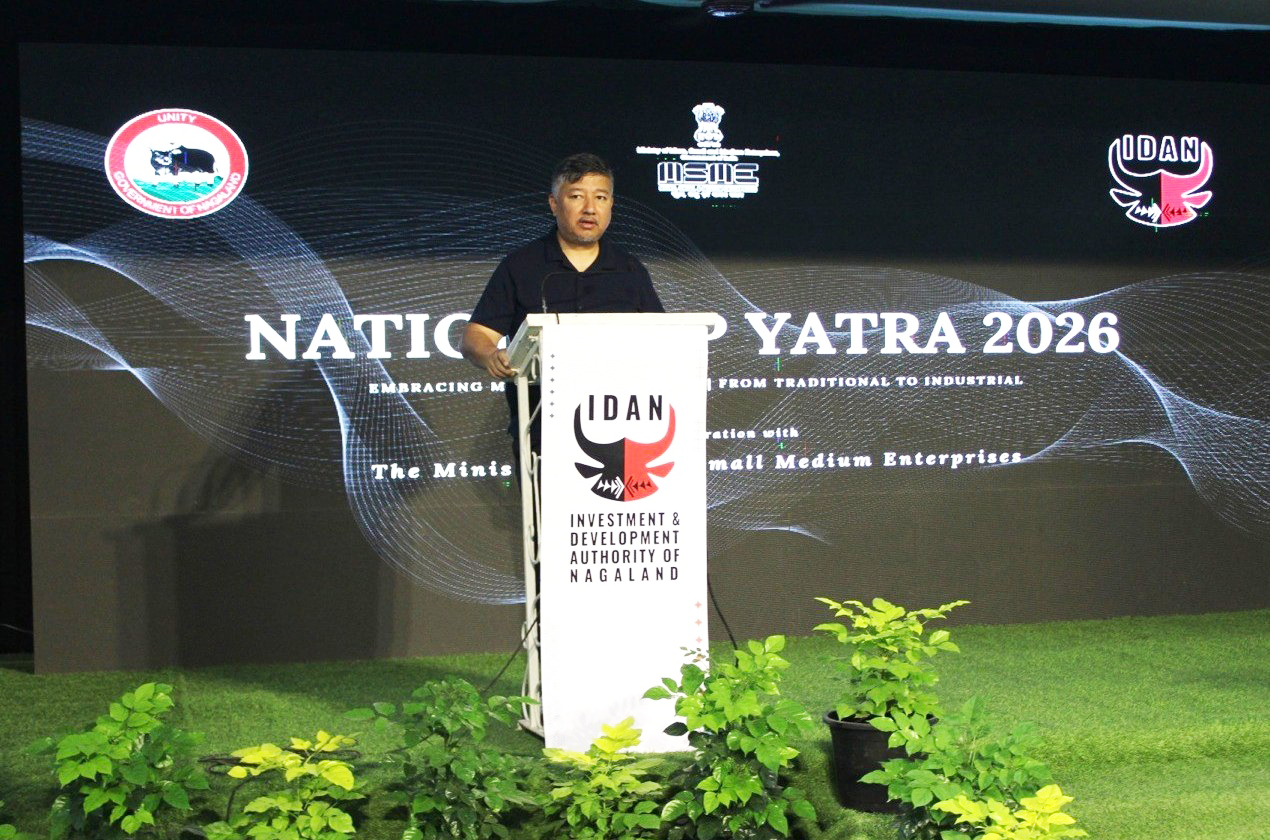
A two-day event of National IP Yatra – Nagaland 2026, commenced from March 12 on the theme “Embracing modern technology” held at the Integrated Business Hub & Innovation Centre, Forest Colony, Dimapur.
The event is being organized by the Intellectual Property Facilitation Centre under IDAN in collaboration with the Ministry of Micro, Small & Medium Enterprises (MSME). This initiative seeks to spread awareness about Intellectual Property Rights (IPR) among MSMEs, start-ups and entrepreneurs. It also aims to sensitize people on the importance of IPR while encouraging the adoption of modern technology in different stages of production and processing. It seeks to pave the way for empaneling a Technology Transfer Facilitation Centre (TTFC), to strengthen innovation and technology adoption in the state.
Advisor to CM & Chairman IDAN, Abu Metha, in his address, highlighted the growing significance of intellectual property in strengthening enterprises and enhancing the overall business ecosystem. He said that MSMEs play a crucial role in India’s economy through employment generation and contribution to the country’s GDP, forming a strong foundation for India’s emergence as a global economic power.
Emphasizing the rapid pace of technological advancement, he urged young people and entrepreneurs to adapt to modern tools and digital platforms to remain competitive in a fast-changing world. He encouraged youth to continuously acquire knowledge and make effective use of the internet and digital resources, stating that in the present era information is readily accessible and the ability to use modern technology has become essential.
He further said that the internet and social media platforms have transformed the global marketplace, allowing entrepreneurs, artists and innovators to reach audiences across the world. According to him, knowledge is no longer restricted to elite institutions, as students from remote areas can now access the same information available globally.
Reaffirming the state government’s commitment to youth empowerment, Metha said the government under Chief Minister, Neiphiu Rio is working to create new opportunities and platforms for young people in Nagaland to learn, innovate and succeed.
He expressed hope that the two-day programme would equip participants with valuable knowledge and insights, enabling them to stay ahead in a competitive environment and contribute to the development of the state. He also thanked officials, partners and line departments involved in organising the event and encouraged participants to make full use of the sessions and interactions during the programme.
Director of MSME DFO Dimapur, Mohd Ali Rahman, in his addressed highlighted the crucial role of the Micro, Small and Medium Enterprises (MSME) sector in India’s economic development and pointed that MSME sector contributes around 30 percent to India’s GDP, 36 percent to the country’s manufacturing output and nearly 45 percent of exports.
Rahman said the ministry is adopting a whole-of-government approach to address the various challenges faced by MSMEs and is working closely with stakeholders through its field offices across the country to reach out to enterprises, to facilitate and handhold MSMEs in their journey towards productivity and growth.
Download Nagaland Tribune app on Google Play

Highlighting digital initiatives, he said the Udyam Registration platform enables MSMEs to access various schemes and programmes designed for their development. According to him, more than seven crore MSMEs have already been registered on the Udyam and Udyam Assist portals, providing employment to over 13 crore people. He further stated that the ministry continues to strengthen the MSME ecosystem through several targeted initiatives focusing on policy formulation, financial support, technological upgradation, marketing support, skill development, infrastructure development, international cooperation and innovation.
Rahman also outlined several flagship schemes implemented by the ministry including the MSME Innovative Scheme for innovation and design, the MSE Cluster Development Programme for infrastructure development, the Procurement and Marketing Support scheme and International Cooperation scheme for marketing support, and the Entrepreneurship Skill Development Programme for skill development.
He added that the ministry has also established technology centres across the country to cater to the tooling requirements of industries and MSMEs, while also training youth and re-skilling workers to meet industry demands.
For artisans, Rahman highlighted the PM Vishwakarma Scheme, which aims to support traditional craftsmen and artisans.
Emphasizing the importance of innovation and intellectual property rights, he said the MSME Innovative Scheme integrates incubation, design intervention and intellectual property protection to enhance competitiveness and help MSMEs move up the value chain to become national and global champions. He pointed out that one of the key challenges today is the commercialization of intellectual property, and stressed the need to support youth, startups and MSMEs in bringing their innovations and creative ideas to the market.
He also noted that the ministry has undertaken initiatives to promote greater participation of women in the MSME sector, including special drives for registration of women-owned enterprises and encouraging their participation in trade fairs under the Procurement and Marketing Support scheme.
Under Secretary, IDAN, I. Changsang, NCS, in his welcome address, noted that for a state like Nagaland, intellectual property goes beyond legal protection, as the state possesses a rich reservoir of indigenous knowledge, traditional craftsmanship, agricultural biodiversity and cultural expressions that have been preserved by communities for generations. Such traditional knowledge systems represent valuable intellectual capital that can significantly contribute to economic development when properly protected and commercialized, he added
He highlighted the importance of geographical indications (GI) in linking products to their unique geographical origin and cultural identity. Notable examples cited included Naga Mircha, globally recognized for its distinctive pungency, and the traditional Chakhesang Shawl, which reflects the rich weaving traditions of indigenous communities, which can transform cultural heritage into marketable identities and economic opportunities.
He further emphasized that Nagaland has immense potential in sectors such as handloom and handicrafts, agro-based products, food processing and traditional art forms, which form an important part of the creative or “orange economy” where culture, creativity and knowledge generate livelihoods and economic growth.
However, he pointed out that a major challenge remains the lack of documentation and protection of many traditional innovations and creative works. Without proper intellectual property frameworks, artisans, farmers, entrepreneurs and innovators often fail to fully capture the economic value of their creations.
He also stressed the importance of integrating modern technology with traditional production systems, which can enhance productivity, quality standards and market competitiveness. He expressed hope that the platform would not only create awareness but also inspire entrepreneurs, researchers and young innovators to view intellectual property as a strategic tool for economic growth, cultural preservation and global competitiveness.
The first day featured a series of technical sessions focusing on innovation, entrepreneurship and intellectual property. Scientist-F from Council of Scientific and Industrial Research – North East Institute of Science and Technology (CSIR–NEIST), Dr. Kalyani Medhi, delivered a presentation on Technology Transfer Facilitation Centre: A key factor for innovation in entrepreneurship. Followed by a session on schemes of the Office of the Development Commissioner, MSME with special focus on Intellectual Property Rights (IPR) and the MSME Innovative Scheme (IPR component), presented by Assistant Director, MSME DFO Dimapur, Kapil Rai. Food Technologist, Mhasiphizo Khezhie spoke on Exploring Innovation Opportunities in Nagaland’s Agro, Handloom and Food Processing Sectors, highlighting the role of technology transfer in bridging production gaps. Networking session, a panel discussion on “Technology Transfer: Converting Ideas into Industrial Applications” was also held.