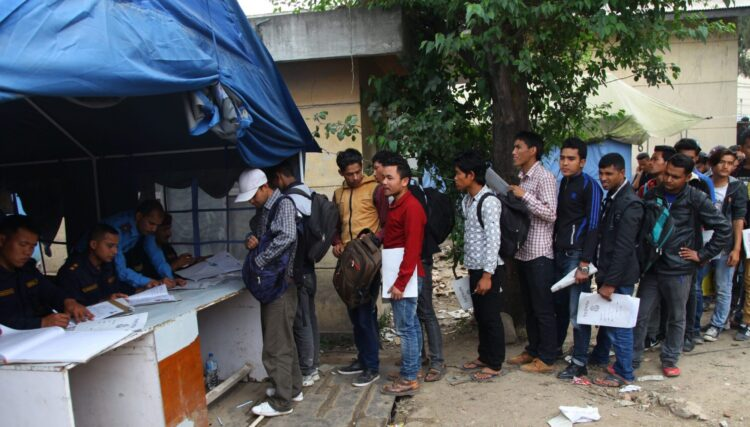
A day before Nepal goes to polls on Thursday, there is an air of anticipation that the mandate will give a clear majority to one party, that the government will be inclusive and democratic and work for the country’s progress, voicing a need for “change”.
From sitting rooms to the streets of Kathmandu, the word echoes, though speakers attribute various reasons for seeking it.
“Earlier, a lot of youngsters would not vote out of frustration that there were no worthy candidates; that nothing would ever change. It was the same with many millennials and the elders, and most of them, too, never voted,” lamented Reecha Sharma, one of the top stars in Nepal’s film industry.
“But this time it’s very important. Voting is the only way we can tell the leaders that we want you, or don’t want you,” she asserted.
The popular model and actress initially could not take to the streets of Kathmandu during the Gen Z movement that led to the fall of the K. P. Sharma Oli-led government last year.
However, she continued using social media to support them and spread the message among her online followers and beyond.
“When a new government assumes office and starts work, I think that for us even to feel any change… it’ll take one or two years,” she added.
The word finds resonance in the streets and markets of Kathmandu, where the traffic is sparse and the crowd of shoppers thinner, though the season is favourable for tourists and revellers.
“Most offices and shops are closed due to the election tomorrow, otherwise it is the season for tourists – especially from India – to come here,” said Kamal Thapa, a shopkeeper selling winter accessories at Kathmandu’s Thamel market.
“First it was the pandemic, then there was the unrest last year, now elections, we’re passing through difficult times,” he added, sharing that of late, business is down “at least 70 per cent”.
He is expecting the government that assumes power after the March 5 verdict to renew the strong bond that Nepal shared with India.
“The earlier government sought relations with China, sometimes at the cost of India, which did not augur well for us,” shared Sanjay Tamang, a resident of Lalitpur, adjacent to the capital.
“India set up projects, helping our economy and providing jobs for the people of the country. The Oli-led government entered into several agreements with China; we were hopeful, but they lay tied in controversies and thus lack implementation,” he added.
Download Nagaland Tribune app on Google Play

Nepal under Oli, the leader of the Communist Party of Nepal (Unified Marxist–Leninist), had a visible tilt towards China, and had entered into several MoUs under the northern neighbour’s ambitious Belt and Road Initiative (BRI).
There was political opposition at home over some of these projects, as they involved borrowing from Beijing, and people were wary after adverse reports from Sri Lanka and Pakistan about similar agreements.
Some of the China-aided projects were diplomatically red-flagged because they were located strategically in sensitive border areas of India.
“We have a long and time-tested relationship with India; we can converse with Indians easily; most of our vehicles come from India. All these make us feel comfortable when dealing with India,” said cab-owner Manoj Roshan.
According to India’s External Affairs Ministry, Nepal was India’s 17th-largest export destination as of June 2024, up from 28th in 2014.
Nepal’s main imports from India are petroleum products, iron and steel, cereals, vehicles and parts, machinery parts, among others.
The two countries also share a long history of cooperation in defence and security, education, culture, and many other areas, it added.
Overall, “change” remains the buzzword in the streets of Kathmandu on the eve of Nepal’s all-important election this year.