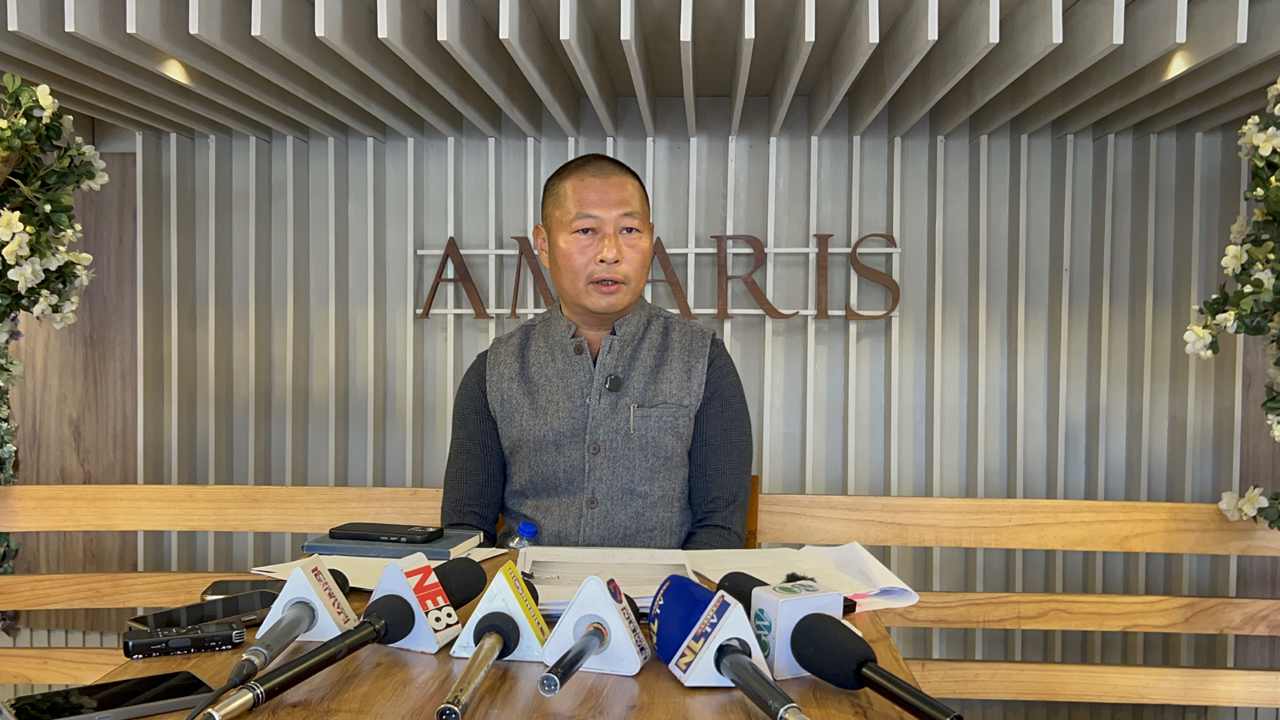
Advisor for School Education & SCERT, Dr. Kekhrielhoulie Yhome on Monday addressed the ongoing agitations by sections of teachers in Nagaland, asserting that while the government empathizes with their concerns, no decision can be taken outside the framework of law and established procedures. Referring to protests by the RMSA 2010 and 2013 batches under the banner of the Nagaland Government Teachers’ Association (NGTA) and the earlier agitation by the All Nagaland Adhoc Teachers Group (ANATG), Yhome emphasized that service regularization, salary restructuring and financial commitments must follow due process and judicial directives.
Dr Yhome said that within the spectrum of the Department of School Education, they have 4 categories of workforce, including teachers and MTS. He said that the Department has regular employee, those are on the payroll of the Government of Nagaland. They have the adhoc teachers who usually are given a scale of pay. Dr Yhome added that this includes the ANATG group where Government has given them a scale of pay.
Referring to the contract teachers, Dr Yhome said most are running under schemes, central schemes which included most of the NGTA. He mentioned about the contingency who are the fixed employees and said, “These are usually in the category of grade four, however, we don’t see them protesting,” he noted.
“They are given a fixed pay. Many of them have retired from fixed pay also. Fixed pays are given based on the Nagaland minimum wages act which is either skilled or unskilled. So most of them, those who are in contingency or fixed pay, they are getting about Rs 5,200 – 6,200, etc, which is not enough to run their family. But they are all part of the inheritance of what we have done before,” he cited.
The Advisor stated that the recurring issues in the Directorate of School Education stem not from a faulty system but from flaws in its design and implementation. He observed that the School Education Directorate often appears to be facing persistent problems, leading many to believe that the system itself is wrong. However, he clarified that the core system is not at fault.
Clarifying the demands of the teachers, the Advisor said that many are reasonable while some are unreasonable. He said that communication gaps were a major factor behind the recent teachers’ protests in the state.
Citing his engagement with various protesting groups, Dr Yhome stated that he personally met representatives of almost all the agitating bodies, including ANATG. During discussions, he urged their leaders to effectively communicate with their members, stressing that clarity within the group was essential.
He also expressed willingness to directly meet all members, recalling that ANATG had earlier staged protests at Naga Solidarity Park.
Acknowledging the teachers’ concerns, Dr Yhome said he understood their frustrations and was sympathetic to their situation. “It is my responsibility to defend my teachers and take care of them,” he said, while adding that there are broader considerations involved in addressing their demands.
Referring to the previous mainstreaming of the erstwhile teachers who are sponsored by the Government of India, Dr Yhome said that 5069 teachers were appointed 5069 and it was done through departmental recruitment. During those days he said there was no NSSB or exams conducted under NPSE. So out of the 5069, he assured that the Department advertised some posts but without advertisement also many of them were given employment. Dr Yhome stated that this is part of the 3rd category who are under contract scheme.
NGTA’s demand that their salary be given from state plan is their prerogative, the Advisor said. He further highlighted that the Department is getting some support from the Government of India through the Ministry of Education, however, if they convert all this into state plan it would have lots of financial repercussions amongst the budgeting system.
“So long as they are getting their salary, I think what we have done for them today it’s enough. It’s a step-by-step basis and what they are asking us today is literally pointing a gun at our head and asking us to take a decision,” the Advisor noted.
The Advisor also clarified the figures and background of the ANATG amid ongoing claims by protesting members.
Dr Yhome stated that a total of 2,483 teachers were appointed under the ANATG category, and all have since been regularized by the government. He noted that while the protesting group claims to represent 1,166 members, official records show the number to be 1,119. He added that some members have passed away while others have resigned from service.
According to him, this leaves around 1,300 teachers who are not part of the current agitation. “I do not know why the other 1,300 are not part of this group, but the total ANATG number is 2,483,” he said.
Yhome further stated that these appointments were not made through formal advertisement or open recruitment channels, acknowledging that many were appointed through personal or political connections. However, he said that considering their years of service and dedication in educating children, the government decided to regularize them and provide them with pay scales.
He maintained that the decision was taken in view of their service and necessity, and not merely as a reward, emphasizing that the government has already addressed their core service concerns.
According to Yhome, the total number of such appointees identified by the Government of Nagaland stands at 3,364, covering 42 departments. Of this, the Department of School Education alone accounts for 2,483, while the remaining 881 belong to 41 other departments.
He acknowledged that these appointments were technically made without formal recruitment procedures. However, the government has taken a policy decision to regularize them, and the process is already underway.
From the department’s side, Yhome said teachers have been asked to submit necessary documents to facilitate the process. He pointed out that in many cases, appointments were made merely on the basis of applications, and several individuals had not even submitted their mark sheets. As a result, their records are incomplete with the Department of Personnel and Administrative Reforms (P&AR).
Dr Yhome said the Department is now collecting the required documents and will proceed in accordance with the government’s decision on regularization.
Recollecting the Umadevi case, Yhome said that the case clearly says that those who were back door appointees after 2006 would not be entitled to get regularization.
“The government of the day headed by our Chief Minister Dr. Rio, we had been magnanimous, so we had taken a cabinet decision, we had taken a legislative decision, and we had circumvented this Umadevi case and we had given them enough,” he cited.
Dr Yhome said that ANATG group has a sense of impatience in them. However, he said that they do not know the government procedures and are unwilling to understand the government procedures. He mentioned that he and various civil society organizations had appealed to the group while the P&AR has divided the regularization processes into 3 stages.
The 1st stage, the Advisor said is all teachers have to submit their appointment order, submit their regularization order against vacancy and release order. He said that the department is in talk with finance department and PN&R department also.
Mentioning about the difficulties in getting release order, Dr Yhome said that Nagaland state was built by people from all over India. Whether it is teachers or in the administration, he stated that many of them had retired.
“We went to AG to find out whether we can get release order. Many of them had retired long time back. The idea of release order. Technically it is not possible. We have already communicated to P&AR department also. And so we are working with them. The P&AR they had asked for medical fitness and ABHAR,” the Advisor said.
He also highlighted that many teachers do not even know APAR (Annual Performance Assessment Report). He said, “APAR not our responsibility. That is the responsibility of every concerned teachers.” Dr Yhome also said that the Department had opened exclusive rooms in the Directorate for teachers to submit papers but many of them are ignorant about this. And as per P&AR communication physical verification will take place, he added.
The Advisor informed that teachers under the All Nagaland Adhoc Teachers Group (ANATG) are required to physically submit their original mark sheets for verification as part of the ongoing regularization process.
Dr Yhome stated that once the original documents are collected, the government will forward them to the respective boards and universities both within Nagaland and outside the state for authentication. He cautioned that if any teacher is found to have submitted irregular or fake certificates, strict action will follow.
“Such individuals will not only be terminated from service but will also be required to reimburse the entitlements and emoluments they have received till date,” he said.
He further revealed that out of the total 2,483 ANATG teachers, 1,166 are currently protesting. Of these, only 235 teachers have so far submitted their documents for verification.
The Advisor informed that the Department of Personnel and Administrative Reforms (P&AR) has already cleared the cases of 100 teachers under the ANATG as part of the ongoing regularization process.
He said he has urged the ANATG leadership to fix a date themselves for submitting all required documents instead of pressuring the government to announce a deadline. “You fix a date for yourselves and communicate it to me,” he stated, highlighting persistent miscommunication surrounding the issue.
He further expressed concern that many teachers may not possess the necessary certificates, stressing that regularization cannot proceed without proper documentation. “We cannot simply say we will regularize without verifying records,” he said.
Referring to past practices, Dr Yhome noted that earlier decisions were taken without adequate data-driven support, often leading to financial complications. He emphasized that the government is now functioning with a more data-driven approach, enabling it to better assess and translate policy decisions into their financial implications.
He added that with capable officers currently leading the administration, the government is better positioned to make informed and financially sustainable decisions.
“Right now, the ANATG group composes of 1119 teachers. They are getting the salary support of Rs 72.83 crore from the Government of Nagaland. Now, in 5 years’ time, this will jump up to Rs 5,043 crores. So the enormity of all these, the government of the day will handle all these cases, but we are able to guide all these,” he noted.
Regarding the NGTA protest, Dr Yhome said he finds it unreasonable for the association to expect the State to independently shoulder salary liabilities when their emoluments are largely supported through funds received from the Government of India in four installments annually.
He pointed out that in 2024, the Centre did not release the fourth installment, which created financial strain. However, he noted that the State Government stepped in to ensure that teachers’ salaries were paid despite the shortfall. He added that the government is once again engaging with authorities in New Delhi to secure the fourth installment for the current year.
According to Dr Yhome, the arrangement reflects the fiscal federal relationship between the Government of India and the Government of Nagaland, under which both work in coordination to manage financial commitments, including teachers’ salaries.
The Advisor also highlighted the financial strain on the School Education Department, revealing that over Rs 9,426.93 crore was spent on school education in the past five years.
Clarifying that the figures exclude technical and higher education, Dr Yhome said that between 2020 and 2025, the State Government alone allocated Rs 7,891.36 crore from its own budget to the department, while Rs 1,535.57 crore was received from the Centre. He described the cumulative expenditure just Rs 573 crore short of ₹10,000 crore as “huge” and stressed that nearly 8.3 to 8.5 per cent of the State’s total budget goes to school education.
However, he pointed out that the bulk of this allocation is spent on teachers’ salaries, leaving minimal funds for capital infrastructure. Of the State’s expenditure over the five year period, only 0.48 per cent was spent on capital investment, while about 14.26 per cent of central grants were utilized for infrastructure.
Dr Yhome admitted that many school buildings, constructed in the 1960s, 70s and 80s, are in poor condition. “I understand the condition of our schools, but I also understand the Finance Department, because nobody wants to give more money,” he remarked.
On the issue of Hindi teachers, Dr Yhome said that more than 1,500 teachers were appointed in the past after being trained at the State-run Nagaland Hindi Institute, which is not recognized by the National Council for Teacher Education (NCTE). As a result, the Government of India did not recognize their qualifications.
He acknowledged this as a backlog and said the State approached the Centre for a solution. Subsequently, a bridge course was introduced, and 300 teachers have completed it, enabling recognition of their certificates and saving the department approximately ₹15 crore. Additional batches are undergoing the process.
Dr Yhome also expressed concern that some Hindi teachers lack basic proficiency and announced plans for departmental examinations and internal audits. He warned that the government would not hesitate to terminate services after due procedures if teachers are found unfit, stating that the State cannot allow unqualified personnel to remain in service for decades at the cost of students’ future.
He also cautioned that accepting the demands of the RMSA group could result in significant financial liability for the State.
He stated that if the Government of Nagaland fully takes over the salary component as demanded, the State may lose over Rs 80 crore in central assistance from New Delhi, as such funding would no longer be provided once the State assumes complete responsibility. “That will become a liability for the State,” he said.
Referring to last year’s agitation by the RMSA group under the erstwhile Rashtriya Madhyamik Shiksha Abhiyan (RMSA), Dr Yhome revealed that the government had calculated the total financial implication till the retirement of the last serving member. Factoring in inflation and revised pay obligations, the projected burden stands at Rs 313 crore.
He further expressed concern over workforce demographics within the School Education Department. He noted that teachers in the 21–30 age group account for only 2.9 per cent of the total workforce, indicating a worrying shortage of young recruits. He stressed the need to bring transitional and inherited service issues to a closure to allow systematic and sustainable recruitment in the future.
While reiterating that he sympathizes with teachers’ concerns, Dr Yhome criticized ongoing street protests that disrupt academic activities. He said several departments, including Personnel & Administrative Reforms and Finance, as well as sections of the State bureaucracy and political leadership, are unhappy with what they view as unruly behaviour.
“Our children are getting affected,” he said, pointing out that many students come from vulnerable and economically weaker sections of society. He urged teachers to uphold their responsibility towards students, emphasizing that their role requires a strong sense of duty and care.
Dr Yhome also highlighted about suggestions, a procedure where they ask the teachers to go back to their own workplace. They will create monitoring system, if they are absent, and if they need to apply for leave, they have to apply leave, but if they are consistently absent from work without application for leave, then the department will have to issue them suspension letter, and the due process of law will follow. But speaking about the critical nature, Yhome said their consistency will be broken. There will be service break and once there is service break, they will not be able to get their remuneration.
He also clarified the salary structure of the All Nagaland Adhoc Teachers Group (ANATG), stating that their monthly pay currently ranges from approximately Rs 50,000 to Rs 85,000 under the scale of pay system.
Dr Yhome said he has reviewed their salary details and urged ANATG members not to compare their pay with that of regular teachers. He noted that while ANATG teachers are now receiving scale pay, other categories—particularly those under contract or centrally sponsored schemes—are drawing significantly lower fixed salaries.
“Many in the third category, such as contract or scheme-based teachers, are receiving as low as Rs 20,000 to Rs 31,000 as fixed pay,” he pointed out, describing the disparity as a source of tension within the department.
He termed such comparisons as counterproductive and stressed that the current situation is a legacy issue inherited by the present government. He said the administration cannot distance itself from past decisions and must address them responsibly.
“As Advisor, it is our job to take care of all these matters,” he said, while emphasizing that any action must be taken within the framework of the rule of law.
Dr Yhome also termed the refusal by some teachers to appear for mandated suitability tests as “ludicrous” warning that non-compliance could invite termination.
Dr Yhome said that while some teachers claim to have previously undergone suitability assessments, they are required to appear again in accordance with existing court directives and government procedures. “Unless you go for suitability tests, we will be going against the court,” he stated, adding that those unwilling to comply are free to challenge the requirement legally.
“If you approach the court and say you will not undertake suitability tests, you will be immediately terminated,” he cautioned, underscoring that the government cannot act in violation of judicial orders.
Acknowledging that teachers may feel strongly about the issue, Dr Yhome described them as “stubborn but simple,” noting that he understands their sentiments as a former teacher himself. However, he stressed that government procedures must be followed and that it remains the responsibility of the administration to ensure lawful and systematic handling of all service matters.
Dr Yhome also stated that the government is reviewing temporary appointments made despite standing court orders banning backdoor recruitment outside prescribed channels.
Download Nagaland Tribune app on Google Play

He said a Cabinet Sub-Committee on temporary appointees was constituted following court directives which clearly state that appointments, except through the Nagaland Staff Selection Board (NSSB) or the Nagaland Public Service Commission (NPSC), are prohibited. He emphasized that the restriction stems from orders of the High Court and the Supreme Court, and is not merely an executive instruction of the State Government.
According to the Advisor, it has come to the government’s notice that appointments continued despite these directives. He revealed that the department has recommended termination of 668 individuals temporarily appointed under the T-4 category.
While acknowledging teacher shortages in specialized subjects such as Chemistry, Physics and Mathematics due to a lack of qualified candidates, Dr Yhome asserted that there would be no shortage at the primary level even if a large number of irregular appointees were removed.
He said the accumulation of such “baggage” over the years has created serious financial implications and fostered a pattern where sections of teachers resort to street protests to pressure the government.
Reiterating empathy for teachers’ concerns, Dr Yhome appealed for patience and reasonableness, stressing that all demands must follow due process of law. He clarified that the High Powered Committee constituted earlier was meant to hear grievances and place recommendations before the government, after which concurrence must be obtained from the School Education Department, Personnel & Administrative Reforms, Finance, and Law & Justice before any final decision is taken.
“The High Powered Committee cannot give assurances. It can only recommend,” Dr Yhome said, urging teachers not to misinterpret its mandate and to allow the government process to take its course.
Referring to last year’s agitation by teachers under the erstwhile Rashtriya Madhyamik Shiksha Abhiyan (RMSA), Dr Yhome said the High Court had delivered a judgment, but the matter now rests with the Supreme Court for final direction. He alleged that some members attempted to pressure the government after interpreting the High Court order as favourable.
“The due process of legality has to be followed,” Dr Yhome asserted, adding that the government cannot act without exhausting all legal procedures. He emphasized that service matters must adhere strictly to the rule of law.
He revealed that the financial implication for last year’s protesting RMSA group was calculated at Rs 313 crore till the retirement of the last serving member. The present agitating group, he said, is an amalgamation of the 2010 and 2013 RMSA batches, whose salary structures are currently being supported under central assistance.
He further informed that Samagra Shiksha 2.0 is set to conclude on March 31 this year, after which the Centre is expected to roll out Samagra 3.0. He said the State must wait for clarity on the new fiscal framework under the Ministry of Education and its financial relationship with the Government of Nagaland before taking any major decision.
“Even if you are shouting on the streets, we cannot take decisions just now. We have to wait and exercise patience,” Dr Yhome said, reiterating that the government is now operating under a data-driven governance model and will carefully assess every case before arriving at a lawful and financially sustainable decision.
The Advisor again clarified that members of the Nagaland Government Teachers’ Association(NGTA) were appointed on a temporary basis under central schemes, and their appointment orders clearly state that their services are not permanent.
Yhome said the terms of engagement specify that the posts are temporary and subject to termination at any time. He added that these teachers fall under centrally sponsored schemes, where salary support is released by the Government of India in four annual installments not on a monthly basis.
He noted that there have been occasions when the State had to borrow from the Finance Department to ensure timely salary disbursement, as delays in central releases caused hardships. Recalling earlier years, he said there was a time when teachers did not receive salaries for extended periods, and the department has since been working to stabilize payments.
Initially, he said, the Centre bore 100 per cent of the salary component. However, the funding pattern gradually reduced by five per cent annually, and at present, the State Government bears 54 per cent of the salary component, while the Centre contributes 46 per cent.
Dr Yhome expressed regret that the State is unable to enhance salaries further due to financial constraints. He remarked that when the scheme was first introduced, the government perhaps should have carefully considered the long-term fiscal implications before appointing large numbers of teachers—stating that 5,069 appointments were made under such schemes.
While refraining from blaming predecessors, he acknowledged that “unhealthy practices” in the past have created substantial financial burdens for the present administration. He said the government is now working to correct these systemic issues and ensure more responsible financial and administrative management moving forward.