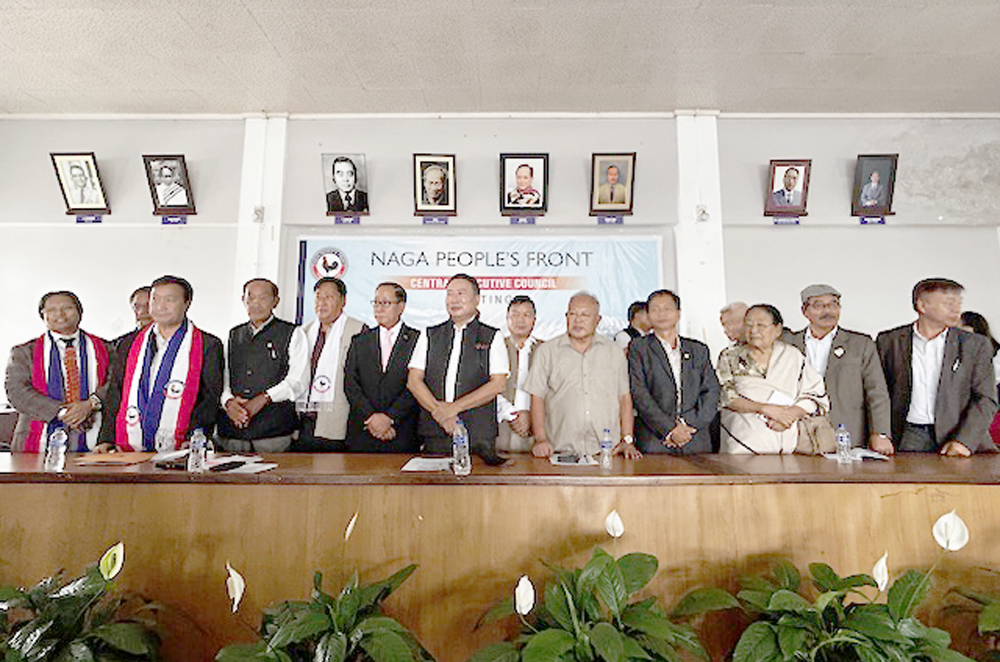
The Naga People’s Front (NPF) on September 6 held its Central Executive Meeting at the NPF Central Hall, Kohima, where party leaders made impassioned appeals for humility, unity and revival of regional forces, while also reflecting on the party’s historic sacrifices and role in the Naga political movement.
In his address, MLA and Leader of the NPF Legislature Party (NPFLP), Kuzholuzo (Azo) Nienu said that with only two MLAs in the State Assembly, the NPF must approach the ongoing process of unification with the Nationalist Democratic Progressive Party (NDPP) with “humility and diplomacy.”
He cautioned that the resolutions adopted should not carry conditions or demands.
“We are only two MLAs. We are beggars, and beggars cannot be choosers. We should welcome the process with wisdom and humility. If we start demanding, before the curry is ready, it will be burnt,” Nienu remarked.
Stating that the NPF’s relevance transcends electoral strength, Nienu declared, “The time will come when NPF will be remembered and cannot fade away. Even if we are reduced to two MLAs or even without any representation, the party will live on.”
On the question of merger, Nienu described it as “divine intervention,” while also acknowledging the role of leaders from both NPF and NDPP. He credited Chief Minister Neiphiu Rio, describing him as a “pure regionalist with a soft heart,” and recalled Rio’s statement during a September 2, 2024 meeting with 19 legislators that “no political party has its relevancy on the Naga political issue except NPF.”
Referring to the NDPP’s recent clarification, Nienu said the party had not rejected the merger move but had only emphasised the need for time and due process. He urged NPF members to be careful with words, warning that even minor remarks could create unnecessary controversies. “We must avoid provocative statements and speak with diplomacy,” he cautioned.
Nienu further underlined that Nagas desired to see a single strong regional party, as two separate regional parties could not survive in smaller states like Nagaland, Manipur or Arunachal Pradesh. He also welcomed the BJP’s assurance of a “friendly contest” in Nagaland, terming it “healthy politics.”
He also mentioned that the need of the hour was to look ahead with unity and humility. He said while NPF’s destiny was in God’s hands, the immediate task was to tread carefully in the merger process. “If we go forward with wisdom, humility and diplomacy, we will have a bright future. But if we start placing demands and conditions, we risk burning the dish before it is served,” Nienu said.
NPF President offers to step down for Rio’s return
Delivering an emotional address, NPF President Apong Pongener declared his willingness to step down from the party presidency to pave the way for Chief Minister Neiphiu Rio’s return and to lead a possible unification of regional forces.
Pongener said his decision was driven by the larger interests of the party and the Naga people, stressing that Rio’s leadership was “monumental” in the past and would once again strengthen the regional movement if he rejoined the NPF. “If Dr. Neiphiu Rio is willing to return to his original political platform, I will resign from the post of president to clear the path for him to lead both the party and the government,” he declared, drawing loud applause.
He reminded that the NPF, founded in 1963, was the first and only political party bearing the name of the Naga people, built on sacrifice and commitment to the Naga cause. He recalled the role of the then Democratic Party of Nagaland (later NPF) in facilitating the 1964 ceasefire through the resignation of its legislators, and the party’s decision to abstain from the 1998 Assembly elections in solidarity with civil society’s call for a solution. He said such sacrifices underlined the party’s distinct identity and relevance even today.

Pongener reiterated the party’s stand for an “honourable, acceptable and inclusive solution” to the Naga political issue and urged all sections of society to unite for the future of coming generations. He also opposed the imposition of President’s Rule in Manipur, stressing that peace and stability can only be restored through a democratically elected government.
On party affairs, he referred to the February 12 resolution inviting former comrades to return, and once again issued a special appeal to Rio, describing him as a “true regionalist” whose return would revive the NPF’s strength and send a positive signal across Nagaland. “My readiness to resign is not a sacrifice but a duty, if it ensures unity among regional forces and a stronger collective front,” he said.
Pongener urged NPF leaders and members to rise above personal positions and work for common cause. “This is a moment to set aside pride and work for the greater cause of the Naga people,” he said, invoking God’s blessings for the party. He also expressed hope that the coming days would mark a turning point in regional politics.
Download Nagaland Tribune app on Google Play

Remembering the first Indo-Naga ceasefire
The meeting also marked the 61st anniversary of the first Indo-Naga ceasefire. NPF Vice President Lanukaba reminded the gathering that the Nagas, of Mongoloid origin, had migrated through Myanmar into their present homeland, remaining unconquered and un-administered until the advent of modern political developments.
He outlined historical milestones that shaped the Indo-Naga issue, beginning with the 1929 memorandum to the Simon Commission, the Hydari Agreement of 1947, the declaration of Naga independence on August 14, 1947, and the voluntary plebiscite of 1951. He also recalled the division of Naga areas by Prime Minister Jawaharlal Nehru and Burmese Premier U Nu in 1953, which was followed by the Indian Army’s entry into Tuensang and a decade of undeclared war between 1954 and 1964.
Lanukaba recalled the atrocities committed during the conflict years, alleging that villages were burnt, women raped, children and elders gunned down, and civilians forced into “grouping” under barbed fencing that he likened to concentration camps. He said forced labour, trench digging and denial of harvest were tactics deployed to suppress the Naga people.
Amid this turmoil, he noted, a handful of educated Nagas initiated the Naga People’s Convention (NPC), which in its third convention at Mokokchung in 1959 adopted six resolutions. He accused the NPC leaders of violating their own resolution by going to Delhi without underground representatives to finalise the 16-Point Agreement, while leaders such as A Kevichusa, Tajen Ao, Vizol and Megorto withdrew in protest.
According to the vice president, the situation became intolerable until the Nagaland Baptist Church Council (NBCC) constituted a Peace Mission in 1963 comprising Rev. Michael Scott, Jayaprakash Narayan and BP Chaliha.
This mission, he said, held extensive negotiations with the Naga National Council (NNC) and the Federal Government of Nagaland (FGN) in May 1964, leading to a joint declaration of ceasefire terms. The agreement was conveyed to Prime Minister Jawaharlal Nehru on May 26, 1964, but after his sudden death a day later, it was Lal Bahadur Shastri’s government that formally accepted the ceasefire on August 10, 1964. The ceasefire officially came into effect on September 6, 1964.
Lanukaba recalled that in parallel, the Democratic Party of Nagaland (DPN), precursor to the NPF, was formed in 1963 with the sole manifesto pledge of working for peace through a ceasefire. Despite being jailed during the elections, 20 DPN candidates contested, and 12 were successfully elected.
True to their manifesto, he said, the 12 MLAs resigned en bloc in 1964 to pave the way for an honourable settlement. “September 6 is a red-letter day for the NPF in particular and for the Naga people in general. We salute those 12 MLAs who upheld the principle of fide non armis—faith, not arms—in pursuit of peace,” he stated.
He further called upon NPF members and the Naga public to collectively pursue accountability for human rights violations committed against innocent Nagas during the conflict years.
Arunachal Pradesh unit president Happa Taidong and Manipur state unit president and MLA Awangbow Newmai also gave their speeches during the CEC meeting.
The meeting was chaired by Blaise Iheilung, Sr Vice President, Padma Shri, Vamuzo Advisor, CWW invoked the gathering while A Prayer for the Nagas was delivered by Rev. Dr. Vevo Phesao. Sr. Pastor CBC, MH, Kohima.
The short program ended with a business session chaired by Achumbemo Kikon, MLA & Secretary General, NPF.