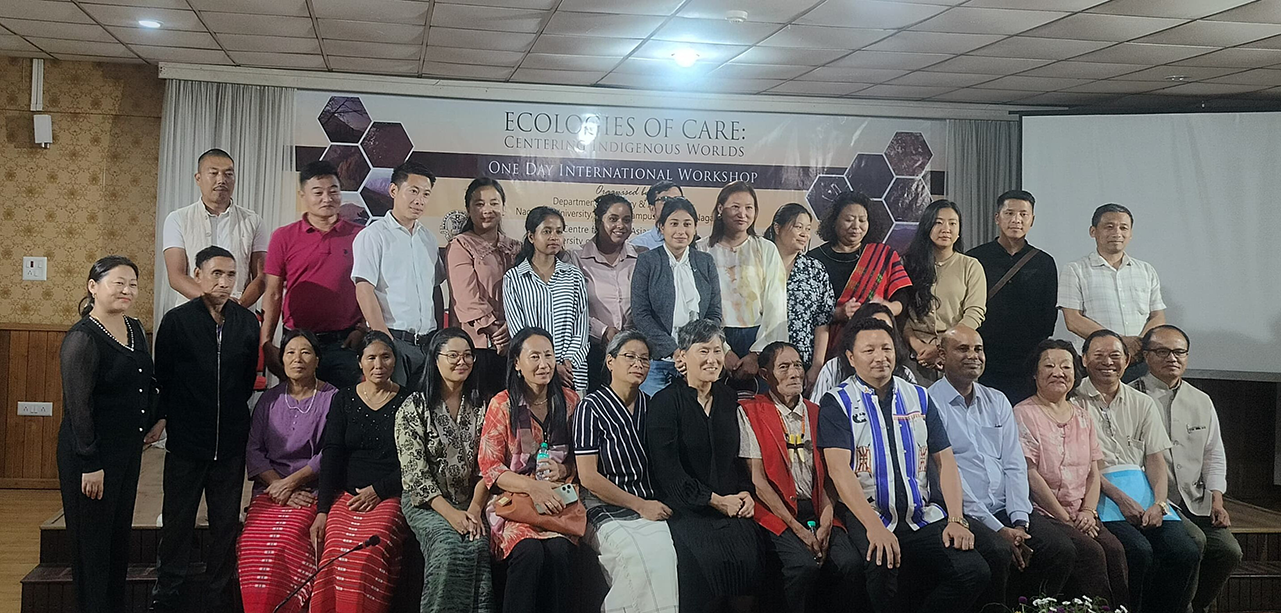
The ‘Ecologies of Care’ workshop was jointly organized by Nagaland University (NU) and University of California, Santa Cruz (UCSC) in Kohima on August 18, which was attended by 150 participants.
At the opening, the Chief Guest Vice-Chancellor, Nagaland University, Prof. Jagadish K Patnaik lauded NU’s Department of History and Archaeology for continuously making huge strides in research and collaboration by foregrounding Naga cultural heritage and Indigenous epistemologies.
Prof. Dolly Kikon, Director, Center for South Asian Studies, UCSC introduced the initiative as a collaborative dialogue to explore the Himalayan region’s various intersections, expressions, and care practices. By centering Indigenous philosophies, and care, Kikon invited participants to only love one another but also love our lands like our ancestors did.
Pointing to the river Chathe, she asked everyone to reflect on how it has shifted from a central part of the Naga world to becoming precarious and dangerous.
While pointing to the dearth of indigenous archaeologists around the world, Prof Tiatoshi Jamir, Department of History and Archaeology, NU invited students to return to the metaphor of the “hearth” where Indigenous knowledge and wisdom was shared and transmitted in the past. Drawing from his research, Jamir explained how returning to folklores on the origins of rice has helped inform archaeology on the early beginnings of crops in Northeast India.
He called for a need for reparative research by Indigenous scholars that emphasize on “with”, “by” and “for” Indigenous communities to decolonise knowledge production in the academia. Both Kikon and Jamir lauded introduction of new courses on Indigenous knowledge now offered in NU and Kohima Science College.
Adela Moa, Director, Department of Art and Culture, Govt. of Nagaland launched the “Naga Lithic Worlds” exhibition curated by Kikon and Jamir which showcased the stone artefacts from the Naga homeland currently held at the Pitt Rivers Museum in Oxford University.
Download Nagaland Tribune app on Google Play

Village elders from Hutsu village, Kenienuo and Thalü, took the audience through their ancestral practice of brine-making. Tenosenuo Angami shared the indigenous procedure of this salt production as practiced in Matikhru village. Prof. Pangersenla Walling, theoretical linguist, showed how Indigenous languages carry their worldview which is deeply informed by the surroundings they are spoken. Dr. Limasanen Longkumer, walked the participants through the myths associated with Jangjanglong from a geological and geomorphological perspective.
Myingthunglo Murry, who teaches at Mount Tiyi College and a PhD scholar at NU, presented on Oha, the luck stones of the Lotha Nagas. These were often placed at the village’s mengkitong. “Some large ones were placed in the Morung, and smaller ones were kept at home to bring luck and good health,” Murry added.
Dr R Chumbeno Ngullie pointed how pottery among the Nagas was never viewed as a trade of low status. “Villages would make significant peace treaties with pottery villages in olden days in order to procure the wares,” Ngullie added.
Throughout the day, academics shared panels with Indigenous knowledge-keepers and practitioners from villages across the Naga homelands. Through these dynamic panel discussions, the audience was reinformed on Naga practices of storytelling, burial practices, songs, languages, fetish stones, luck stones, salt production, architecture, pottery, as well as geologicaldistinctness and metallurgical heritage.
The organisers of the workshop hope that the richness and knowledge shared by Indigenous researchers and community elders will provide the requisite inspiration and motivation for young researchers to centre their indigeneity in their research and document the intergenerational wisdom of the Naga people.