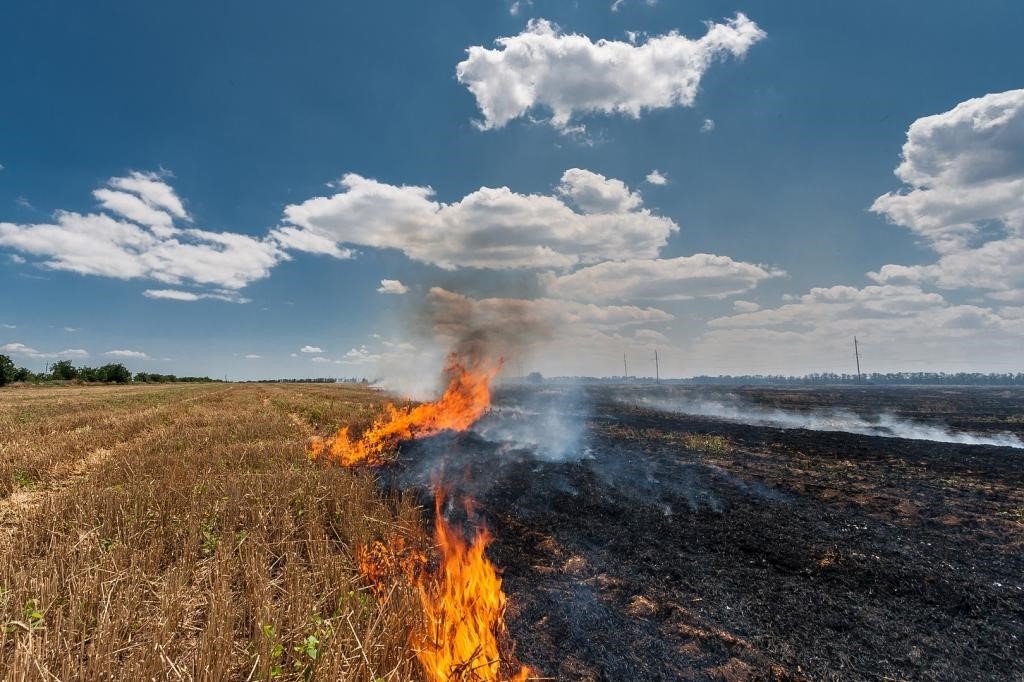
Over the last three years, incidences of paddy stubble burning have witnessed a significant decrease, including in 2023, both for Punjab and Haryana, informed the PIB.
Recording of paddy straw burning events, through a standard protocol developed by ISRO, is carried out on year-to-year basis from September 15 to November 30. The paddy harvesting season 2023 now comes to an end and with it, the efforts made towards management of paddy straw for the current season have also been concluded.
Formulation of district specific action plans, intensified monitoring at the level of Chief Secretary, Dy. Commissioners and officers concerned in the State Govts., improving availability and utilisation of machines for in-situ / ex-situ management and a quantum rise in utilisation of paddy straw for various industrial / commercial applications has led to substantial decrease in paddy straw burning incidents in Punjab and Haryana.
According to PIB, against cumulative 83,002 fire counts on account of paddy stubble burning in Punjab during 2020, the fire counts in the corresponding period were 71,304 during 2021, 49,922 during 2022 and 36,663 during 2023.
For the State of Haryana 4,202 fire counts were reported in 2020. Against this figure, paddy stubble burning cases were 6,987 in 2021, 3,661 in 2022 and 2,303 in 2023 respectively.Punjab thus recorded an overall 27 percent decrease in the total fire counts owing to paddy stubble burning during 2023 as compared to 2022. Reduction in the farm fires in 2023 with respect to the figures in 2021 and 2020 has been 49 percent and 56 percent respectively.
Likewise, substantial reduction has also been witnessed in the total number of paddy farm fires in Haryana i.e., 37 percent reduction in 2023 vis-à-vis 2022. The reduction in farm fire incidences in 2023 with respect to 2021 has been much higher at 67 percent while a reduction of 45 percent has been witnessed as compared to the incidences in 2020.
While number of days where more than 2000 fire counts were reported in a single day from Punjab were 16 in 2020, 14 in 2021, 10 in 2022, the current year 2023 witnessed only 4 days where the individual fire counts exceeded the 2000 mark.
Download Nagaland Tribune app on Google Play

For Haryana, there were 16 days where more than 100 fire counts were reported in 2020. Such instances were 32 in 2021 and 15 in 2022. 2023 however, witnessed only 3 days where individual fire counts exceeded the 100 mark.
The single-day highest fire count in Punjab was 5491 in 2020, 5327 in 2021, 3916 in 2022 and 3230 in 2023. The single-day highest fire count in Haryana was 166 in 2020, 363 in 2021, 250 in 2022 and 127 in 2023.
High number of fire counts in a single day, coupled with meteorological factors like wind speed and direction etc. have been greatly impacting the AQI in Delhi-NCR as evident from the records of AQI of Delhi and number of farm fires in Punjab / Haryana, year on year.
Despite significant reduction in the number of farm fires owing to paddy stubble burning in Punjab and Haryana, achieved owing to concerted and collective efforts of all the stakeholders, the resultant improvement did not reflect as much in the daily average AQI of Delhi / NCR during the month of November, 2023. This has primarily being attributed to highly unfavourable meteorology and climate conditions prevailing over the region particularly since the last week of October, with low speed winds from the north-westerly direction, very low rainfall and near-calm wind conditions over Delhi which badly impeded the dispersion of pollutants, thus reflecting in a much higher AQI during the month of November, 2023 as compared to the November months in preceding years.
With further concerted actions and strengthening of the action plans to prevent and control paddy stubble burning, it is expected that straw burning events will see a further significant decline in the ensuing year, thereby also improving upon the over all.