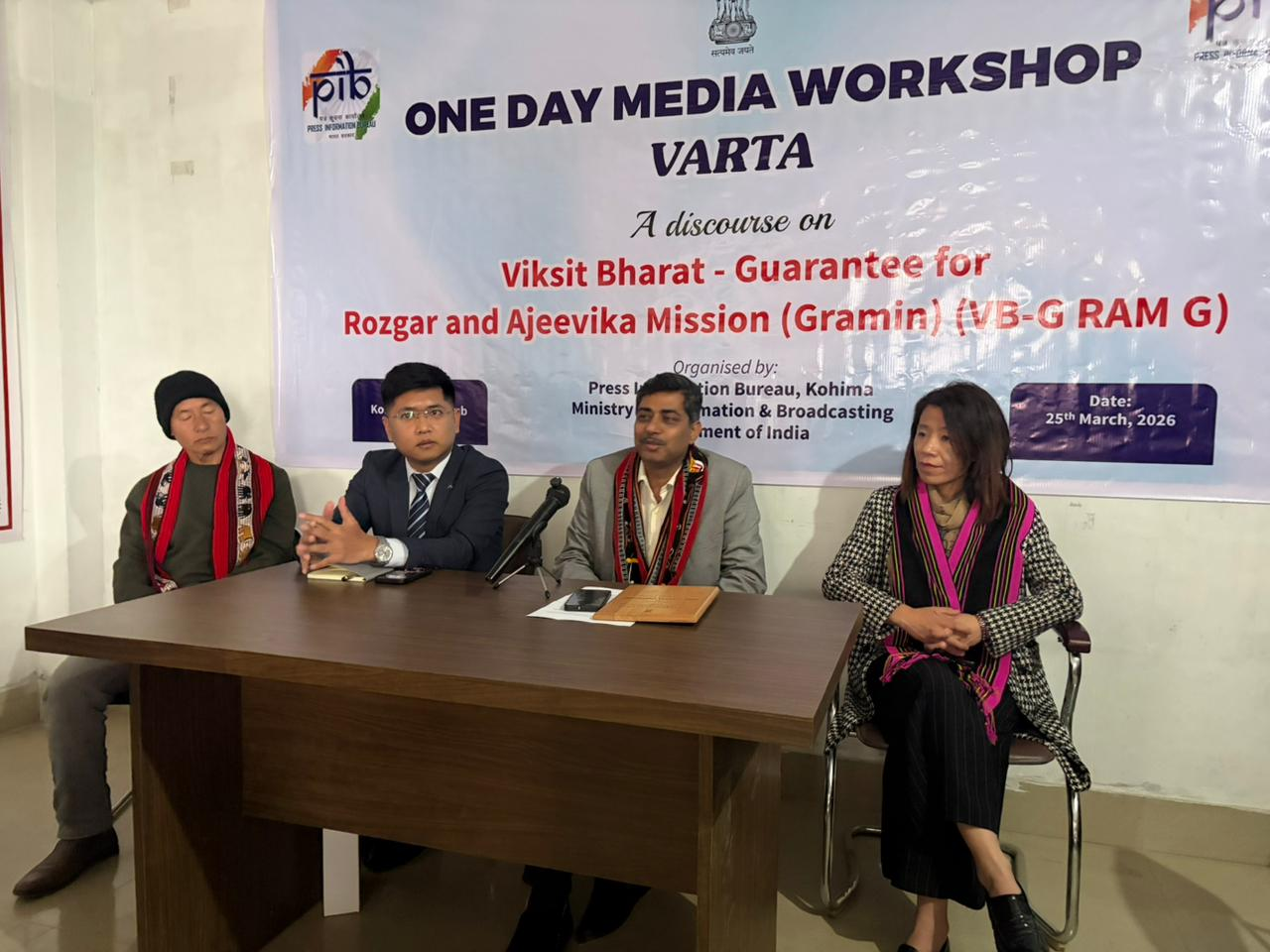
The Press Information Bureau (PIB), Kohima, under the Ministry of Information & Broadcasting, Government of India, held a one day media workshop VARTA discourse/ Interaction (Varta) on the recently rolled out central scheme ‘VB GRAMG’ under Ministry of Rural Development on March 25 at Kohima Press Club Office.
Prof Jayanta Choudhury, Head of the Department of Rural Development and Planning at Nagaland University, emphasized the central role of rural development in achieving the vision of Viksit Bharat 2047 while speaking on VBGRAMG.
Highlighting the broader vision of national progress, Prof Choudhury stated that efforts toward Viksit Bharat 2047 must prioritize rural development, as it forms the backbone of inclusive growth. He noted that policymakers and practitioners increasingly advocate for the localisation of Sustainable Development Goals (SDGs), focusing on grassroots-level implementation.
Drawing attention to global realities, he pointed out that over 80% of the world’s poor reside in rural areas. Issues such as zero hunger and malnutrition are also predominantly concentrated in these regions, underscoring the urgency of targeted rural interventions.
Prof Choudhury stressed that sustainable solutions—such as sustainable agriculture, organic farming, and natural farming—are essential to addressing these challenges. He further observed that even the development of clean and sustainable urban centers is closely linked to the strength of rural economies.
“Improved rural development can significantly reduce migration to urban areas,” he said, adding that balanced regional growth is critical for long-term sustainability.
Prof. Choudhury asserted that the success of all SDGs ultimately depends on how effectively rural development is addressed, making it a cornerstone of India’s development agenda.
Highlighting on the VBGRAMG (Viksit Bharat Guarantee for Rogar and Ajeevika Mission, Gramin) Prof. Choudhury highlighted that it is a reformed rural employment scheme intended to replace MGNREGA, aiming for 125 days of guaranteed work per household but introduces significant structural changes shifting the scheme from demand-driven to supply-driven.
Emphasising on the purpose and Scope of VBGRAMG he said that VBGRAMG is designed to guarantee 125 days of wage employment per rural household, slightly higher than the earlier 120 days under MGNREGA. He also mentioned that the scheme is renamed from MGNREGA and proposes a 60:4 O Centre-State funding share, with North-Eastern and Himalayan states receiving a higher 90% central funding share and it also intends to address rural employment gaps and support livelihood initiatives under the Rozgar and Ajee vika mission framework.
On key Changes from MGNREGA, Prof. Choudhury stressed on the shift from Demand-driven to Supply-driven Model. The scheme he said it allows the central government to set state- wise normative allocations for employment rather than responding to demand from rural households. He added that Rural work is restricted during peak agricultural seasons to prioritize farming activities, which could affect rural wage earners relying on continuous employment.
Download Nagaland Tribune app on Google Play

On Wage and Employment Days , he emphasized that VBGRAMG introduces a guaranteed 125 employment days, but does not specify inflation-linked wage revision or address long- standing wage stagnation. Past MGNREGA wage adjustments, which lagged behind agricultural wages, remain an unresolved concern.
On Fiscal responsibility , the professor highlighted that the burden of financing is shifted more towards states except for special regions, while earlier MGREGA had broader central funding. This he said may strain state budgets, particularly in high-migrant or economically weaker states
While emphasising on Technology and Monitoring , The professor stressed that Biometric attendance and daily tracking using apps like the NMMS are mandatory to ensure transparency. However, unreliable digital infrastructure and poor network connectivity in rural areas could cause wa ge delays or exclusions
Highlighting on Parliamentary Committee Concerns, He asserted that a Parliamentary Standing Committee has previously highlighted the need for expanding the number of workdays, revising wages, and increasing central share to protect rural livelihoods. He said that many recommendations remain unimplemented, raising concerns that VBGRAM could weaken safety nets instead of streng thening them
While highlighting on Implications for Rural Households , he explained that while the scheme promises more employment days, actual benefits may be limited due to allocation restrictions, supply-driven planning, and peak-season work bans.
Dependence on technology for attendance may create barriers to wage receipt for low-connectivity areas. The fiscal shift to states could exacerbate disparities among poorer and high-migrant-sending states, affecting program effectiveness.
Prof. Jayanta in conclusion added that VBGRAMG aims to enhance rural employment but introduces structural changes that diverge from MGNREGA’s demand- driven principles. He said that its success will depend on careful implementation, monitoring, and state-level capacity to manage allocations, while ensuring fair wages and technological accessibility
For detailed legal provisions, operational manuals, and budget allocations, He said that the stakeholders should refer to t he bill text and government notifications related to VBGRAMG.
Andrew Lalchhandama, Media & Communication Officer at the Press Information Bureau, Kohima, highlighted a significant policy shift in rural development initiatives during his address .
He stated that the initiative, rolled out in 2025, reflects a transformation in both vision and scope. “Earlier, the programme was known as the Mahatma Gandhi National Rural Employment Guarantee Act, which primarily focused on wage employment. Now, it has evolved into the Viksit Bharat Guarantee for Rozgar and Ajeevika Mission, Gramin,” he said.
According to Lalchhandama, the revamped programme adopts a more holistic approach to rural development, moving beyond wage generation to encompass livelihood enhancement, sustainability, and community-driven growth.
He emphasized that such an approach is particularly relevant in Nagaland, where a large proportion of the population remains deeply connected to rural life and traditional community structures.
“The shift reflects a broader understanding that rural development must go beyond employment and address overall quality of life, economic resilience, and sustainable livelihoods,” he added.
Lalchhandama concluded by noting that the new framework aligns with the larger national vision of inclusive and sustainable development under the Viksit Bharat initiative.