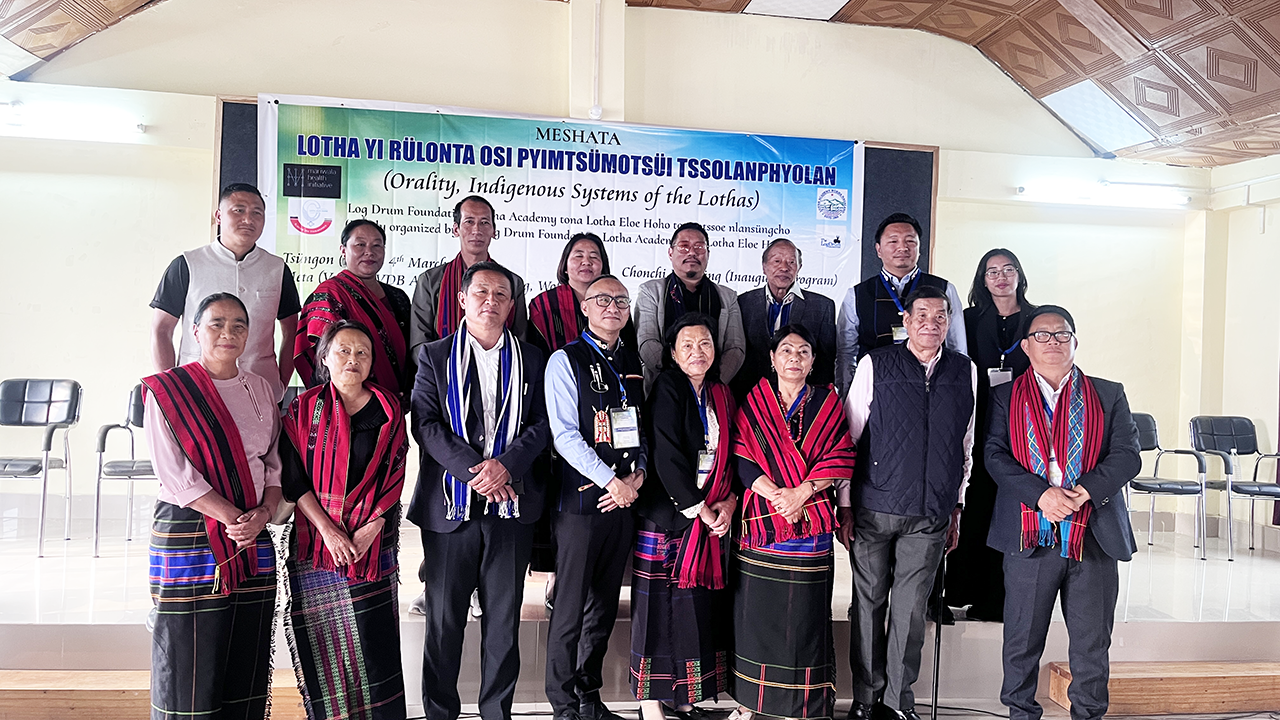
LogDrum Foundation in collaboration with Lotha Academy and Lotha Eloe Hoho organised a one-day seminar on Orality and Indigenous Systems of the Lothas at the VDB building, Wokha, on Wednesday.
The programme brought together scholars, community leaders, and cultural activists to deliberate on the importance of preserving oral traditions and indigenous knowledge among the Lothas.
Delivering the keynote address, Mmhonlumo Kikon of LogDrum Foundation emphasized that Lotha history and identity have largely been sustained through oral transmission. He noted that such initiatives are crucial in reviving traditional systems that are gradually being overshadowed by modern influences.
He cautioned that the neglect of oral traditions—the earliest form of information dissemination—could result in cultural dilution and identity crisis. Observing the growing impact of globalization and technology, Kikon remarked that the younger generation faces the risk of cultural amnesia if indigenous systems are not actively preserved. He called for a collective mass movement among Nagas to safeguard traditional knowledge, stressing the need for systematic cultural archiving and revival.
Abeni TCK, author of The Story of Our Threads (Oying Motsü), highlighted the historical role of Lotha women in sustaining cultural narratives through weaving. She explained that traditional attires were not merely garments but carriers of values, emotions, and identity worn by both men and women.
She informed that nearly 3,000 Naga traditional attires are preserved at the Pitt Rivers Museum in the United Kingdom, of which around 80 belong to the Lothas. She observed that the decline in traditional weaving may be linked to village displacements and disturbances following Indian Independence and the Naga political movement, during which several villages were burned and communities were forced to flee. She encouraged women to undertake further research and documentation to revive lost weaving traditions.
Download Nagaland Tribune app on Google Play

The afternoon session, chaired by Penthungo T Lotha, secretary of Lotha Academy, featured Rev Dr Ezamo Murry, former principal of ETC Jorhat, who spoke on the transition from oral to written traditions. He encouraged greater translation efforts in the Lotha language, while retaining original names and places, and expressed concern that socio-political developments have weakened linguistic and cultural continuity.
Thungjamo Tsanglao, former chairman of the Lotha Literature Committee, spoke on the traditional practice of tiger hunting among early Lotha tribes. He elaborated on the technical methods employed by villagers in hunting tigers, describing it as both a protective measure and a source of communal pride.
Dr Libemo Kithan, associate professor at Mount Tiyi College, Wokha, shared insights from his research on Lotha village formation, based on his published work, Naga Village Formation. He appreciated the collaborative initiative to sustain oral traditions and expressed hope that more such discussions would be organised for deeper academic engagement.