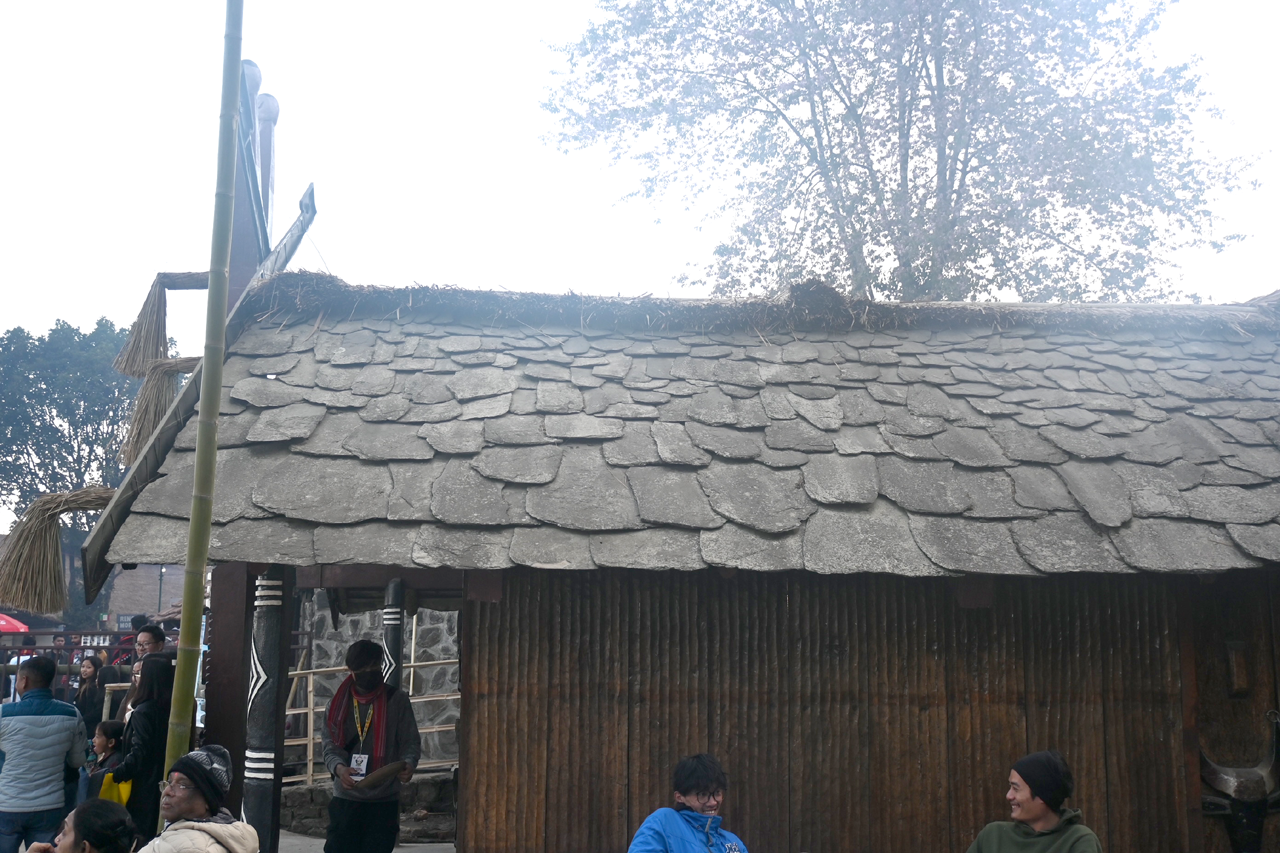
Three Naga communities — Pochury, Khiamniungan and Tikhir — are drawing attention at the Hornbill Festival at Kisama Heritage Village with their slate-roofed Morungs, a rare architectural tradition once reserved for kings, warrior houses, and the elite across Naga history.
Pochury Morung: A Legacy of Royal Roofing
According to Olivi Kajiri from the Pochury Women Organization, the Pochury Morung has used stone slates instead of thatch since the very first Hornbill Festival.
“In olden times, only kings and those who had taken heads during head hunting days lived in slate-roofed houses,” she explained.
The Pochury community comprises five ranges, but the practice of using stone slates survives only in the Phoyisha area.
While renovations have happened over the years, the original stone slates remain untouched a symbol of continuity amid rapid modernization.
The tradition, however, is fading. Stone is expensive, difficult to carve, and even more difficult to transport.
“They brought the slates from Phoyisha. It must have been a huge challenge,” Olivi recalled. “Today only a few homes still use them. But we are committed to preserving our culture and showcasing it to the world.”
Khiamniungan Morung: Preserving a diminishing tradition
Thangpong, from Sanglao village in Noklak district, shared that in Khiamniungan villages, stone houses were once a sign of wealth and status, as the stones were found only in specific forested areas.
“The less privileged couldn’t afford stone-slate homes,” he said.
In the early Hornbill years, the Khiamniungan Morung at Kisama was built with thatch. But in 2013–2014, the community rebuilt it using stone slates sourced from Longkhew Village in Noklak.
Though a few stone-slate houses still stand in villages, the practice is rapidly declining.
“With modern changes, stone houses are vanishing. We try our best to maintain this roof because it is part of who we are. But today, finding these stones has become very difficult,” Thangpong added.
Download Nagaland Tribune app on Google Play

Tikhir Morung: A young tribe with strong cultural resolve
Torepkiu Tikhir, President of Tikhir Union Kohima, said that stone slates were once used widely in Tikhir villages not only for Morungs, but for almost all households.
“With modern government projects reaching villages, stone-slate houses have nearly stopped,” he said. “But we do not want to give up our culture, so we built our Morung at Kisama with stone slates to carry this identity forward for generations.”
Their stone slates were transported from Metonger Village, which is 50-60 Kilometers away from Kiphire District. Metonger still has an abundant supply of stone slates, enabling community members to build such houses whenever materials are available.
As one of Nagaland’s youngest tribes and smallest populations, Tikhir faces more challenges than other communities in maintaining their Morung at Kisama.
“Other tribes have many officers, legislators, and long histories at the festival,” Torepkiu explained. “We have no elected legislator yet and very few officers. Managing the Morung is difficult, but we try our best.”
Their Morung, only three years old, may not match the elaborate designs of older communities, but its stone slate roofing and log drum are sources of deep pride.
He added that the community has submitted grievances to the Tourism Department, requesting support for a retaining wall around their Morung.
Stone slates as cultural identity
The slate-roofed Morungs at Kisama stand as living museums of Naga architectural heritage, harking back to a time when prestige, craftsmanship, and social status were carved in stone.
As slate-roofed construction fades across Nagaland due to cost, scarcity, and modernization, the efforts of the Pochury, Khiamniungan, and Tikhir communities serve as a powerful reminder: Heritage survives only when people choose to uphold it.
And at the Hornbill Festival, these Morungs stand proudly not just as structures, but as enduring symbols of identity, resilience, and cultural memory.