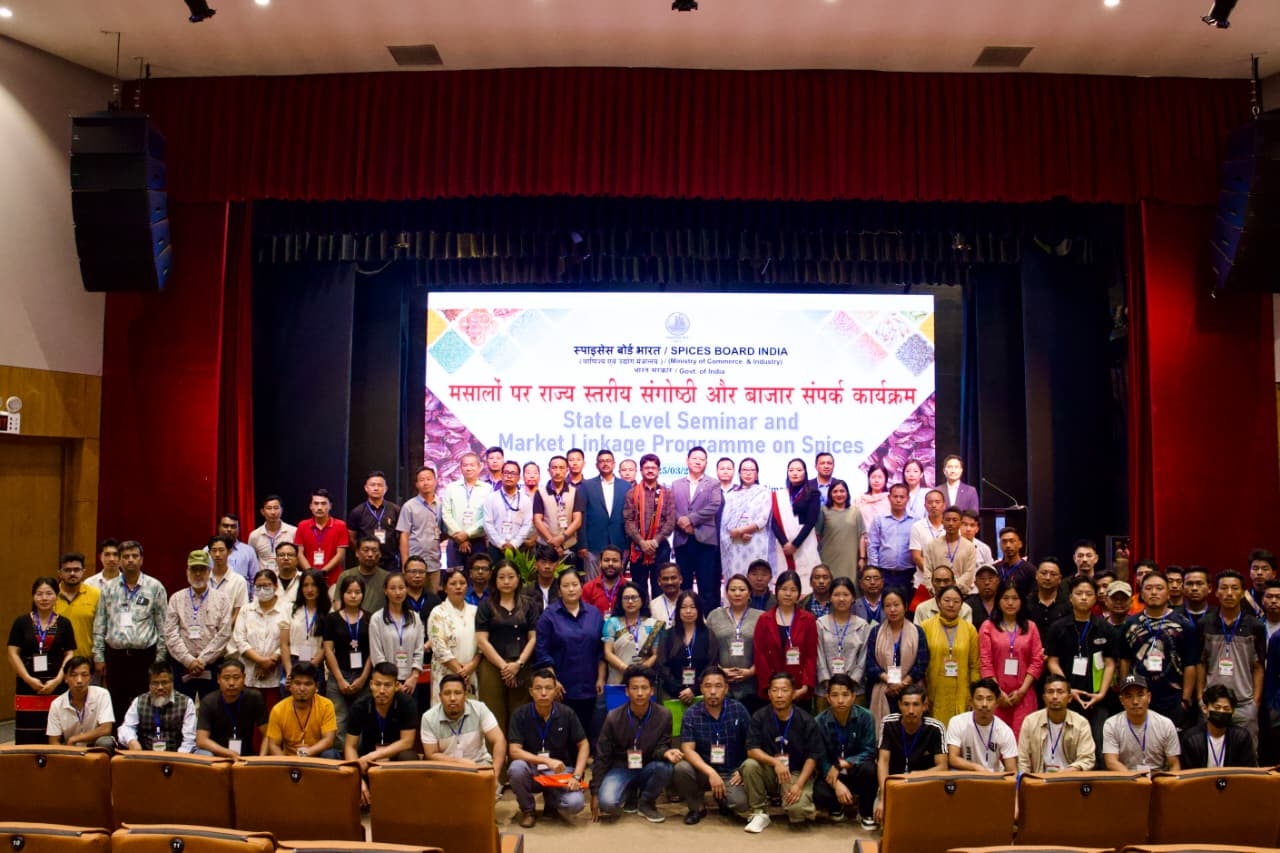
A State Level Seminar and Market Linkage Programme on Spices was held at Town Hall, Dimapur, Nagaland on March 25. The programme was organized by the Spices Board India under the Ministry of Commerce & Industry, Government of India, with the objective of promoting spice cultivation and strengthening market linkages in the North Eastern region.
Addressing the gathering, Special Guest Razouvollie Dozo, NCS, Additional Secretary, Horticulture, said that despite years of discussions and deliberations, market linkages in Nagaland continue to remain weak and largely unstructured across various crops including spices, cereals, fruits, and vegetables. He observed that while the state has favourable soil, suitable climatic conditions, and hardworking farmers, the real challenge lies not in production but in marketing and creating sustainable market systems.
He pointed out that small landholdings often result in low-volume production, making it difficult to meet larger market demands. He stressed the need to focus on key areas such as quality control, export standards, and proper post-harvest handling practices. According to him, farmers alone cannot address these challenges, and there is a need for collective efforts involving government departments, entrepreneurs, buyers, and Farmer Producer Organisations (FPOs).
Emphasizing the importance of youth participation, Dozo said that young entrepreneurs can play a vital role in strengthening market linkages by engaging in aggregation, sorting, grading, value addition, and marketing of agricultural produce. He noted that with proper skill development and capacity building, youth can transform agriculture into a viable and attractive livelihood option.
He also highlighted the lack of infrastructure for value addition, recalling instances where farmers suffered losses due to price drops and the absence of processing facilities. In some cases, middlemen benefitted significantly by reselling local produce outside the state at much higher prices, indicating missed opportunities for local stakeholders.
Calling for better coordination among departments and stakeholders, he remarked that many agencies are currently working in silos without adequate convergence. He said the seminar provides an important platform for interaction among farmers, buyers, government officials, and organizations like the Spices Board to jointly address existing gaps.
Dr. Cressida Jamir, Deputy Director, Agriculture, highlighted the continuing challenges in establishing strong market linkages for farmers in Nagaland, stating that a structured market system is still lacking despite years of discussion.
She observed that while the state has favourable climate, fertile soil, and hardworking farmers, the key issues lie in volume, quality, and market access rather than production. Fragmented landholdings, she said, make it difficult to meet large-scale demand.
Emphasizing the need to strengthen Farmer Producer Organizations (FPOs), she also stressed the role of youth and entrepreneurs in aggregation, grading, value addition, and marketing of produce.
Dr Jamir pointed out that lack of proper post-harvest handling and infrastructure affects quality and pricing. Recalling instances where farmers had to discard produce like ginger due to poor market returns, she underscored the importance of value addition and processing facilities.
She further called for youth empowerment and better coordination among departments and agencies, noting that collective efforts are essential to improve market linkages and connect farmers to wider markets, including exports.
Rituraj Hazarika, Chief General Manager, M Junction, spoke on strategies for spice marketing in the North East. He highlighted that M Junction’s strategy focuses on digital empowerment through e-auctions and direct market linkages. By partnering with the Spices Board, the initiative aims to connect local farmers directly with national buyers, ensuring transparent pricing, eliminating middlemen, and improving farmers’ income and market access.
Earlier, the programme began with a welcome address by Dr Dwijendra Mohan Barman, Deputy Director (Development), Spices Board. The inaugural session concluded with a vote of thanks by Sam Sing Taro, Officer-in-Charge, Spices Board, Dimapur.
The technical session featured presentations on turmeric production and market insights, prospects and challenges of Naga King Chilli, and market potential and trends for ginger products. Experts from the Spices Board shared insights to help farmers and stakeholders enhance production and access better markets.
The programme aimed to promote high-value spices such as large cardamom and GI-tagged Naga King Chilli (Bhut Jolokia), while also creating opportunities for direct trade linkages between farmers and buyers across the country.