The Department of Employment, Skill Development & Entrepreneurship, Government of Nagaland, on December 5 organized the State Level Campaign on Promotion of Apprenticeship under the PM-National Apprenticeship Promotion Scheme (PM-NAPS) at the Capital Cultural Hall, Kohima. Held as part of a special Pilot Initiative to boost apprenticeship in the North Eastern Region, the programme brought together government officials, industry partners, training bodies, and young aspirants to strengthen the State’s apprenticeship ecosystem.
MLA & Advisor for Labour & Employment, Skill Development & Entrepreneurship and Excise, Moatoshi Longkumer, in his address, said Nagaland has no shortage of talent but needs structured opportunities. “Apprenticeship bridges this gap,” he stated, adding that the youth cannot rely solely on education and that employability requires exposure, practical experience, and immersion in real workplaces.
He highlighted that productivity in today’s environment requires more than traditional processes, and apprenticeship remains a transformative model.
He said apprenticeship offers real workplace experience, helps industries build adaptable manpower, and gives the state a pipeline of skilled workers aligned with industry needs. He identified hospitality, food services, electrical and plumbing trades, construction, MSMEs, retail, logistics, digital services, IT support, agriculture, food processing, handicrafts, carpentry, graphic design and other emerging areas as sectors where young Nagas already show promise.
Stressing convergence across Government departments, industry bodies, Sector Skill Councils and training providers, the Advisor reaffirmed the State Government’s commitment to strengthening apprenticeship through industry engagement, upgraded ITIs, MSME support and sensitisation of youth. He urged industries to utilise the support available under PM-NAPS and encouraged young people to take apprenticeships seriously, noting that discipline, teamwork and responsibility are learned through experience, not classroom teaching.
Download Nagaland Tribune app on Google Play

To the youth, he said apprenticeship is the beginning of their professional journey, instilling discipline, teamwork, and responsibility that classrooms cannot provide. He urged them to treat their training seriously, learn continuously, and understand that their first apprenticeship can shape the next decade of their career. He thanked the organisers and underlined the importance of long-term partnerships between industry, institutions, and the government to build a skilled and future-ready workforce.
Earlier, in her welcome address, Commissioner & Secretary, Labour & Employment, Skill Development & Entrepreneurship, Sotsula, IAS said the programme marked a crucial step toward deepening industry–institution collaboration and expanding youth employment opportunities in Nagaland. She highlighted PM-NAPS as a major initiative enabling young people to gain industry-ready skills through structured training.
She said the programme empowers apprentices with practical experience while supporting industries with a skilled and productive workforce. She encouraged more organisations to join the effort to nurture talent, foster innovation, and build a stronger skill ecosystem. She added that speakers for the day would guide participants through various aspects of the PM-NAPS programme and urged everyone to participate actively. She conveyed best wishes on behalf of the Department for the success of the programme.
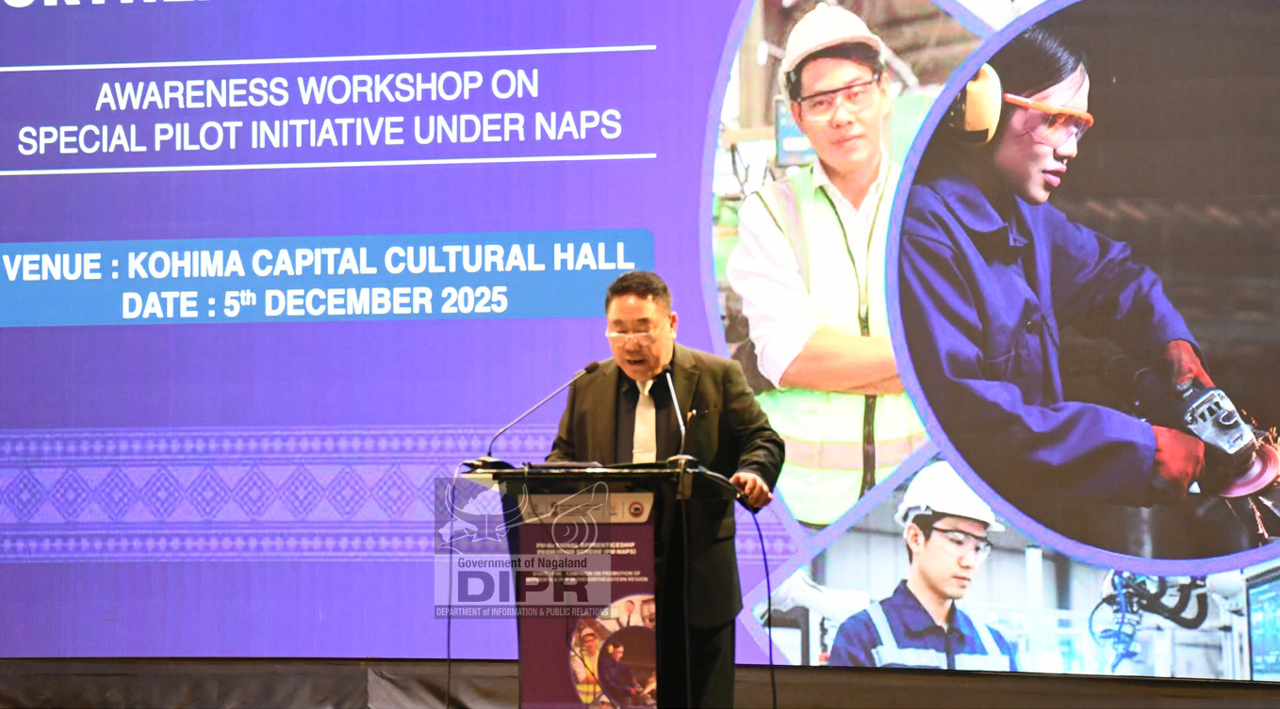
Advisor, Labour & Employment, Moatoshi Longkumer addressing during the State Level Campaign on Promotion of Apprenticeship under PM-NAPS held at Capital Cultural Hall, Kohima
Officials from RDSDE, Assam presented key aspects of the PM-NAPS programme, informing that over 15 lakh students pursue ITI courses annually across 1,170 trades. Apprenticeship, they said, provides a vital link between academic learning and industry requirements. They explained the provisions of the Apprentices Act, 1961 (amended up to 2014) and the Apprenticeship Rules, 1992 (amended up to 2019), including establishment eligibility, training duration, and financial structure. The Government reimburses 25% of the prescribed stipend (up to ₹1,500 per month) via DBT for eligible apprentices. Presenters also highlighted new initiatives such as virtual training, degree apprenticeships, NER-specific incentives and the unified Apprenticeship Portal.
Speaking on “Apprenticeship: Importance of Convergence and the Way Ahead,” a resource person from IIE, Guwahati said industries in cities like Delhi and Chennai have shown interest in engaging apprentices from the Northeast, but many youths remain hesitant to move outside their home states. He informed that the Government of India provides a special Northeast incentive of ₹1,500 per month for apprentices training outside their home state, urging youths to step out for broader exposure and long-term benefits. He emphasised improved stakeholder communication and assured continued support from the Ministry.
Sharing his long association with Nagaland since the 1990s, he expressed that the State feels like a second home and affirmed full support from the Ministry. He encouraged the youth and all stakeholders to promote apprenticeship, saying many other states have benefitted significantly from the scheme and that the Northeast must also utilise it fully.
A networking session with Sector Skill Councils (SSCs) and Third Party Aggregators (TPAs) followed, where stakeholders discussed candidate registrations, opportunities, and establishment participation. During the open discussion, participants raised queries regarding registration procedures, post-enrolment processes, and concerns related to workplace and sexual harassment. Officials clarified that TPAs are responsible for ensuring safe working environments and addressing such issues. Questions on placement opportunities post-apprenticeship were also addressed.
The programme concluded with the Vote of Thanks delivered by Savio Visa, Director, DESDE, who expressed gratitude to all officials, resource persons and participants for their contributions.
The campaign aims to enhance awareness, strengthen industry participation, and promote wider apprenticeship engagement across the State.
Through the Pradhan Mantri National Apprenticeship Promotion Scheme (PM-NAPS), the initiative encourages youth and organisations to join India’s largest apprenticeship network. The scheme supports the creation of a skilled workforce pipeline, reduces training expenditure for industries, and provides government-funded stipend assistance to apprentices, ensuring that both trainees and establishments benefit from the programme.
Apprenticeship opportunities are open to all. ITI graduates can undergo a one-year apprenticeship aligned to their trade, while candidates with qualifications from Class 8 onwards are also eligible, with longer training durations to ensure they gain the required industry skills. The scheme allows youth from different educational backgrounds to enter the workforce through structured, hands-on learning.