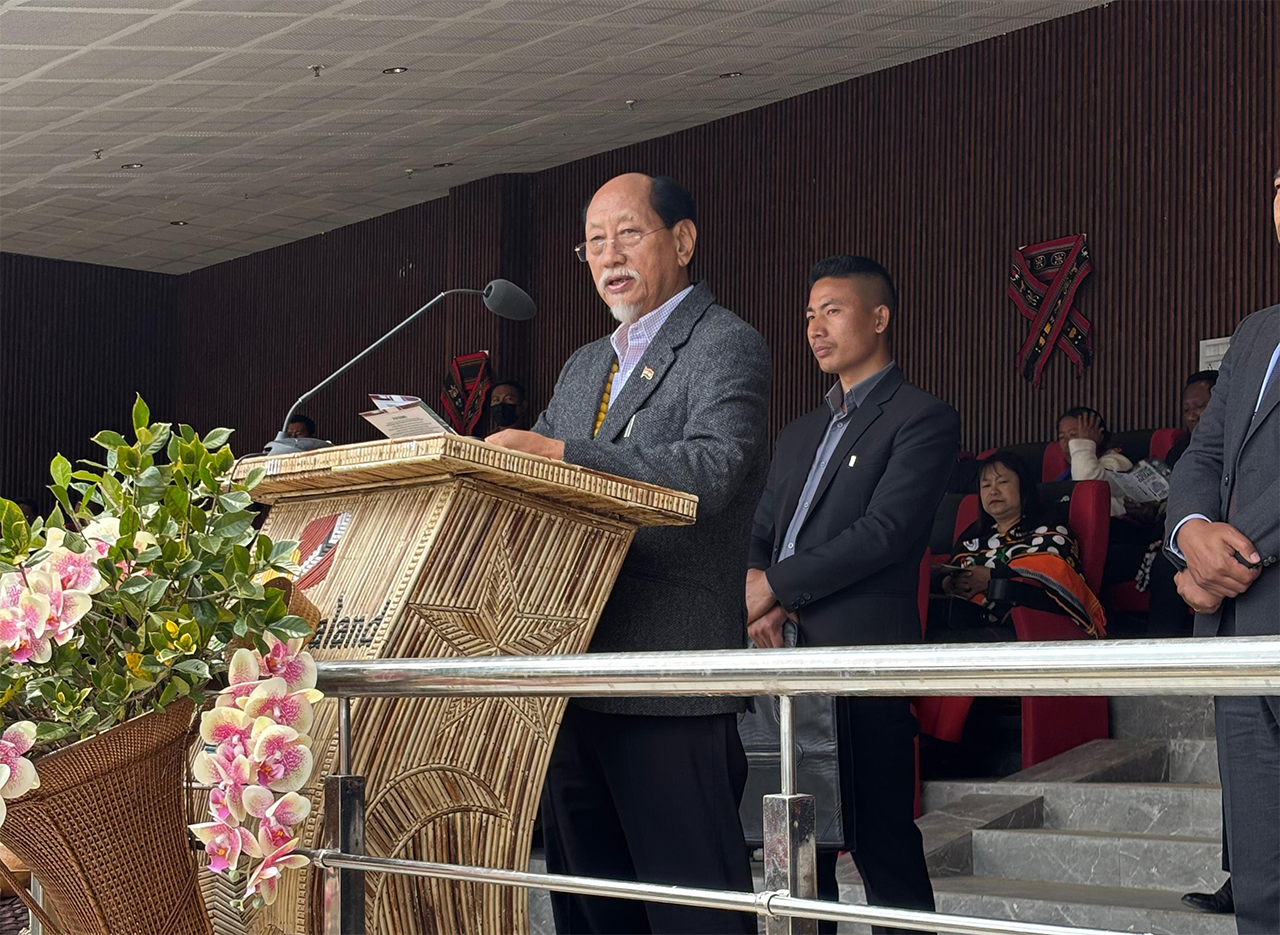
The 1st Tenyimi Youth Cultural Festival 2026 was held at Naga Heritage Village, Kisama, on March 25 under the theme “Unity through Cultural Heritage”, with Chief Minister of Nagaland, Neiphiu Rio, as the Special Guest.
Addressing the gathering, Rio said the festival was a matter of pride and a celebration of the shared identity, living heritage, and enduring spirit of the Tenyimi people wherever they are. Referring to the theme, he said that although the people belong to different tribes, backgrounds, and even different states, they are all united through the Tenyimi family, sharing rich traditions and histories.
He said that these cultural markers of identity bring the people together, and that the event stood as a testament to the strength of that legacy and the commitment of the youth in preserving and upholding it. He stressed that preserving culture is not merely a reflection of the past, but an investment for the future.
Rio remarked that the songs they sing and the stories they tell are threads that bind them together as a people. In a rapidly changing world with growing challenges and responsibilities, he said it was important to ensure that culture and tradition are carried forward with pride and purpose.
He also referred to a request from the Ura Academy, which has been promoting and teaching the Tenyidie language. He said it would be a great achievement if people could understand and speak to one another in Tenyidie. Referring to the 11 schools in Nagaland, including Navodaya Vidyalayas and Central Schools, he pointed out that English is the first language, Hindi the second, and Assamese the third language in these institutions.
While acknowledging that those languages are compulsory and must be learned, Rio said there should also be efforts to promote the learning of Tenyidie in Tenyimi tribal areas. He appreciated the efforts of the Ura Committee in carrying out research and promoting the language, adding that Tenyidie has reached the universities and has become an important tribal language. In this regard, he appealed that Tenyidie may be considered in place of Assamese in Navodaya and Central Schools in Nagaland, and urged everyone to make an effort toward this cause.
Speaking on Naga unity, Rio said much has been spoken about oneness, brotherhood, and unity within the Naga family. He noted that the Government of India has recognized the Nagas as Nagas, and therefore their commitment should be to further strengthen Naga unity. He said the elders have done a commendable job in bringing the Nagas together.
He also highlighted the historical protections granted to the Nagas, stating that the Bengal Eastern Frontier Regulation Act of 1873 provided safeguards to indigenous tribes through the Inner Line Regulation. He said that through political agreements and the efforts of leaders, the law continued to be enforced in Nagaland, and that the Nagas later received special recognition and protection from the Indian Government under Article 371(A). He added that the Nagas continue to pursue the Naga political movement, and that all are trying their best to resolve the political issue.
Referring to the Statehood Agreement, Rio said one of the most important points remains the integration of Naga contiguous areas. He noted that the Nagaland Legislative Assembly has passed this resolution six times, and said this remains one of the important points under negotiation.
He further said that while physical integration may not be possible at present, the Nagas must remain politically, emotionally, socially, and culturally integrated, since their traditions, culture, and customary laws are similar. He said it is the duty of all Nagas to unite and reconcile, so that the future of the Nagas is not forgotten. In this regard, he said the Tenyimi platform should serve as a means of bringing the Nagas together.
“When others recognize us, how can we not recognize or accept ourselves,” Rio said, adding that history, identity, culture, tradition, and customary laws define the people. He said the youth are the custodians of heritage, and that their energy, creativity, and efforts are vibrant and vital.
Urging the youth to take their culture seriously, he quoted the proverb, “A tree without roots cannot stand,” and said the people must ensure that their roots are deeply grounded so that no storm can uproot them.
He said that just as their forefathers and elders came together with the understanding of a common ancestry, the youth today have a special responsibility, with the guidance of elders, to uphold rich cultural traditions and promote customary laws. He stressed that those who are educated must teach, and those who learn must also pass on that knowledge, since teaching and learning are essential to preserving history and what is important in society.
Rio reminded the youth that roots provide both strength and identity, and said that while life today is highly competitive and fast-changing, with many opportunities and challenges, the youth must equip themselves with skills, knowledge, discipline, integrity, resilience, and wisdom. He added that success comes to those who are prepared and persistent, and encouraged the youth not to be discouraged by failure or setbacks.
Download Nagaland Tribune app on Google Play

Expressing hope for the future, Rio said he hoped the celebration would continue in the years ahead and that the festival would strengthen unity, oneness, and better connections among the people, and thereby strengthen the entire Naga community. He said this would also lead others to respect the Nagas more and take them seriously, especially as they seek an honourable settlement to their issues. For that, he said, the Nagas must make themselves honourable by uniting and working hard to show their capability in all affairs.
He concluded by saying that Naga society is educated and vibrant, and that such efforts would greatly enrich and preserve culture and traditions.
Deputy Chief Minister, TR Zeliang, who attended as the Special Guest of the evening programme, said the event provided a much-needed platform for the Tenyimi family to come together and strengthen the bonds of brotherhood.
He said the Tenyimi Union is not merely a civil society organisation, but essentially a family closely knit by blood, as all are descendants of “Tenyiu,” their ancestors, through whom the Tenyimi family continues to this day.
Zeliang said there may be attempts to portray the Tenyimi Union as just another organisation with political or other agendas, but their culture and traditions stand as a powerful testament to their identity as kindred people. He pointed out that the similarities in dialects, lifestyle, food habits, traditional attire, and overall way of life clearly reflect their shared roots.
He said the cultural festival was therefore a significant step toward strengthening unity and bridging gaps among the people. With a special focus on the youth, whom he described as the leaders of tomorrow, he said the festival was highly commendable and expressed confidence that every participant would leave with a deeper sense of brotherhood and unity.
He also called upon the Angami brothers and sisters to continue leading and supporting the rest of the Tenyimi family as they had done in the past. He said that with the advent of Christianity in the Angami areas, leaders of those times had spread the Word of God through the medium of Tenyidie, which had a profound influence, and many Tenyimi tribes learned through Tenyidie, even in schools.
Drawing a parallel, he said that just as the Ao community had influence in the ENPO areas, where many from the older generation learned and spoke the Ao dialect, the Angami community has long played the role of an elder brother to the rest of the Tenyimi family.
He referred to Khrielie Kevichusa, IAS (Retd.), who had headed the Committee on Job Reservation in 2010, and quoted from the report: “The ones who have had a head start in a running race always have the advantage.”
In the same spirit, he said the smaller and less advanced tribes continue to look forward to the support and guidance of the more advanced sections of the family, particularly in matters concerning welfare and upliftment. He said that if they stand by one another and care for each other as one family, their bonds will only grow stronger and their shared sense of brotherhood will deepen.
Zeliang said that calling themselves a family in words alone, without genuine care and belonging, would be an empty claim. However, he said initiatives like this, if sustained and held regularly, would undoubtedly foster unity and strengthen cooperation.
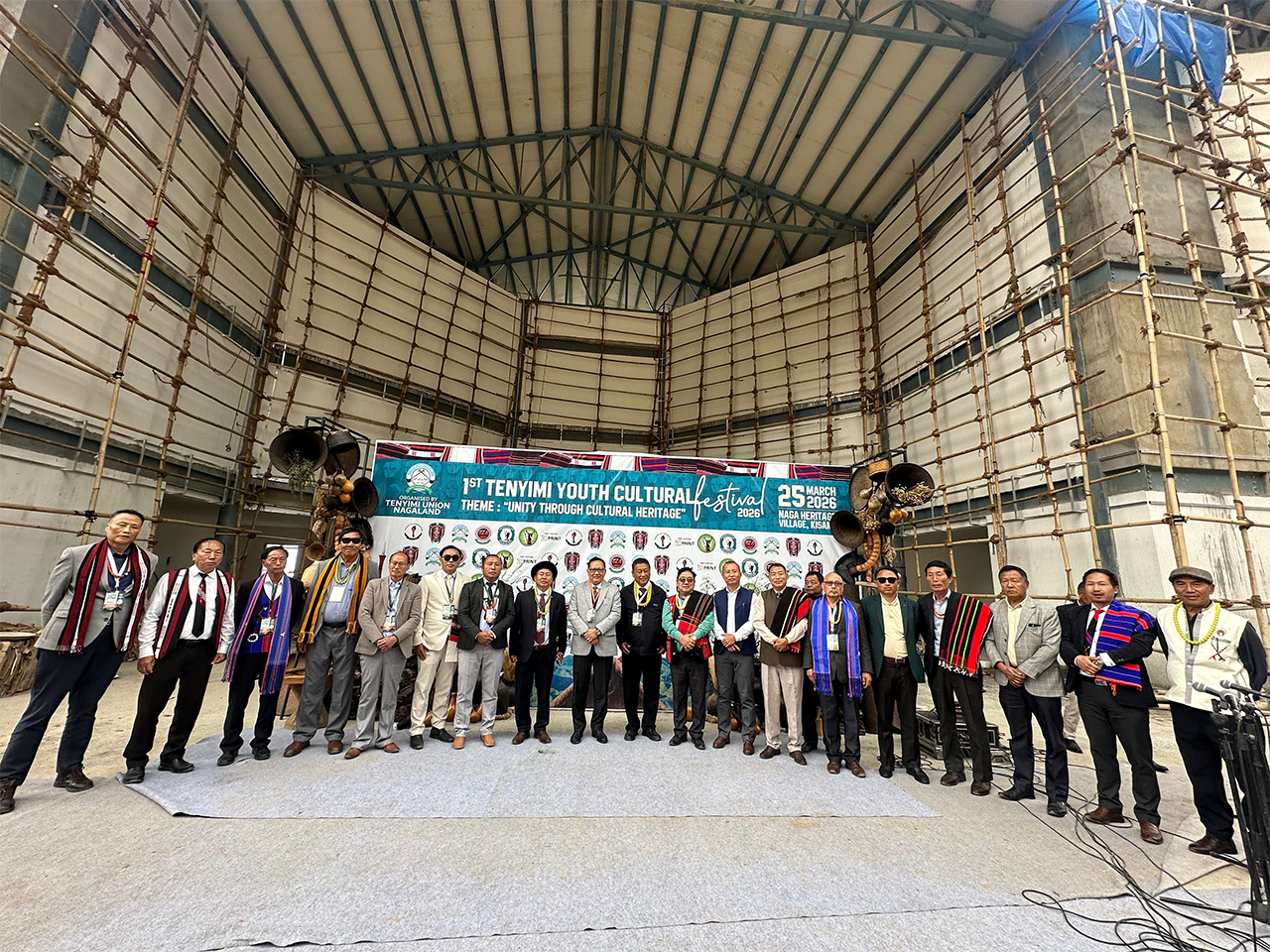
At the same time, he called upon those with a passion for research and history to sincerely explore and document the roots of the Tenyimi people, tracing back to “Tenyiu,” regarded as their ancestral father. He said that if their history can be preserved in written form, the younger generation will be better equipped to carry forward the legacy of their ancestors.
He observed that while oral traditions are valuable, they are at risk of fading away with changing times and lifestyles. Without proper documentation, he cautioned, there may come a day when the very identity of the Tenyimi family could be diminished.
To stress the importance of historical documentation, he cited the example of the Imperial House of Japan, the oldest continuous hereditary monarchy in the world, dating back to 660 BC, with an unbroken lineage of 125 monarchs. He said that if one were to ask many people today which generation of the Tenyimi family they belong to, many might not be able to answer. This, he said, underlines the need for serious research and documentation.
He expressed hope that what earlier generations could not achieve, the present and future generations would be able to accomplish with the help of advanced technology.
Zeliang said it was encouraging to witness such enthusiastic participation and expressed hope that in the years ahead, with more such initiatives, even larger gatherings would follow, enabling the Tenyimi family to grow stronger and more united as one.
He urged the youth of today to strive to bring together every kindred tribe of the Tenyimi community and leave behind a legacy that will be etched in history.
President, TUN Kekhwengulo Lea in his address stated that the Tenyimi people are spread across different parts of the North Eastern region of India.
“Though we live in different states, we are united by our shared cultural heritage that we inherited from our ancestors. The Tenyimi People’s Organisation (TPO) represents all Tenyimi people regardless of geographical boundaries to serve the interests of all our people,” he said.
Lea said that the Tenyimi people residing within the state of Nagaland felt the need for a common platform through which they could address local concerns and grievances confronting the Tenyimi people of the state. He added that this platform was conceived with the objective to foster better understanding among the Tenyimi tribe in Nagaland, to recommit themselves to maintain peace, harmony and mutual respect among all communities and to preserve, promote and undertake research on Tenyimi culture and history.
On behalf of the TUN, he appealed to all Tenyimi citizens to uphold their inherent traditional values of justice, humility, and unity in every field of work and activity.
The inaugural programme was chaired by President, Angami Youth Organisation, Kesosul Christopher LTU.Executive Secretary, Pochury Baptist Church Council, Rev. Rümatho Nyusou blessed the programme with the invocation.
General Secretary, TUN, Dr. Tumda Newme led the acknowledgement. Coloured Keys presented a special number, while the Naga People’s Organisation cultural troupe, Senapati, presented a cultural dance.
President, Rengma Selo Zi, Kegwayhun Tep pronounced the vote of thanks, and President, NCRC Chakhesang Council, Rev. Zaseyi Veswüh, pronounced the benediction.
Cultural presentations were also made by the Angami Youth Organisation cultural troupe, Phusachodu Cultural troupe (CYF), Tesophenyu Cultural Society Kohima (RSZ), Pochury Youth Organisation cultural troupe, and Zeliang cultural troupe.
In the second session Associate Pastor Youth Rengma Baptist Church Kohima Zakevi Kesen and Principal, St. Joseph’s Colege (Autonomous) Jakhama Dr Fr George Keduolhou Dzeyie blessed the program with prayer.