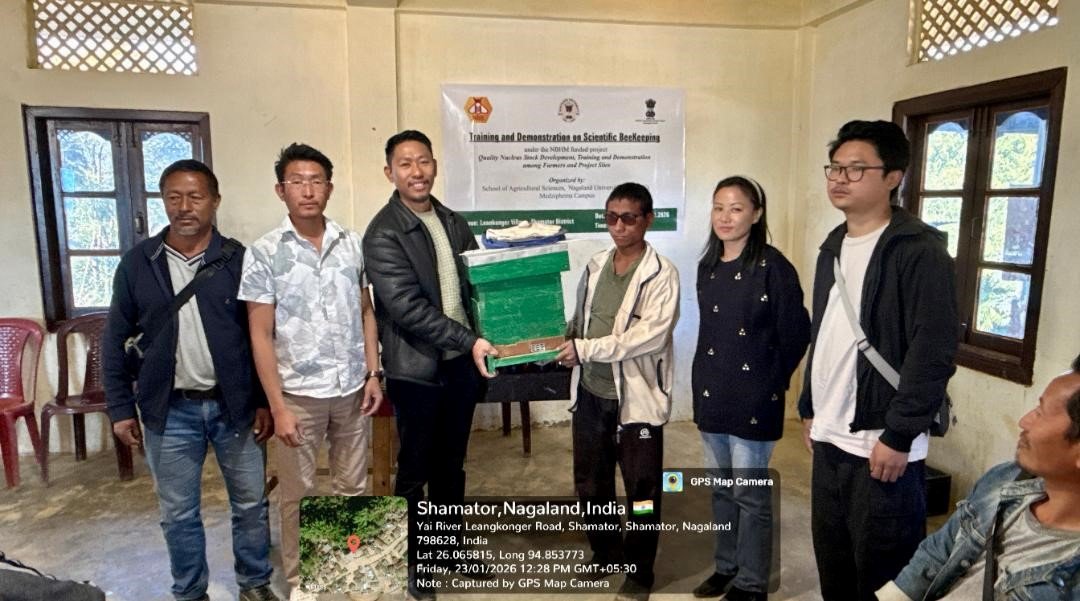
During the scientific beekeeping training programmes conducted under National Bee Board–National Beekeeping and Honey Mission (NBB-NBHM) from 19–27 January 2026, one inspiring story stood out—that of Tsangmong, a 37-year-old visually impaired apiarist from Leankonger Village, Shamator District, now fondly referred to by the technical team as the “Miracle Beekeeper.”
Blind since childhood due to illness, Tsangmong began his beekeeping journey nearly five years ago without formal training, informed a press release by the Nagaland University PRO. Inspired by information shared by fellow villagers, he taught himself apiculture through persistence and experimentation. Using locally available materials, he constructs semi-traditional handmade bee boxes and independently manages his colonies.
His first colony was formed when a natural swarm settled near his home, which he identified through sound and carefully transferred into a box. Despite slow initial progress, his determination yielded results. Today, he maintains four active bee colonies and produces multiple honey harvests annually.
Remarkably, he determines the right harvesting time by lifting the boxes and judging their weight, relying on touch and experience rather than sight. His journey powerfully reflects the inclusive potential of apiculture, demonstrating that scientific beekeeping can empower individuals across abilities and circumstances, while strengthening rural livelihoods.
Bodi Kapfo, SDO (Civil) who joined the team for one of the training days at Leankonger Village in Shamator District handed over a scientific bee box to Tsangmong, the Miracle Apiarist.
Download Nagaland Tribune app on Google Play

It may be noted that intensive training and demonstration programmes on scientific beekeeping were conducted across Eastern Nagaland districts under the National Bee Board-National Beekeeping and Honey Mission (NBB-NBHM) to strengthen farmer capacities, promote scientific apiculture practices, enhance livelihood opportunities and improve productivity in oilseed crops through organised beekeeping.
The programme is funded by the National Bee Board (NBB), Ministry of Agriculture and Farmers Welfare, Government of India, under the scheme National Beekeeping and Honey Mission (NBHM) and is being implemented by the School of Agricultural Sciences, Nagaland University, Medziphema Campus. The project is led by Dr. Mary N. Odyuo, Associate Professor and Principal Investigator (PI) and Dr. Avinash Chauhan, Scientist, AICRP on Honey Bee and Pollinators as Co-Principal Investigator (Co-PI), who are also serving as the Course Directors of the training programme.