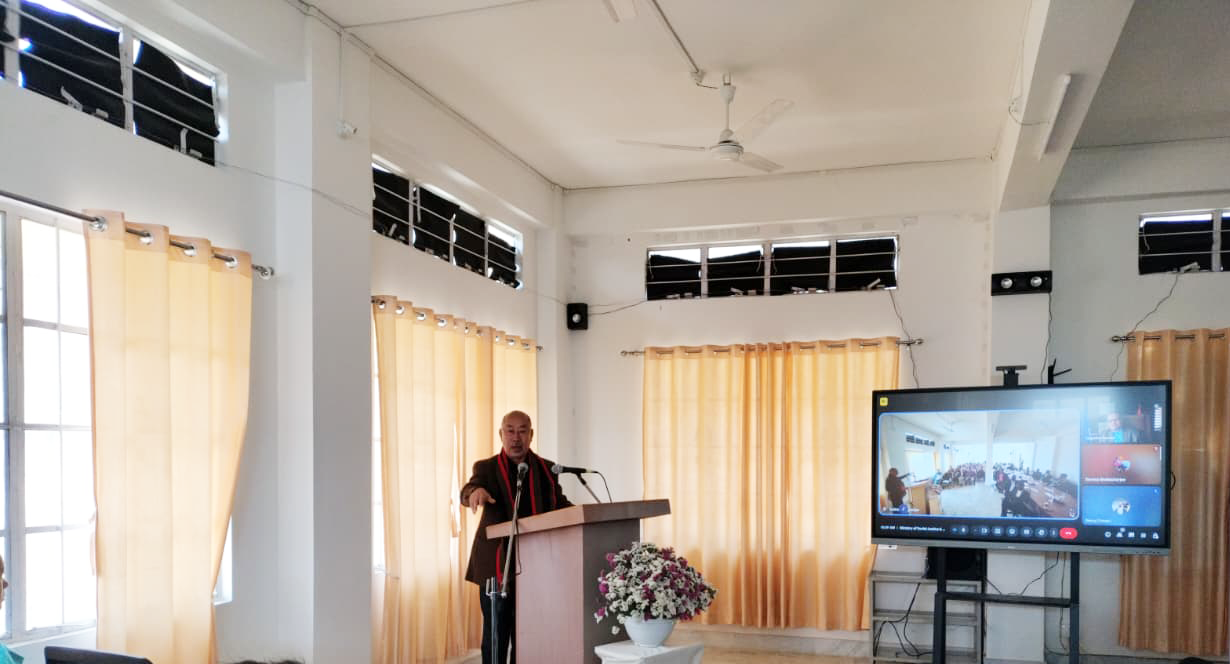
A two-day National Level Training Programme & Workshop on Social Empowerment and Beggary Prevention, being organized jointly by the Department of English and the Department of Teacher Education, was inaugurated on March 25 at the Department of English, Nagaland University, Kohima Campus.
The first day of the training programme and workshop commenced with great academic and social fervour, bringing together participants, stakeholders, research scholars, and faculty members from various departments, creating a vibrant platform for meaningful dialogue and engagement.
The inaugural session was graced by the Vice-Chancellor of Nagaland University Prof JK Patnaik who delivered a thought-provoking address highlighting the significance of indigenous knowledge systems in addressing contemporary social issues. He particularly appreciated the Naga indigenous culture, which inherently discourages beggary through its strong emphasis on dignity, community solidarity, and self-reliance.

He noted that the traditional Naga way of life does not promote dependency but rather fosters mutual care and responsibility, thereby offering a valuable cultural model for the prevention of beggary in modern society. His address underscored that the eradication of beggary must be rooted not only in policy interventions but also in cultural ethics and community values.
Guest of Honour, the Pro Vice-Chancellor of NU, Kohima Campus Prof N Venuh delivered an insightful deliberation focusing on the psychological aspects of beggary. He emphasized that beggary is often a manifestation of deeper psychological distress, social alienation, and emotional deprivation. He called for a more humane and empathetic approach in addressing this issue, urging stakeholders to adopt counselling-based interventions and community-oriented strategies to overcome this persistent social menace.
The academic framework of the programme was clearly articulated by the Convener, Dr Subhashis Banerjee, who presented the concept note. His address comprehensively outlined the socio-economic, cultural, and psychological dimensions of beggary, stressing the need for collaborative efforts among government agencies, educators, social workers, and the community at large. He highlighted that beggary is not merely an economic issue but a complex social phenomenon requiring interdisciplinary solutions.
Download Nagaland Tribune app on Google Play

Prof MAJ Khan, Head, Department of English, spoke on the relevance of the programme in the present socio-economic context. He emphasised the responsibility of academic institutions to engage with pressing social issues and contribute to societal transformation through research, dialogue, and policy-oriented initiatives.
Prof Nigamananda Das, Senior Professor, Department of English, delivered a critical address focusing on various issues related to child abuse and beggary. He highlighted the vulnerabilities faced by children in marginalised communities and stressed the urgent need for legal safeguards, awareness, and collective social responsibility to address these concerns.
The technical sessions of the day were enriched by the contributions of distinguished resource persons. Dr Jasojit Debnath, Associate Professor, delivered an insightful lecture on Microfinance and Beggary Prevention, emphasising the role of financial inclusion, skill development, and sustainable livelihood opportunities in eradicating beggary.
Dr Dhrubajyoti Bordoloi, Assistant Professor, presented on Beggary and Child Exploitation, critically examining the intersection of poverty, child labour, and forced begging, and advocating for stronger policy intervention and community awareness.

An intellectually stimulating segment of the programme was the round table discussion led by Dr Brijesh, Assistant Professor, Department of Hindi, who spoke on the Reflection of Child Abuse in Hindi Literature. His presentation brought a literary and cultural perspective to the discourse, demonstrating how narratives in Hindi literature have historically represented the pain, marginalization, and exploitation of children. He effectively connected literary representation with social reality, emphasizing the role of literature as a medium of awareness, resistance, and ethical reflection.
A significant highlight of the day was the documentary screening conducted by Dr Prasenjit Pal, Assistant Professor, Department of Teacher Education and Joint Convener of the programme. The documentary on child abuse and beggary served as a powerful visual narrative that complemented the academic discussions. Dr Pal also chaired a motion on the theme, facilitating an engaging and critical discussion among participants.
The sessions witnessed active participation from stakeholders, research scholars, and faculty members, who contributed to the discussions through questions, reflections, and debates. The interactive round table discussion further provided a platform for collective review and feedback, fostering a spirit of collaborative learning and shared responsibility.
Overall, the first day of the programme successfully established a strong academic and ethical foundation, integrating cultural values, psychological understanding, socio-economic perspectives, and literary insights to address the issue of beggary. The deliberations emphasized the need for humane, inclusive, and interdisciplinary approaches to combat this social challenge, aligning with the broader objectives of social empowerment and community development.