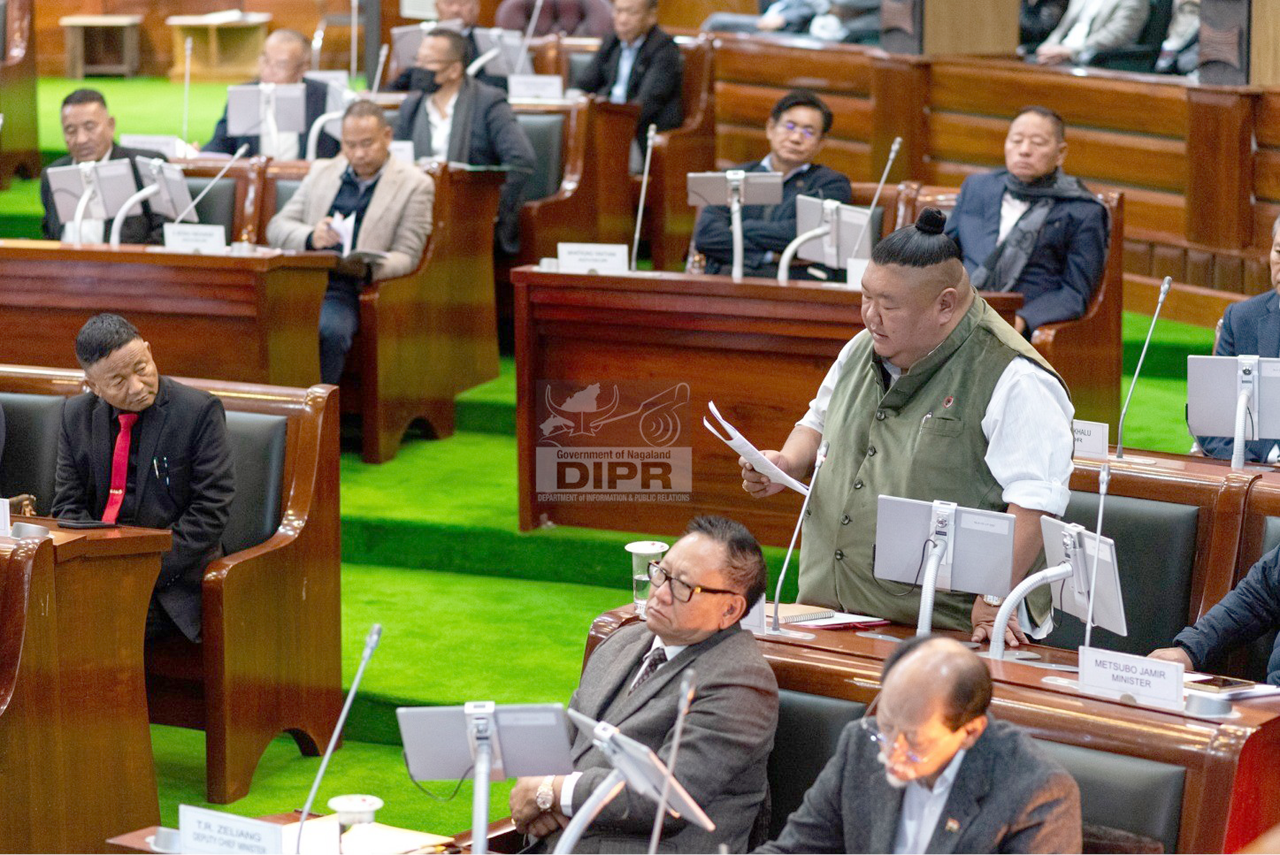
On the second day of the eight session of the 14th Nagaland Legislative Assembly (NLA), during the discussion of motion of thanks to the governors address MLA Temjen Imna Along also commented on the singing of Vande Mataram. He stated that the national song was adopted by the Constituent Assembly in 1950 and was originally written in the 1870s by Bankim Chandra Chatterjee. He remarked that the song emerged during a time when India was engaged in a struggle against the British Empire, and therefore its historical context must be understood.
Along noted that India today has a population of 142 crore, with more than a hundred crore Hindus, and emphasized the need to understand how much of the country symbolically portrays the motherland in different forms according to their belief system — as Durga, representing strength and protection; Saraswati, symbolizing knowledge; and Lakshmi, representing prosperity and wealth. He clarified that he was not attempting to justify any viewpoint but urged that the sentiment of the nation be respected.
Drawing from personal experience, Along, who stated that he is a Christian and studied in Christian schools, said that during prayers such as “Our Father who art in heaven,” he had witnessed people of different faiths, including Hindus and Muslims, respectfully folding their hands and participating in the prayer.
He further stated that secularism is not about superiority but about accepting and respecting each other’s beliefs and thought processes. He asserted that the matter should not be taken personally as an infringement on Article 371(A) or on one’s faith as followers of Christ. Instead, he stressed that it should be regarded as a national song, and whenever it is sung, citizens have a duty to accord it due respect.
Legislators share views and objections on Vande Mataram
Several members of the Nagaland Legislative Assembly shared their views and objections regarding the playing and recitation of Vande Mataram prior to the National Anthem during the opening of the Eighth Session.
MLA Küzholüzo Nienu stated that he had obtained the order issued by the Ministry of Home Affairs relating to the National Song of India and noted that while it directed strict compliance and issuance of suitable instructions to concerned agencies regarding the playing of the National Anthem, the Assembly was not specifically mentioned. He expressed that in his 24 years as a member of the House, this was the first time he had witnessed such a practice.
As a Christian, he said he believes in one God and cannot serve two masters, and therefore registered his strong objection and resentment over what transpired. He maintained that the recitation of the song was unnecessary since the National Anthem was already being sung, and argued that references in the later stanzas to Goddess Durga conflicted with the Christian faith. He further contended that the move could amount to an infringement of Article 371(A), which protects the religious and social practices of the Nagas unless the Assembly resolves otherwise.
MLA Lima Onen Chang also expressed concern over the playing of Vande Mataram before the National Anthem during the Governor’s entry. He said his conscience did not permit him to agree with the practice and emphasized that while he respects all religions, he expects the same respect in return. He termed the move a violation of the democratic rights of one religion.
Similarly, MLA, P Longon described the playing of the song during the Governor’s entry and exit as unusual and surprising. According to his understanding, the so-called National Song is essentially a religious song of the Hindus. Being from a Christian-majority state and himself a Christian, he said he could not willingly sing it and viewed the move as an imposition. He urged the House to invoke Article 371(A), which stipulates that no Act of Parliament shall apply to Naga religious and social practices unless resolved by the NLA, and called upon members to reject the inclusion of the song before the National Anthem in the state.
Nagaland Tribune app on Google Play

MLA Dr. Tsielhoutuo Rhutso raised what he termed a matter of grave concern arising from the Ministry of Home Affairs notification dated January 28, 2026, making the singing or playing of Vande Mataram compulsory. While acknowledging the place the song holds in many parts of the country, he said enforcing it in Nagaland raises constitutional and conscientious concerns, particularly under Articles 25 and 29. He elaborated on the historical background of the song, composed by Bankim Chandra Chatterjee between 1870 and 1875 and later published in the novel Anandamath. He noted that only the first two stanzas were adopted in 1950 alongside the National Anthem Jana Gana Mana, as later stanzas contain explicit references to Hindu deities. He argued that compelling its recitation would infringe upon the freedom of religion guaranteed under Article 25(1) and could override the protections under Article 371(A). He asserted that patriotism should not be measured by a compelled hymn but by loyalty and service to the nation.
MLA Jwenga Seb also registered opposition to the proposal to mandate the full version of the song. While expressing appreciation for the inclusive governance vision of Narendra Modi and the principle of “Sabka Saath, Sabka Vikas,” he said the latter stanzas of the song contain explicit devotional references that pose a conflict of conscience for a Christian-majority state like Nagaland. He maintained that his opposition was rooted not in a lack of patriotism but in safeguarding constitutional rights under Article 25. He suggested that expressions of patriotism in the House should unite rather than divide and even proposed an alternative hymn, “God Bless My Nagaland,” as a possible prelude if permissible.
MLA Achumbemo Kikon strongly disagreed with the playing of Vande Mataram and stated that remarks made earlier by Temjen Imna Along were an attempt to change the narrative, which he would not accept. He emphasized that members have always respected the National Anthem and stood in reverence whenever it was played. Describing the song as historically controversial and not adopted unanimously, he said its sudden imposition warranted strong resentment. Citing India’s unity in diversity, including its accommodation of various religions, he urged the House to pass a befitting order stating that the Assembly and the people of Nagaland are not in a position to accept such imposition and would continue to oppose it.