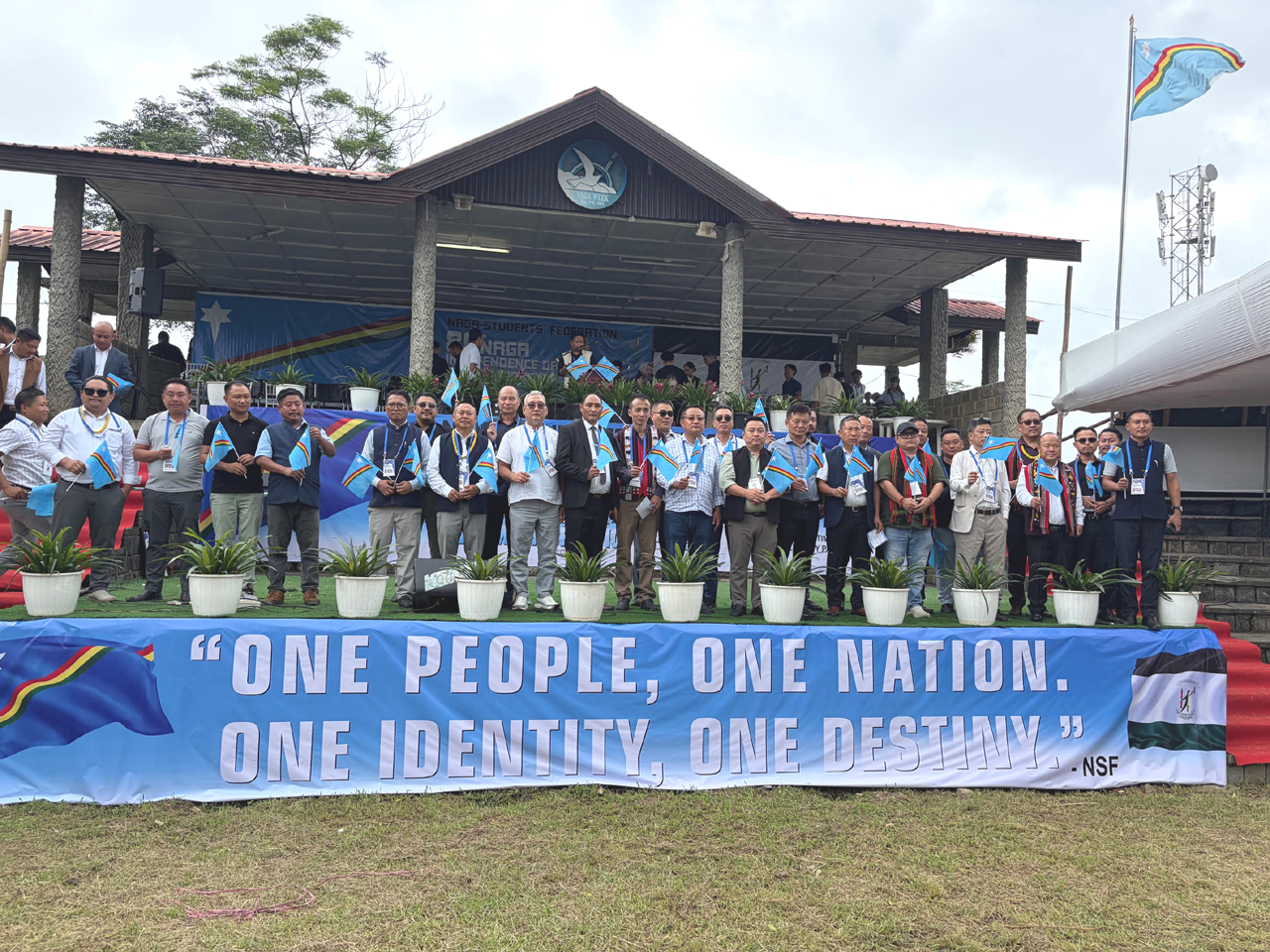
The 80th Naga Independence Commemoration was observed at Naga Solidarity Park, Kohima, on August 14, with speakers reflecting on the historical significance of the Naga Independence declaration and calling for renewed unity, self-reliance and reconciliation among the Naga people.
Guest speaker, Advocate Tongpok Pongener recalled that 80 years ago, Naga forefathers declared August 14 as Naga Independence Day after years of consultation, communication and mobilisation across villages.
He said the declaration was not a sudden or hasty decision, but the outcome of a long process in which Naga leaders travelled extensively from one part of the region to another to communicate and build consensus among the people.
Pongener said the vision of the forefathers was not to wage war against neighbouring communities, but to live as a nation among the community of nations and maintain peaceful relations with neighbours.
Pongener also stressed the need to acknowledge not only achievements but also the darker chapters of Naga history.
He said internal conflict, killings and divisions had caused the unity of the people to splinter, adding that the continuing fragmentation within Naga society and civil organisations raises serious questions about the future.
Pongener called for a deliberate effort to rebuild the trust that existed among the Naga people during the early stages of the movement.
He urged students and young people to begin building bridges at their own level and cultivate a sense of brotherhood and belonging irrespective of the groups or organisations they belong to.
The Advocate also raised the question of whether the Nagas are truly free today, asking whether external influences and various obligations have compromised their freedom.
“Unless we ourselves are free, the actual freedom becomes a difficult destination to achieve,” he said, urging people to examine their own independence, work ethic and ability to stand on their own.
Reflecting on the Christian foundation of Naga society, he further questioned whether the people had genuinely followed the principles associated with the slogan “Nagaland for Christ.” He said slogans alone were insufficient and urged Nagas to live by the values they profess.
He posed a final question on whether it would be better for the Naga people to turn back to God and seek guidance from Jesus Christ, emphasising that prayer should not remain merely a ceremonial practice but should become a genuine part of life.
Addressing the commemoration, Mteisuding, President of the NSF recalled the formation of the NSF, stating that visionary Naga leaders came together in 1946 and formally established the federation on October 29, 1947, with the objective of addressing not only student and youth concerns but also safeguarding the rights and aspirations of the Naga people.
Mteisuding stressed that the NSF has never restricted itself to student issues, saying the organisation has consistently raised matters concerning the general public, youth and the broader Naga community.
The president said the significance of Naga Independence Day goes beyond an annual gathering and represents an important moment to remember the history and sacrifices behind the Naga political movement.
Download Nagaland Tribune app on Google Play


Recalling the July 19, 1947 meeting between the Naga delegation led by A.Z. Phizo and Mahatma Gandhi, he referred to Gandhi’s reported assurance that Nagas should not be forced into the Indian Union if they did not wish to be part of it.
Mteisuding urged the Government of India to honour its commitments towards a political solution, taking into account the unique history and circumstances of the Nagas. He called for the finalisation of an honourable settlement based on coexistence, urging all stakeholders to set aside differences, ego and enmity.
The NSF president also highlighted the federation’s commitment to strengthening Naga unity and collective identity across international and state boundaries. He urged the younger generation to work towards rebuilding unity among Nagas.
At the same time, he appealed to Naga political groups not to recruit non-Nagas into the Naga political movement, describing it as a clear message from the NSF on the 80th Naga Independence Day.
Mteisuding concluded by calling on the Naga people to come together beyond mere understanding and work collectively towards a unified Naga dream, peace and the future of the Naga people.
Eastern Naga Students’ Federation (ENSF) President Nuheymong Yimchunger said the Nagas possess a unique heritage, customs and cultural identity, which have endured despite historical challenges and attempts to overpower the Naga people.
He said that although Nagas are presently divided across different administrative territories, their common aspiration has never died down.
Referring to the Church’s earlier commitment to sending 10,000 missionaries, he said Nagas have instead witnessed the mushrooming of thousands of organisations and urged the people to reconsider such divisions.
“Let us do away with it, so that we get to see a better Nagalim,” he said, calling for collective efforts to strengthen Naga unity and work towards a better future.
The programme was compered image0.jpegimage1.jpegby Kevizeno Kiso, while C. Jungithung Yanthan, Tribunal NSF, served as the Chairperson.
The commemoration formally began with the hoisting of the Naga National Flag, followed by the declaration of the 80th Naga Independence Day Commemoration.
The program began with an invocation by Vezokho Vero, Pastor, Naga Shisha Hoho Prayer Centre.
Students of Living Tree School, Kohima, presented God Bless Nagaland, followed by Healing of Our Spirit by Immanuel Baptist Khriesarüü Krotho.
A poem titled Rise Nagas was presented by Jochebed Belho, while Khekavi Sumi, Pastor, Sumi Baptist Church, Daklane, Kohima, led the Prayer for the Naga Nation.