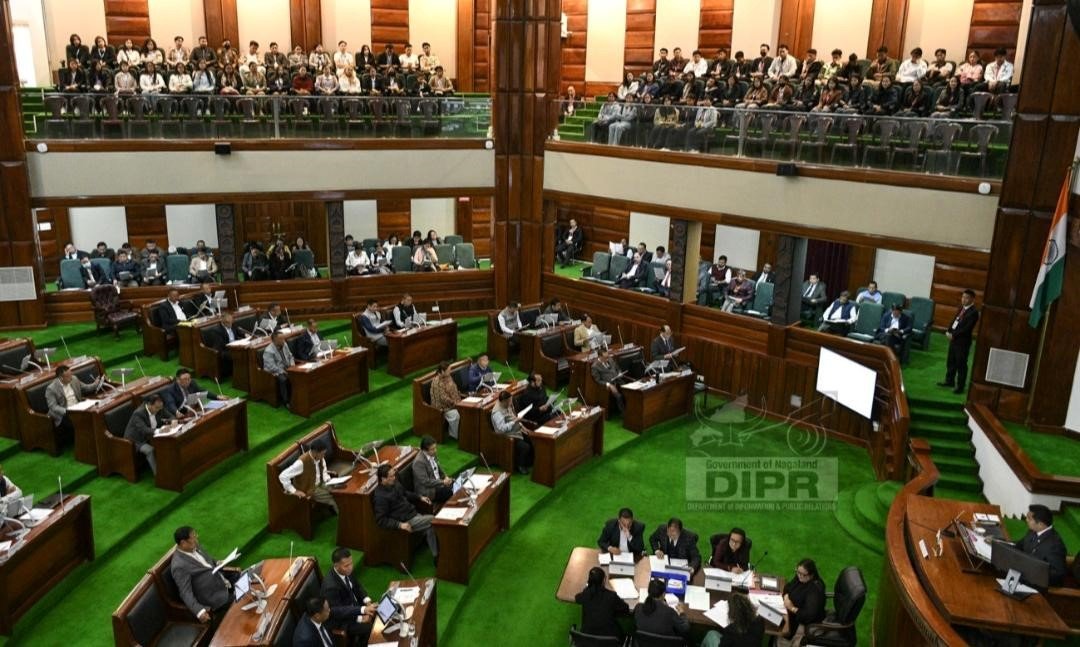
MLA Achumbemo Kikon raised serious concerns over Nagaland’s financial position, arguing that historical disadvantages and inadequate recommendations by successive Finance Commissions have left the state lagging behind the rest of the country.
Speaking during the discussion on the Budget for the year 2026–27, Kikon referred to Paragraph 7 of the speech by Chief Minister Neiphiu Rio and highlighted the financial commitments outlined in the 16-Point Agreement, which led to the creation of Nagaland.
He pointed specifically to Clause 11 of the agreement, which mandates financial assistance from the Government of India, including grants from the Consolidated Fund of India and support to meet administrative costs. “This was not a favour, but a commitment made when the state was formed through a political agreement,” Kikon asserted.
Explaining the role of the Finance Commission of India, he noted that it is a constitutional authority whose recommendations significantly influence central and state finances. However, he argued that Nagaland missed out on the benefits of the first four Finance Commissions due to historical circumstances, including the delayed formation of the state in 1963.
Kikon pointed out that even the Fourth Finance Commission of India, which included Nagaland after statehood, failed to provide meaningful financial support. It was only during the Fifth Finance Commission that Nagaland, along with Assam and Jammu & Kashmir, received “special category status,” allowing for preferential central assistance.
He described the Ninth Finance Commission of India as a turning point, but in a negative sense. Its recommendations, he said, discontinued the earlier practice of covering excess state expenditure from the Consolidated Fund of India, pushing Nagaland into a fiscal crisis.

“Because we missed the first four Finance Commissions, we are effectively 20 years behind other states,” Kikon said, stressing that this historical gap continues to affect the state’s development trajectory.
Kikon expressed disappointment with the projections under the Sixteenth Finance Commission of India. He noted that Nagaland is expected to receive ₹7,341 crore as its share of central taxes, which is significantly lower than the ₹8,684 crore he believes the state rightfully deserves.
“This is a shortfall of ₹1,343 crore. It is unfair and must be addressed,” he urged.
Kikon urged the Government of India and the Finance Commission to take into account Nagaland’s unique historical and political context while making financial allocations. He emphasized that the state was created through a political agreement and therefore deserves special consideration in fiscal matters.
Concluding his remarks, Kikon said that without correcting these structural imbalances, it would be unrealistic to expect Nagaland to match the pace of development seen in other states.
He also welcomed the increase in the Local Area Development Programme (LADP) funds but proposed that the scheme be named in honour of former Chief Minister Vamuzo Phesao, in recognition of his contributions.
Raising concerns on border areas, Kikon called for enhanced budgetary allocation under the Border Affairs sector. Representing a constituency along the Assam border, he noted that his region spans over 105 km and requires urgent developmental attention, especially in comparison to infrastructure progress on the Assam side. He urged the government to increase the allocation to at least ₹50–60 crore to address these challenges effectively.
Advisor, Fisheries and Aquatic Resources, A Pangjung Jamir stated that the innovative Budget presented by Chief Minister Dr. Neiphiu Rio is not merely a budget statement, but a true roadmap for a developed Nagaland, aligned with the national vision of Viksit Bharat 2047 and grounded in practical and judicious planning.
Referring to the Nagaland Strategic Water Resilience Initiative, with an allocation of Rs. 724 crore, he said the initiative to enhance water security through the creation of water bodies, strategic storage facilities, rainwater harvesting, and urban groundwater recharge in all district headquarters will greatly benefit the people. He also welcomed the allocation of Rs. 76.22 crore for improved water supply to Kohima, Mokokchung and Wokha, along with departmental infrastructure in selected districts, online water billing, and rooftop rainwater harvesting at major centres.
The Advisor acknowledged the launch of the Chief Minister’s Community Solar Partnership Initiative under the Nagaland Solar Mission, with an allocation of Rs. 11 crore, stating that it would help reduce power imports, ensure reliable electricity, and generate revenue at the community level.
Drawing attention to the Fisheries sector, Jamir said that fisheries has steadily gained momentum among educated unemployed youth and has transformed from a traditional livelihood activity into a scientifically fast-growing sector within agriculture. He stressed that investment in the fisheries sector needs to be enhanced and revitalised on a larger scale, especially in local and cluster-based fish pond development.
He stated that the fisheries sector has played a meaningful role in generating rural employment and supporting millions of small-scale fishers and farmers. Sustainable development of the sector, he added, contributes to food security, nutrition, livelihood, and inclusive growth in rural areas.
Highlighting the untapped potential, Jami said that Nagaland has a vast potential area of 30,000 hectares for fisheries development, of which only 15.31 per cent, or 4,595 hectares, has been utilised so far. With greater public participation and concerted effort, he said the unutilised area could be brought under scientific management and infrastructure development to strengthen inland fisheries.
Download Nagaland Tribune app on Google Play

He further said that the next mission of the fisheries sector is to enhance fish production. At present, fish production in the State stands at 11,692.88 metric tonnes, whereas, based on the WHO recommendation of 11 kg per person, the total requirement comes to around 22,000 metric tonnes. As a result, a large quantity of fish continues to be imported from outside the State. He stressed that as demand continues to rise, production must also increase in a sustainable manner through responsible management of ponds, reservoirs, rivers, and hill streams.
In order to increase fish and fish product output, greater emphasis must be placed on technology-driven activities to reinforce Nagaland’s vision of a vibrant and resilient fisheries sector, stressed Jamir.
While appreciating the Budget allocation for the construction of new office buildings and renovation/upgradation of existing district headquarters, sub-divisions, and new district headquarters, Jamir requested for sanctioning a new Administrative Office Building at Tuli, stating that the existing infrastructure is in deplorable condition. He said the present condition makes it difficult to host officers from outside the State and different jurisdictions, especially as Tuli is located along the Assam border and serves as a major business corridor after Dimapur.
Participating in the discussion, Neisatuo Mero described the budget as pragmatic, responsible, and people-oriented that reflects the aspirations of the people of Nagaland.
With a total expenditure of Rs. 22,127.33 crore and a reduction in the fiscal deficit by Rs. 74.77 crore, Mero noted that despite financial challenges, the State is witnessing steady, sustainable, and visible development. “The Budget is not merely about figures and statistics, but represents better livelihoods, rising income, and growing confidence among the people,” said Mero.

He expressed hope that the developmental expenditure of Rs. 6,171.08 crore would bring villages closer to better economic opportunities, students to quality education, and citizens to innovative possibilities, while ensuring efficient and responsive governance that reaches the most marginalised sections of society.
Mero welcomed the introduction of three key women-centric initiatives: establishment of crèches in all major Government establishments across the State, Innovation Seed Fund of Rs. 2 crore targeting 1,000 women entrepreneurs statewide and the introduction of 50 Pink Scooty Taxis.
He said these initiatives represent a significant paradigm shift—from a “women’s development” approach to “women-led development”, where women are not merely beneficiaries but innovators and investors in their own right.
With the rural population of Nagaland heavily dependent on agriculture and allied activities, Mero maintained that the investments made in the sector should serve as an assurance to farmers and as a commitment to food security.
While appreciating the efforts of both the State and Central Governments for the two-lane National Highway-29 from Kohima to Jessami, he pointed out that the road is a lifeline not only for several districts of Nagaland but also for neighbouring Manipur. However, he drew attention to Package-II between Kohima and Pfutsero, where he said the work has been progressing at a very slow pace, even though other packages were completed years ago.
He recalled the hardships faced by commuters during the last monsoon, when multiple landslides left vehicles stranded for several days, severely affecting daily life and the movement of thousands of people. In this regard, he requested the concerned department, through the Speaker, to ensure the completion of Package-II before the onset of the monsoon.