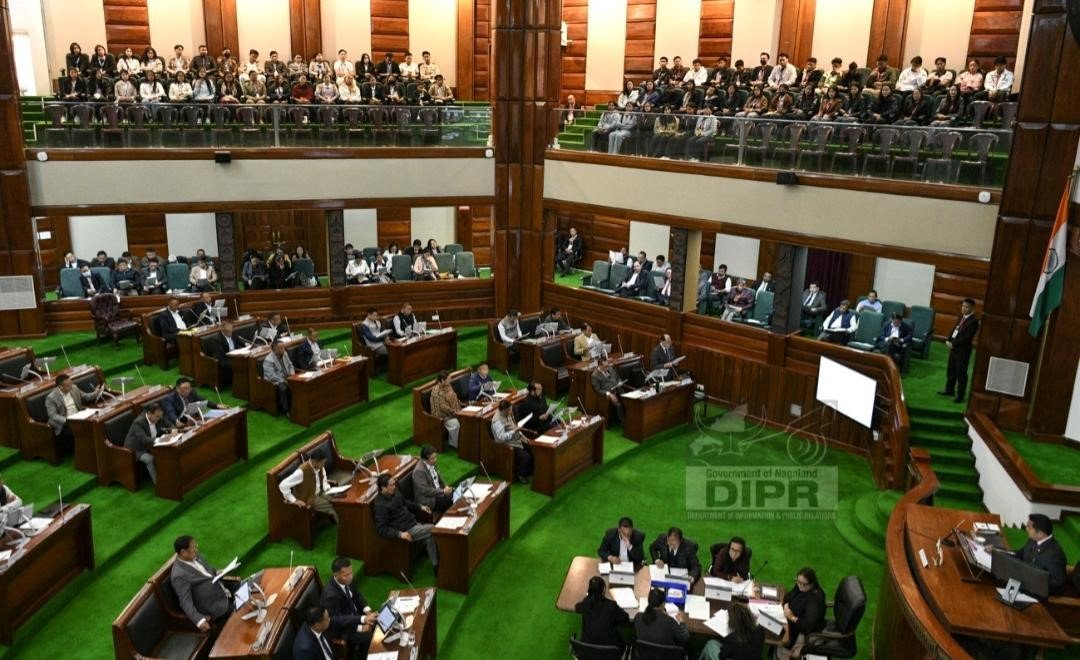
Advisor for Food and Civil Supplies and Legal Metrology, K.T. Sukhalu, while participating in the Budget discussion, commended the Chief Minister for presenting a projected roadmap and strategic approach for the development of Nagaland despite the adverse fiscal impact resulting from the discontinuation of the post-devolution revenue deficit grants to the State.
Given the Chief Minister’s diplomatic skill and the confidence reposed in him by the central leadership, Sukhalu exuded confidence that the discussions held with the Union Finance Minister will yield productive outcomes.
Referring to the observations made by successive Central Finance Commissions regarding the State’s high revenue expenditure, particularly on salaries, Sukhalu said this could partly be attributed to past appointments made without following due procedure or sanctioned posts. “If such practices are still being followed by any officers or officials, stern action must be taken against those responsible,” suggested the Advisor.
He further stated that as a welfare State, Nagaland cannot sustainably deliver essential services if there is continued non-payment of service charges such as power and water bills, which impose an unsustainable fiscal burden on the Government. In this regard, he suggested that the concerned departments undertake awareness campaigns with the support of civil society organisations, tribal hohos, student bodies, and churches, not merely for the Government’s benefit, but for the welfare of society as a whole.
On the issue of revenue generation, the Advisor stated that Nagaland has significant potential in oil exploration. He, therefore, urged that action be initiated without further delay. He also suggested that the State seriously consider the lifting of prohibition, keeping in mind the larger public interest.
Turning to the issue of drug abuse, he said the State must take serious note of the growing threat. He referred to the fact that Myanmar, which shares an extensive eastern border with Nagaland, is now one of the largest producers of illicit opium in the world, making Nagaland particularly vulnerable to both opiate and synthetic drugs.
While acknowledging the commendable efforts of the Police in apprehending drug peddlers and curbing illicit liquor outlets, he cautioned that unless policy-level decisions are taken, such efforts would remain insufficient. He described drugs as insidious, noting that by the time a drug user is visibly identifiable, it is often already too late. He said that even one life lost to drugs is one too many, and stressed that policymakers must address the issue directly and proactively.
Download Nagaland Tribune app on Google Play

Asserting that the Nagaland Liquor Total Prohibition (NLTP) Act, 1989, has clearly failed in the State, Sukhalu affirmed that it is time for a frank and open discussion on the need to review it. He pointed out that although the prohibition was imposed in response to the social problems caused by alcohol abuse, liquor remains freely and easily available in the State despite the efforts of the Police and Excise Department.
He added that much of the liquor available is adulterated and dangerous, and that many families have suffered both emotionally and financially as a result of alcoholism. In this context, he referred to a newspaper article published by Catholic Association of Nagaland expressing serious concern over rising liquor-related violence, while disagreeing with the Church’s position on the NLTP Act.
The Advisor noted that the issue should not be viewed only in terms of revenue, but also from the perspective of public welfare, regulation, and harm reduction. “In its present form, the NLTP Act and its rules not only restrict citizens’ freedom of choice, but also prevent the Government from regulating the sale of spurious and adulterated alcohol, which has caused immense suffering,” stated Sukhalu.

In conclusion, he said that it is the Government’s responsibility to reduce dependence on borrowing and narrow the fiscal deficit by exploring all possible avenues, including early oil exploration and a serious review of the prohibition policy. With proper regulation, Sukhalu expressed, the State must make use of every available means to become more financially self-sustainable and independent, in the best interest of the people.