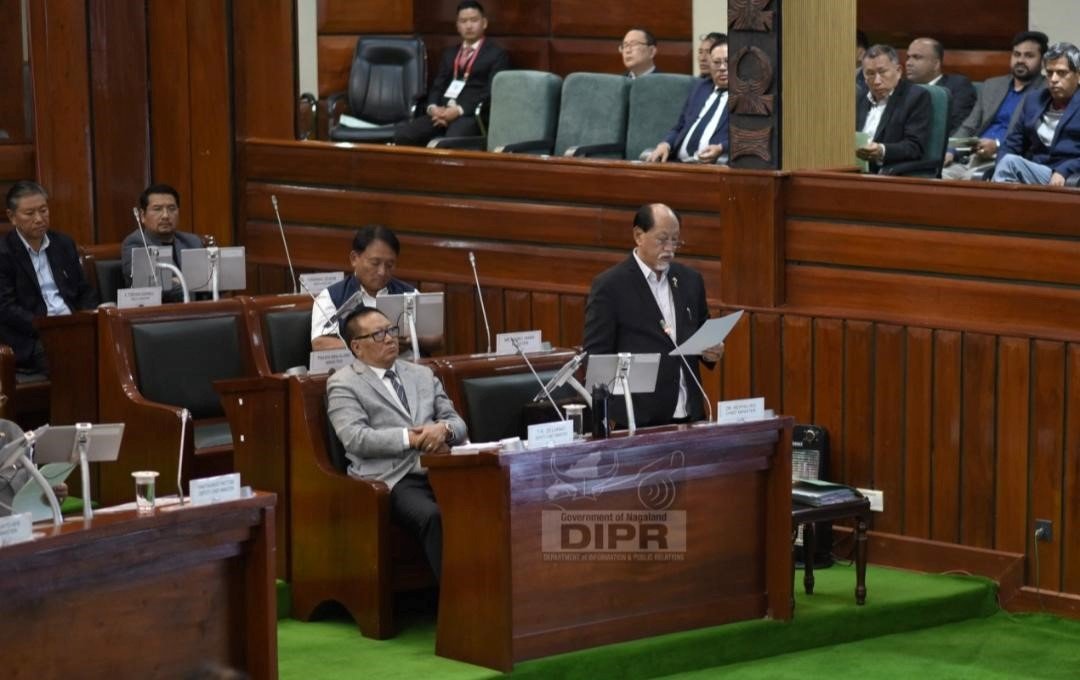
Chief Minister Neiphiu Rio on Friday concluded the discussion on the State Budget 2026–27 with a wide-ranging response that combined fiscal realities, infrastructure concerns and long-term policy direction, while assuring that inputs from legislators would inform governance decisions.
Delivering his concluding remarks in the Assembly, Rio placed on record his appreciation for members who participated in the debate, including Hekani Jakhalu Kense, A. Pangjung Jamir, Kekhrielhoulie Yhome, Neisatuo Mero, Tongpang Ozukum, K.T. Sukhalu and Achumbemo Kikon. He said the deliberations reflected seriousness of purpose and a shared intent to advance the State’s development agenda. He also acknowledged members who refrained from speaking due to time constraints but followed the proceedings.
While it was not feasible to address each issue individually, Rio said, the concerns raised would be taken into account in shaping policies and improving delivery mechanisms. He emphasised that cooperative engagement within the House strengthened democratic functioning and ensured that governance remained inclusive and responsive.
On gender-focused provisions in the Budget, Rio noted that the emphasis on women-centric schemes had drawn positive response, and reiterated that the effectiveness of such initiatives would depend on ensuring accountability and tangible outcomes in expenditure.
Taking up infrastructure concerns, he said the demand for upgrading administrative facilities, including in Tuli, highlighted a larger systemic issue. A significant portion of government infrastructure, both residential and institutional, dated back to the early years of statehood and had now deteriorated considerably. With more than half of residential buildings and a substantial share of non-residential structures over three decades old, he said the State faced a mounting challenge of maintenance and replacement, which required external financial support.
Placing the discussion in historical context, Rio referred to the 16-Point Agreement, stating that Nagaland’s creation carried an understanding of sustained central assistance to address its unique circumstances. He observed that despite limited fulfilment of these assurances, the State had undertaken measured fiscal corrections, focusing on improving internal revenue, controlling committed expenditure and maintaining deficit levels within manageable limits.

On the stalled progress of NH-29 Package-II, particularly the Kohima–Pfutsero stretch, Rio said implementation challenges persisted due to contractor performance issues under the National Highways and Infrastructure Development Corporation Limited. He stated that despite earlier setbacks and slow execution by a new contractor appointed in 2024, recent monitoring had led to incremental progress, with physical work crossing 40 per cent.
Addressing the Trans-Nagaland Highway (Foothill Road), he pointed out that although the State had already invested ₹245.50 crore, the scale of the project required substantial central intervention. He said the proposal for inclusion under national highway funding by the Ministry of Road Transport and Highways depended on meeting conditions such as provision of a 30-metre right of way. While environmental clearance had been secured, land-related issues remained under discussion with stakeholders.
On administrative reforms, Rio responded to concerns about irregular appointments by stating that systemic changes over the past decade had improved transparency in recruitment. The introduction of digital personnel records and financial systems, coupled with restrictions on non-regular appointments and the establishment of a formal recruitment board, had resulted in a gradual reduction in government workforce size and better control over salary expenditure, he said.
Turning to social concerns, Rio acknowledged the growing problem of substance abuse and said enforcement efforts had led to a significant number of cases and arrests under the NDPS Act in 2025. However, he stressed that the issue required a broader response beyond policing, and highlighted the newly introduced Nagaland Community Wellbeing Initiative aimed at addressing mental health and behavioural challenges among youth.
On the Nagaland Liquor Total Prohibition Act, 1989, he said the government was aware of diverging public opinion. While the law had been rooted in strong social backing, changing circumstances had brought new challenges, including enforcement gaps and illicit trade. He said the matter was under careful and consultative examination.
Reviewing the status of petroleum exploration, Rio recounted that operations by Oil and Natural Gas Corporation had been halted in the 1990s and efforts to revive the sector had since faced legal and policy hurdles. He said discussions with the Centre were ongoing, with the State pressing for terms that would ensure better revenue sharing, smaller exploration blocks and local value addition through downstream industries.
Rio also outlined upcoming institutional measures, including the creation of a Revenue and Development Fund Mobilisation Cell to explore alternative financing strategies. He said a high-level committee under his chairmanship would also examine expenditure patterns and revenue enhancement options, incorporating suggestions made during the Budget debate.
Download Nagaland Tribune app on Google Play

On urban governance, Rio noted that improving the efficiency of urban local bodies had become critical, particularly in the context of performance-linked grants recommended by the 16th Finance Commission. He said the State was extending both financial support and capacity-building initiatives to strengthen these institutions.
Clarifying the reduction in allocation for border area development, he said the Budget had adopted a more balanced distribution approach across sectors, even as earlier provisions had specifically targeted inter-state border infrastructure.

Positioning the Budget within a long-term framework, Rio said it was aligned with the goal of achieving a “Developed Nagaland” by 2047, in sync with the national vision. He underlined that the State was operating within tight fiscal space, particularly in the absence of revenue deficit grants, and had therefore prioritised essential services while continuing to invest in growth-oriented sectors.
He said the government’s focus would remain on strengthening human resources, expanding livelihood opportunities, improving infrastructure and enhancing financial inclusion, with targeted attention to youth, women and grassroots institutions. He added that the integration of SDG-linked and gender-responsive approaches signalled a shift towards outcome-driven governance.
Concluding, Rio said the Budget reflected an effort to move towards a more disciplined and transparent fiscal framework, anchored in efficiency and accountability, while reaffirming the government’s commitment to equitable development across all districts.