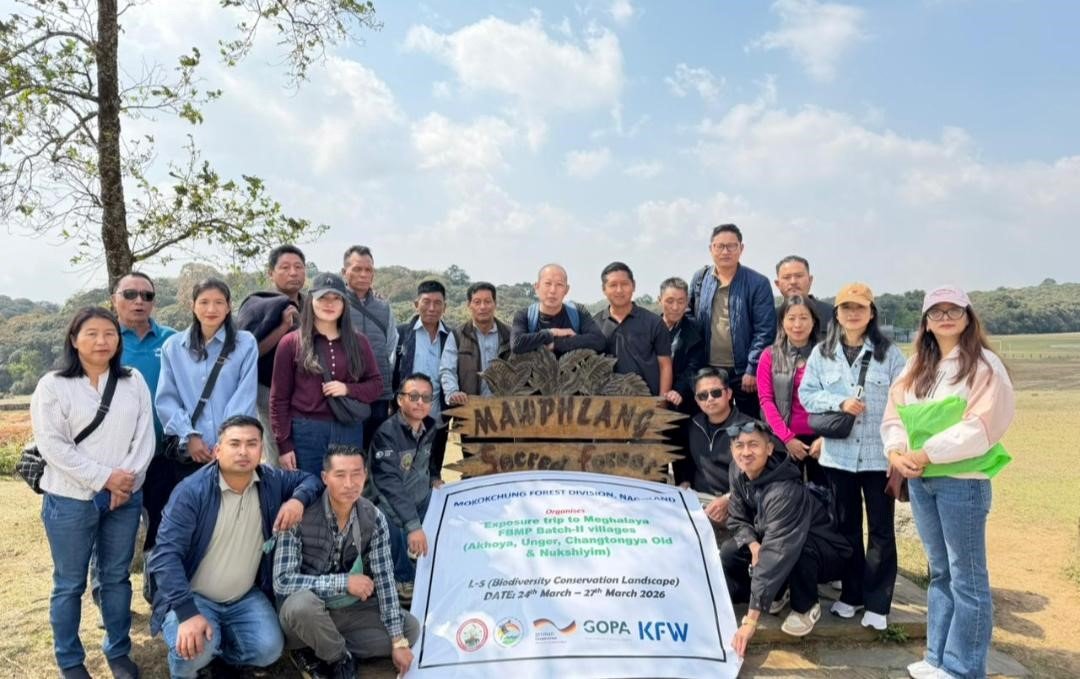
The Mokokchung Forest Division organized an exposure visit to Meghalaya under the Forest and Biodiversity Management in the Himalaya, Nagaland Project (FBMP) from March 24 to 27.
According to a press release, the project is co-financed by the Federal Republic of Germany through KfW (German Development Bank) and focuses on strengthening biodiversity conservation and improving community livelihoods through sustainable forest management.
A total of 23 participants from Azunglu CCA Batch-2 villages—Unger, Akhoya, Changtongya Old, and Nukshiyim—took part in the exposure programme. Each village was represented by members from Community Conserved Areas (CCAs), Village Councils, and Self-Help Groups (SHGs). The team was led by Shri Imcha John, Deputy Ranger, along with five supporting staff members from the division.
The exposure visit aimed to enhance awareness on biodiversity conservation, promote sustainable natural resource management practices, and encourage community-led eco-tourism and livelihood initiatives through experiential learning.

On March 25, participants visited the Meghalaya Biological Park, where they observed captive wildlife species and gained insights into ex-situ conservation practices and wildlife management systems. On March 26, the team visited the Mawphlang Sacred Forest, an internationally recognized example of community-protected forests, followed by visits to Nohkalikai Falls, Garden of Caves, and Mawsmai Cave, where participants observed nature-based tourism models integrated with conservation.
Download Nagaland Tribune app on Google Play

On March 27, the participants visited Laitlum Canyons and the North East Cane and Bamboo Development Council (NECBDC). At NECBDC, participants were introduced to bamboo-based value-added products, enterprise development models, and livelihood opportunities linked to sustainable bamboo resource utilization.
Participants expressed that the exposure visit significantly improved their understanding of community-based conservation and sustainable tourism practices. They appreciated the proactive role of local communities in Meghalaya in maintaining ecological integrity while promoting responsible tourism.
The programme concluded with participants expressing their commitment to replicate the best practices and conservation approaches in their respective villages under the FBMP initiative.