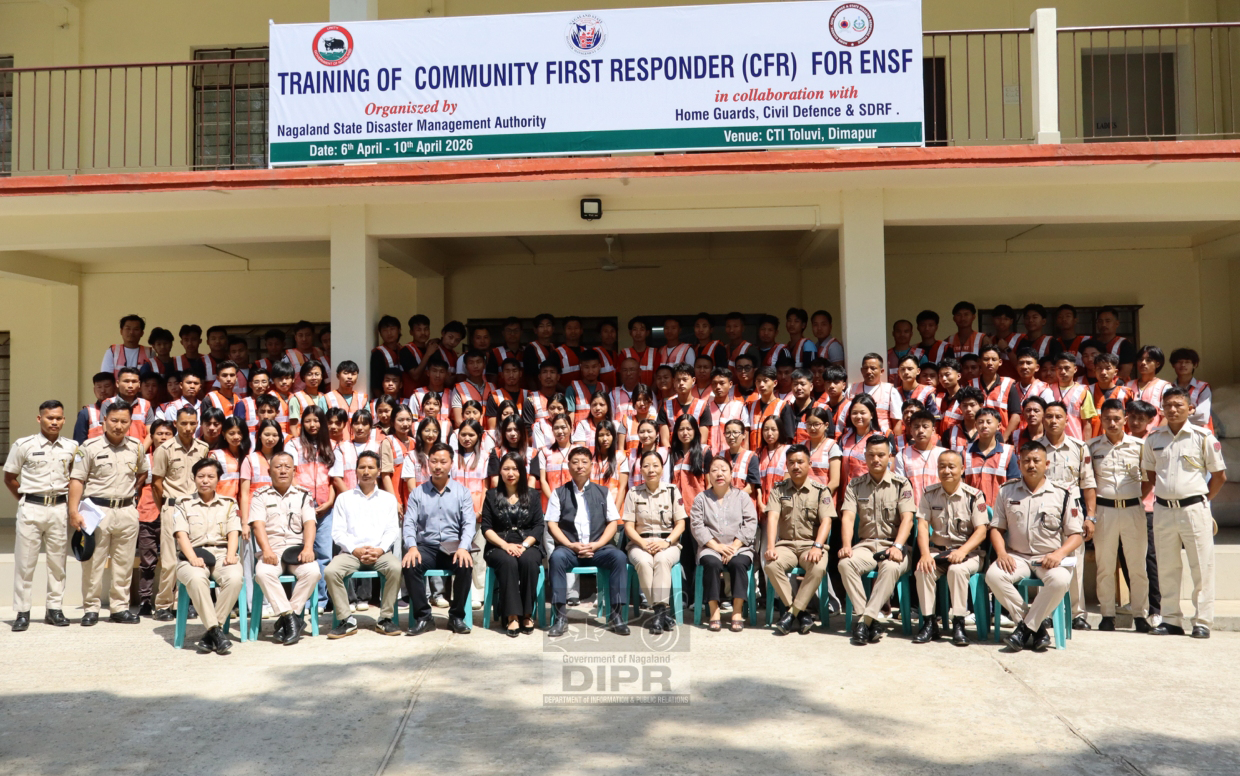
The Community First Responders Training programme for members of the Eastern Nagaland Students’ Federation (ENSF) was held at the Central Training Institute (CTI), Home Guards, Civil Defence & SDRF, Toluvi, Dimapur on April 6.
The five-day training programme is being attended by a total of 104 trainees, including 81 male and 23 female participants.
The inaugural programme was chaired by District Commandant, Dimapur, M Yingnyei Konyak. In his address, he emphasized the importance of community-based preparedness and highlighted the crucial role of trained first responders in mitigating emergencies and disasters at the grassroots level. He urged the participants to take the training seriously and prepare themselves to serve effectively, stating that courage, determination, and commitment are key to becoming efficient responders.
Delivering the welcome address, Commandant, CTI, HG, CD & SDRF, Avinuo, underscored the objective of the training programme, stating that it aims to equip participants with essential skills and knowledge to effectively respond during emergencies and support disaster management efforts at the grassroots level. She warmly welcomed all the trainees and emphasized that disaster management is not merely a duty but a service to humanity and the community.
She highlighted that the Central Training Institute is the only dedicated training institute under the Department of Home Guards & Civil Defence focusing on disaster response and preparedness, and has been actively conducting training programmes for individuals, organizations, and communities across the state. She further informed that, in collaboration with the State Disaster Management Authority, the institute has successfully trained around 1,000 community first responders under the Aapda Mitra Scheme, along with nearly 700 volunteers from organizations such as NSS, NYKS, and Bharat Scouts and Guides.
Outlining the training modules, Avinuo stated that participants would undergo intensive hands-on sessions in first aid, road rescue, water rescue, firefighting, search and rescue, and overall disaster preparedness. She stressed that the focus of the programme would be on practical learning to ensure that trainees are confident and capable of responding effectively in real-life emergency situations.
She also encouraged the trainees to remain disciplined, attentive, and proactive throughout the five-day training, and to make full use of the experience and expertise of the instructors. She expressed confidence that empowering youth and student bodies with such life-saving skills would go a long way in strengthening community resilience and preparedness.
Download Nagaland Tribune app on Google Play

She concluded by urging the participants to carry forward the knowledge and skills gained during the training to their respective communities, and wished them a meaningful, enriching, and successful training experience.
Secretary, NSDMA, Sentiwapang Aier, in his address described the training as a significant and timely initiative aimed at empowering the youth of Eastern Nagaland with essential disaster management skills. He noted that disasters often occur without warning and tend to have a more severe impact in remote and far-flung areas where access to immediate emergency services is limited.
He emphasized that in such situations, community members—especially the youth—serve as the first line of response. With proper training, awareness, and preparedness, they can act swiftly to save lives, reduce risks, and minimize damage before professional responders arrive. He stated that the objective of the programme is not only to impart practical skills but also to instill a sense of responsibility, leadership, and readiness among participants.

Aier lauded the Eastern Nagaland Students’ Federation (ENSF) for its proactive initiative, particularly the formation of its Human Resource Committee, which reflects a strong commitment towards the welfare and development of youth. He remarked that such initiatives play a crucial role in building a more prepared and resilient society.
He further expressed appreciation to the Home Guards & Civil Defence and the Central Training Institute for their continued support and expertise in organizing such training programmes, stating that their contribution is vital in developing capable and confident community responders.
Highlighting the vision of the Nagaland State Disaster Management Authority, he said that strengthening disaster preparedness at the grassroots level is key to reducing vulnerability and enhancing resilience across the state. He added that this training programme is a step towards creating a network of skilled individuals who can effectively respond during emergencies and support their communities when it matters the most.
He encouraged all participants to actively engage in the sessions, learn with sincerity, and carry forward the knowledge and skills gained for the benefit of their communities, thereby contributing to a safer and more disaster-resilient Nagaland.
Pusho P, Vice President, ENSF, also spoke briefly and expressed gratitude to the organisers and trainers for providing such an opportunity to the youth.
The programme began with an introduction of trainees and concluded with closing remarks by the chairperson.