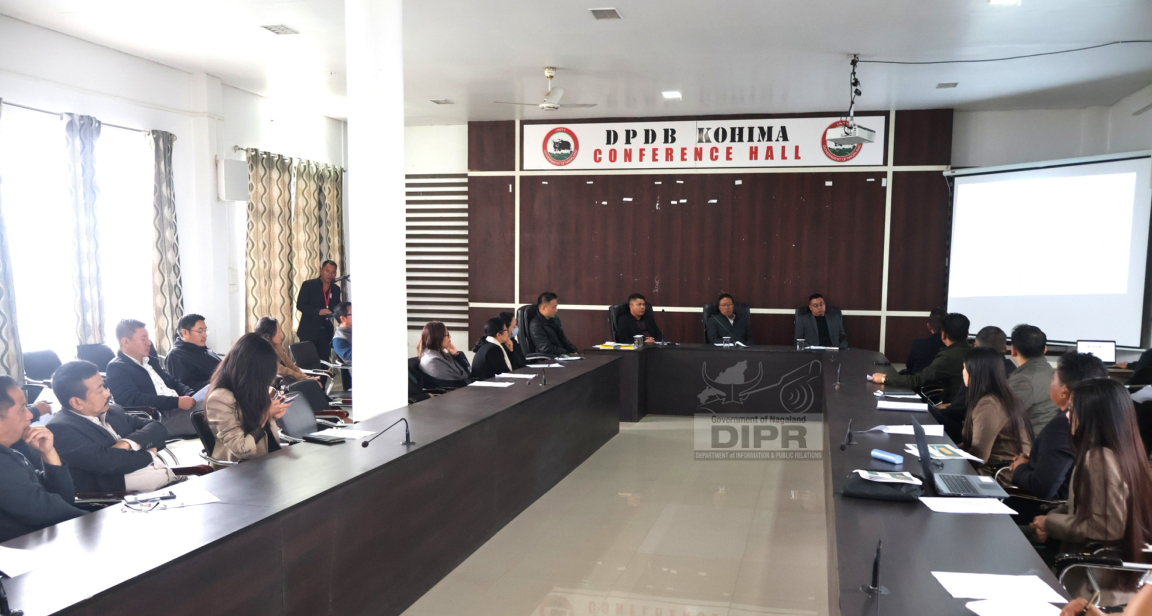
The Kohima District Planning & Development Board (DPDB) meeting was held at the DPDB Hall, Kohima, with Deputy Commissioner & Vice-Chairman DPDB Kohima, B Henok Buchem, NCS chairing the programme in the presence of Chairman DPDB and MLA, Kevipodi Sophie on April 29.
A significant concern regarding the non-recognition of traditional Naga naming conventions in national digital systems was highlighted during the meeting.
Presenting the issue, District Agriculture Officer, Kohima, Kekhrieletuo Yhome, drew attention to the challenges faced by Naga communities due to the rejection of certain characters particularly the commonly used ‘ü’ and ‘-o’ components in names on national portals such as the Single Nodal Agency (SNA) system. He explained that names among Naga communities are not merely identifiers but carry deep cultural, emotional, and spiritual significance.
“Names are given by parents and elders with meaning, affection, and a sense of identity. Altering them strips away their essence,” he stated. Yhome pointed out that when such characters are not accepted by digital systems, individuals are compelled to modify their names to comply with technical requirements. While temporary manual corrections are currently possible, he cautioned that increasing automation in the future may eliminate such flexibility, potentially excluding many individuals from accessing services.
He further noted that altering names can lead to unintended consequences, including distortion of gender identity. In some cases, female names may change into male equivalents when specific characters are removed or replaced, leading to confusion in official records.
Highlighting broader implications, Yhome said the issue affects multiple Naga communities, with many individuals already forced to alter their names in official documents, often resulting in a loss of original meaning and cultural relevance.
Download Nagaland Tribune app on Google Play


Key concerns raised included emotional distress due to loss of identity, administrative complications arising from mismatched documents, and legal challenges in areas such as banking, property ownership, and travel. He warned that inconsistencies in documentation could also create difficulties during verification processes, including passport applications and international travel.
He stressed that the problem could have long-term consequences, particularly for younger generations, if not addressed at the policy level, and urged authorities to accommodate indigenous naming systems in national databases.
Meanwhile, President of the Voluntary Blood Donors Association of Nagaland (VBDAN), Burakum, outlined ongoing efforts to promote voluntary blood donation in the state. He informed that VBDAN, established in 2011, has organized over 80 voluntary blood donation camps in collaboration with various organizations and institutions.
Burakum noted that Nagaland requires around 20,000 units of blood annually, with Kohima district alone needing over 3,600 units. He emphasized the need for stronger district administrative support, inter-departmental coordination, and financial assistance to expand donation drives. He also highlighted a mobile application developed to connect donors and recipients, aimed at improving emergency response.
Following deliberations, the DPDB decided to organize a blood donation camp on May 13, 2026. All DPDB members, along with at least five additional participants each, have been requested to come forward and donate. Further details will be finalized in due course.
EAC Dr. Riku announced that the Census of India 2027 will be conducted in a fully digital mode, with self-enumeration scheduled from June 15 to 30, followed by house-to-house surveys from July 1 to 30. He highlighted the roles of charge officers, enumerators, and supervisors, noting that areas will be divided into blocks of 700–800 households. Training and awareness initiatives will be undertaken to ensure smooth implementation.
He urged public cooperation, emphasizing that the census is crucial for effective planning and development.
The Food & Civil Supplies Department also presented an overview of its functioning and the implementation of the National Food Security Act (NFSA). DCSO Kohima, Metsisieto Zhasa stated that the primary objective is to ensure food security through the Public Distribution System (PDS) by providing subsidized food grains to eligible beneficiaries.
Under NFSA, Priority Household (PHH) and Antyodaya Anna Yojana (AAY) cardholders receive allocated food grains, currently provided free of cost by the Government of India. Distribution has been streamlined through digitization, with ePOS devices and Aadhaar-based authentication ensuring transparency.
In Kohima district, food grains are supplied through designated depots and distributed via fair price shops, covering over 90,000 beneficiaries. Zhasa also highlighted the ongoing e-KYC drive to verify beneficiaries and ensure that only eligible households receive benefits.