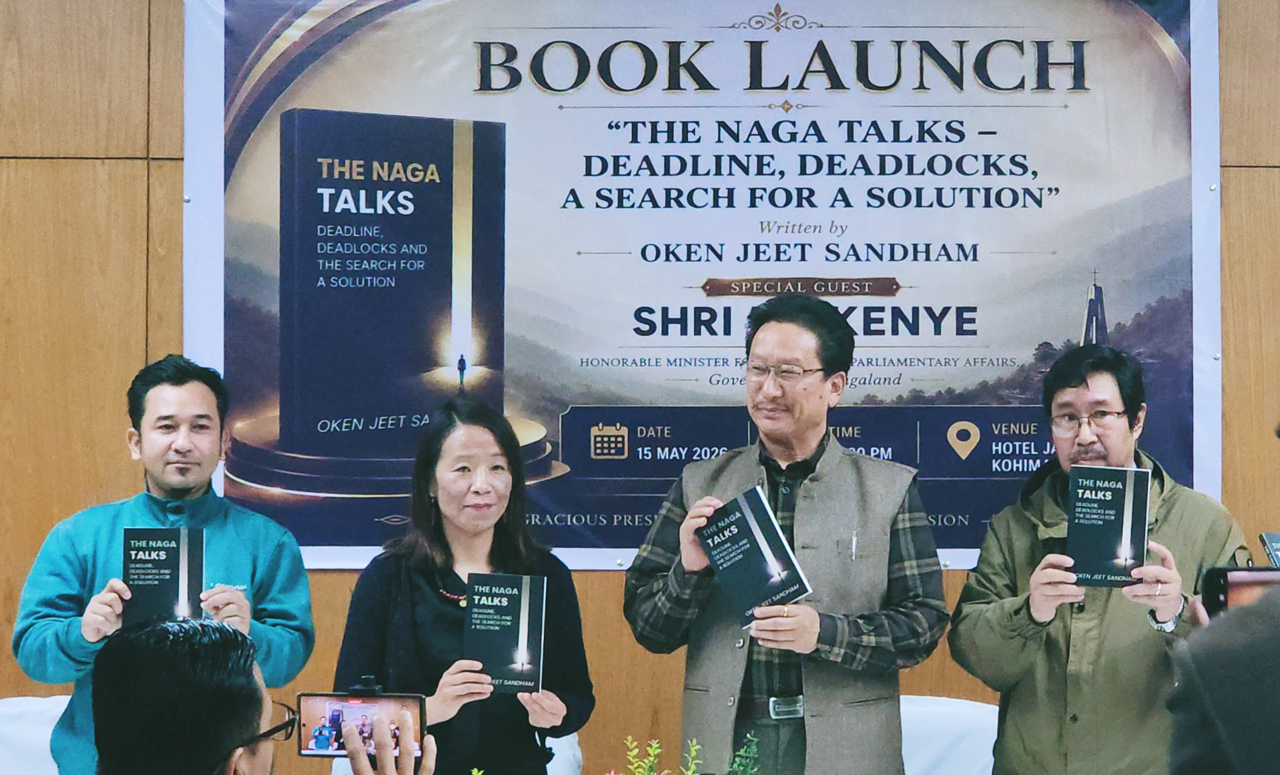
Veteran journalist Oken Jeet Sandham’s sixth book, The Naga Talks: Deadline, Deadlocks and the Search for a Solution, was officially launched by Minister for Power and Parliamentary Affairs, KG Kenye in the state capital on Friday.
The book examines the history and trajectory of political negotiations on the Naga issue, including the 2015 Framework Agreement and the October 31, 2019 deadline set for concluding the Indo-Naga political talks.
Speaking at the launch, author Sandham said the work documents “expectations, missed opportunities, political complexities, and the continuing search for a solution that is honourable, inclusive, and lasting.”
Sandham said his interest in the subject began after Prime Minister Narendra Modi’s meeting with members of the Parliamentary Working Committee of the Nagaland Legislators’ Forum in New Delhi on July 16, 2015.
Recalling Modi’s remarks, he said, “If peace comes, it must come in toto. Every single Naga person is important in bringing the solution.”
Such words, he said, made him think seriously about the approach the Government of India was preparing toward resolving the Naga issue.
He said the signing of the Framework Agreement between the Government of India and the NSCN (IM) on August 3, 2015 raised several questions on what was contained in the agreement, why the details were not made public, and what direction the peace process was taking.
Sandham noted that the talks were “officially concluded” on October 31, 2019, but the outcome remains undisclosed. “Years have passed. Political circumstances have changed. Governments have changed. Yet, the final settlement continues to remain unresolved,” he said.
“Today, the Naga peace process appears to stand at a difficult and uncertain stage. Yet the larger question remains — whether the journey still has the strength, wisdom, and political will to move forward toward a meaningful destination,” he added.
Launching the book, KG Kenye said it provides “an insight into the recent and not so recent dialogues, the political negotiations that have taken place.”
Referring to his personal ties with the author, Kenye said, “Oken Jeet, to me, is my brother-in-law. He married my cousin sister… He has merged into the Naga society, which has given him some sort of emotional attachment in the issues that confront us.”
The minister traced the Naga political movement to the Memorandum submitted to the Simon Commission in 1929. “We have travelled a journey of 97 years, in search of a very, very elusive aspiration, which seems inconclusive, unending, unceasing,” he said.
“Above all, the political issue has been most contentious, for which we are still struggling to arrive at a destination. In 100 years time, what awaits us is anybody’s guess. But the way things are developing around us, there is much hope,” Kenye said.
He underlined the importance of documentation. “We have missed precious anecdotes, events of the past also which, if they were recorded as it is being done today by our learned literary community, especially those in journalism… many of the confusions our society has today would not have happened,” he said.
Download Nagaland Tribune app on Google Play


Kenye said the book provided “an insight into the recent and not so recent dialogues, the political negotiations that have taken place,” showing the author’s deep understanding of the issue.
Kohima Press Club president and poet, Vishü Rita Krocha said the book comes with “a sense of high anticipation.” She said the author’s name is “synonymous with a deep, persistent, and analytical gaze into the heart of our political journey.”
“Oken Jeet is not merely an observer; he has been a chronicler of our times. His writing has consistently provided a window into the complexities of the Naga political issue,” Krocha said.
She termed the book’s title ‘a powerful summary of collective history’, saying it reflects the urgency and imposed timelines that have characterized peace talks, and captures ‘the moments of frustration, the stalemates, and the ideological barriers that have defined our journey’.
“‘The Search for a Solution’ is the heartbeat of the book, reminding us that despite the obstacles, the pursuit of a lasting and honorable peace remains the ultimate goal,” she said.
“In an era of rapid information and often ‘surface-level’ reporting, a comprehensive book like this is essential. It serves both as a record and a guide offering insights that might help policymakers, scholars, and the youth to better understand the weight of the ‘Naga solution’,” Krocha added.
Chairing the programme, Menuse-O Max Marius said in his welcome address that Sandham “began his stellar journalism career right here in Kohima with the Weekly Journal in 1987.” His sharp reportage, he said, led him to work with The Statesman and serve as a stringer for the Hindustan Times.
Marius added that Sandham formerly edited The Northeast Herald and continues to shape public discourse as the Editor of the North East Press Service (NEPS), an independent online news agency based in Kohima.
He said Sandham has written extensively on politics, governance, insurgency and culture, and has authored Narendra Modi and the Naga Peace Accord and Modi Walking on Elusive Naga Peace, among others.
Earlier, Arjun Chetri, deacon of Nepali Baptist Church, Kohima, invoked God’s blessings. Veteran journalist and advisor of Kohima Press Club, Kopelo Krome, proposed the vote of thanks.
MLA Neisatuo Mero, members of the literary and media fraternity, and well-wishers, friends and family members of Sandham attended the event.
Priced at Rs 500, the book is available at Students’ Book Centre, PR Hill, Kohima.