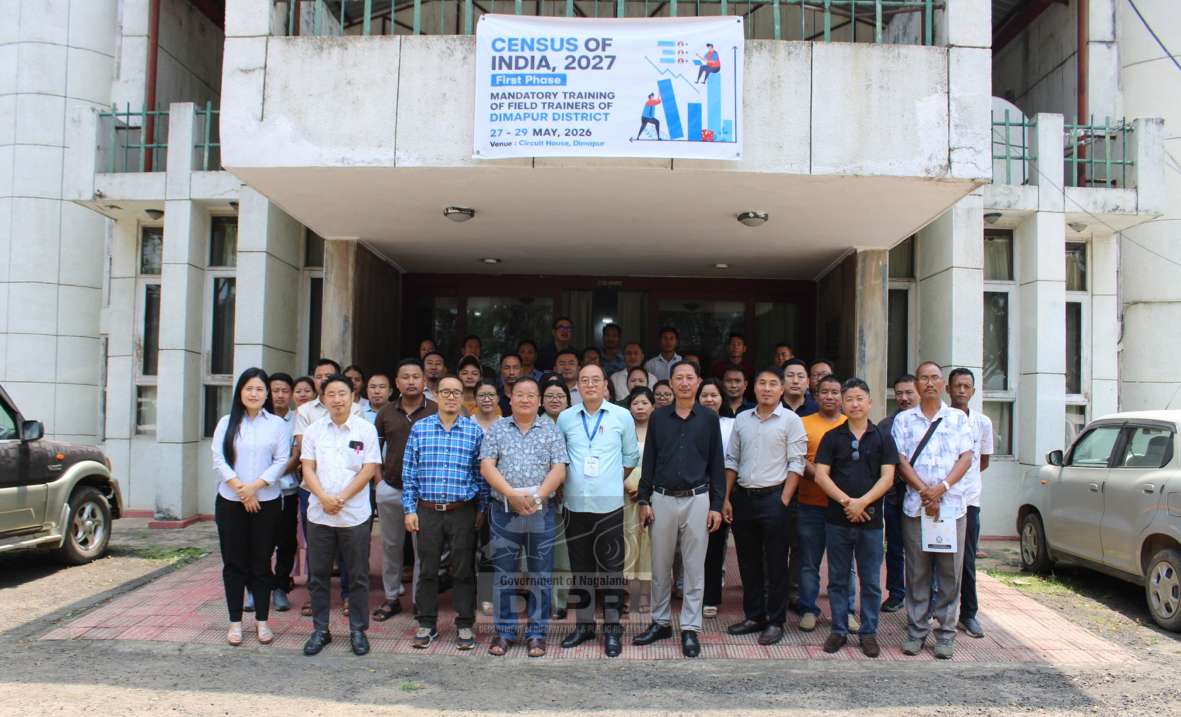
In preparation for the First Phase of the Census of India 2027, the Office of the Deputy Commissioner and Principal Census Officer, Dimapur, commenced a three-day Field Trainers Training programme for officials from Dimapur, Niuland, Chümoukedima, Peren and Mon districts at Circuit House, Dimapur, on May 27.
The training programme, which will continue till May 29, is being organised in pursuance of directives issued by the Directorate of Census Operations, Nagaland. The initiative aims to equip Field Trainers with the legal understanding, technical expertise, operational knowledge and practical exposure necessary for the smooth and effective conduct of the upcoming Census exercise.
Addressing the inaugural session, Deputy Commissioner & Principal Census Officer, Dimapur, Dr Tinojongshi Chang, NCS, emphasised the importance of preparedness, coordination and accuracy in carrying out Census-related responsibilities. He stated that the Census exercise remains one of the largest administrative undertakings in the country and urged officials to discharge their responsibilities with dedication, sincerity and professionalism.
Highlighting the significance of the Census, Dr. Chang informed that census operations in India have been conducted under the Census Rules, 1990, and involve the comprehensive process of planning, collecting, processing, analysing and disseminating demographic, economic and social data at the smallest geographical level. He noted that population census operations have been conducted every ten years since 1872, with the last census completed in 2011.
He further stated that Census 2027 would mark a major transition with the adoption of digital tools and modern technology for data collection and monitoring. He pointed that, the upcoming Census will be conducted through digital platforms and mobile applications supported by real-time monitoring systems. Several new features, including digital house-listing, digital data collection and the use of Artificial Intelligence for enumeration and monitoring processes, are also being introduced.
Dr Chang informed that the first phase of the Census, namely the House Listing of Housing Census, is scheduled to be conducted from July 1 to July 30, 2026, while the self-enumeration facility will remain available from June 15 to June 30, 2026. The Population Enumeration phase is scheduled for February 2027.
Download Nagaland Tribune app on Google Play


He also highlighted that preparation of House Listing Blocks (HLBs) and layout maps forms an important component of Phase-I activities. The layout maps prepared by enumerators will include houses, roads, streets, lanes and other important landmarks within the designated enumeration areas.
Stressing on the importance of accurate and complete data collection, he stated that successful implementation of Census 2027 would depend on coordinated field-level planning and proper execution of enumeration activities.
During the first day of the training, sessions focused on the legal aspects of Census 2027, including Census concepts, definitions and operational procedures to be followed during the enumeration process. Officials were also trained on methods of engagement with Enumerators and Supervisors, verification and ground-truthing of House Listing Block boundaries, preparation of layout maps, and installation and overview of the HLO Mobile Application.
The second day of the programme would begin with a recap and quiz session, followed by intensive modules on HLO questions and techniques for explaining Census concepts and definitions to Enumerators and Supervisors. Practical demonstrations will include methods of filling responses through the HLO App, procedures for data verification by Supervisors, and the respective roles of Enumerators and Supervisors during self-enumeration exercises.
Sessions on data security, confidentiality and proper usage of the mobile application will also form a key component of the training programme, in line with the increasing emphasis on digital data collection for Census 2027.
On the final day, trainees would receive orientation on the Census Act and Rules, including approaches for interacting with households, handling refusals and sensitive situations, and maintaining proper questioning techniques and courtesy protocols during enumeration activities.
Participants would also engage in role-play exercises and field visits involving sample layout map preparation and simulated data collection exercises in nearby habitation areas to strengthen practical understanding and field readiness.
The training programme forms part of the larger nationwide preparations for Census of India 2027, with particular emphasis being laid on digital enumeration, standardised procedures, field preparedness and effective public interaction throughout the Census process.
Officials attending the programme from the five districts will subsequently serve as Field Trainers for Census operations in their respective jurisdictions.