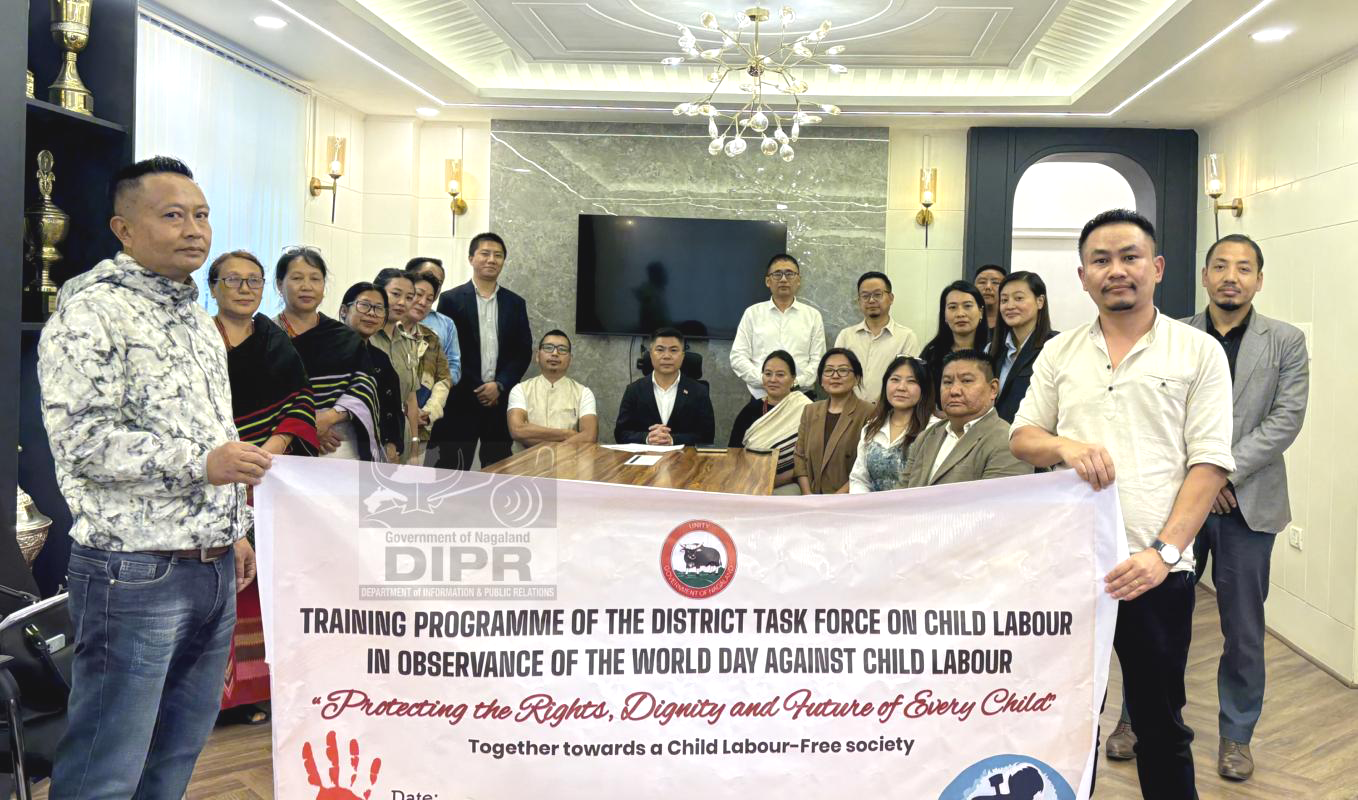
An orientation programme on the Standard Operating Procedure (SOP) for the rescue, rehabilitation and post-rescue management of child labourers under the provisions of the Child and Adolescent Labour (Prohibition and Regulation) Act, 1986 was held at the Deputy Commissioner’s Chamber, Kohima, on June 23 with members of the District Task Force (DTF) on Child Labour.
Addressing the programme, Deputy Commissioner and Chairman of the District Task Force, Kohima, B Henok Buchem, NCS emphasised that issues concerning children require the collective responsibility of all stakeholders. He said every department and organisation represented in the task force has a crucial role to play in ensuring the protection and welfare of children.
Stating that members should be well informed about their respective responsibilities under the law, he stressed the need for regular coordination and quarterly meetings to formulate action plans and strengthen implementation mechanisms.
The Deputy Commissioner also highlighted the importance of public awareness on child protection laws and child labour issues. He called for intensified Information, Education and Communication (IEC) campaigns and urged all stakeholders, including public organisations and community leaders, to actively participate in creating awareness and educating the public on the rights of children and the legal consequences of child labour.
Assistant Labour Commissioner, Neimenuo, presented the Standard Operating Procedure and explained that it was developed to ensure a coordinated and child-centric approach among all departments involved in the rescue and rehabilitation of child labourers. She said the SOP aligns with the provisions of the Juvenile Justice (Care and Protection of Children) Act, 2015 and outlines the responsibilities of various departments and agencies at every stage of intervention.
Explaining the rescue process, she stated that the first step involves receiving information and rescuing a child in need of care and protection. Information may be received directly from the child, relatives, members of the public, government agencies, surveys, non-governmental organisations or other credible sources.
Rescue operations may be carried out by authorised personnel, including police officers, labour inspectors, Child Welfare Police Officers, Childline personnel, Child Welfare Officers, social workers and other competent authorities recognised under the law.
The rescued child must then be produced before the Child Welfare Committee (CWC), which assesses the child’s situation and determines appropriate care, protection and rehabilitation measures. Registration of a First Information Report (FIR) is initiated wherever offences are identified under relevant laws.
Download Nagaland Tribune app on Google Play


She further informed that rescued children may be placed in temporary shelters or child care institutions to ensure their immediate safety and well-being. The Labour Department subsequently initiates proceedings against employers and ensures compliance with legal provisions. Measures are also taken to secure payment of pending wages and compensation to the child, while prosecution and adjudication are pursued against offenders to ensure accountability and justice.
Neimenuo stressed that members of the District Task Force should not only be familiar with the SOP but also ensure that every child found engaged in labour is rescued, protected, rehabilitated and provided the compensation and support guaranteed under the law.
Labour Inspector, Mhaletuonuo Keditsu, highlighted the provisions of the Child and Adolescent Labour (Prohibition and Regulation) Act, 1986 and the relevant state rules. She explained the legal framework governing the prohibition of child labour and the regulation of adolescent employment in hazardous occupations and processes. She also elaborated on the penalties prescribed for violations and the responsibilities of enforcement agencies in protecting children from exploitation.
Representatives from the Child Welfare Committee shared their field experiences, informing that three recent cases involving children employed primarily by relatives had been successfully intervened upon and the children restored to their biological families after due inquiry. In another case, a child was accommodated in an open shelter following complaints of physical abuse. The matter was investigated and a case was registered against the accused, who was reportedly a repeat offender.
Police officials from the Women Police Station also shared experiences from cases handled by the department and stressed the importance of timely reporting, coordinated action and community participation in addressing child labour and child abuse.
During the programme, participants were informed about the Child Helpline number 1098, which provides emergency assistance to children in distress. Discussions also covered issues relating to compensation, transportation and rehabilitation support for rescued children.