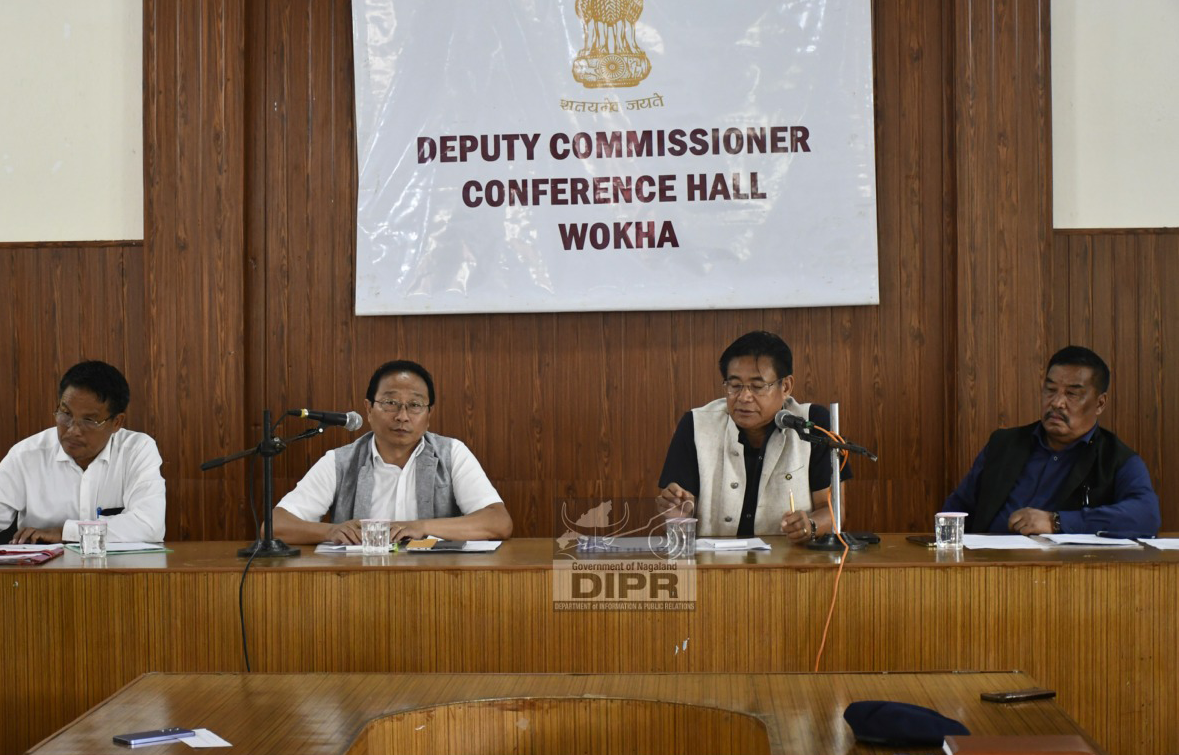
The District Planning & Development Board (DPDB) meeting for July 2026 was held at the Deputy Commissioner’s Conference Hall, Wokha on July 10. The meeting was chaired by DPDB Chairman & Advisor, Government of Nagaland, Mhathung Yanthan, with MLA Mhonbemo Humtsoe in attendance. Vice Chairman DPDB & Deputy Commissioner Wokha, K. Mhathung Tsanglao, co‑chaired the session.
The meeting began with a review of the previous month’s agendas, where the drying up of the Etsutchukha water source pond was discussed with urgency, and the need for Nagaland State Transport (NST) bus services in proposed locations was reiterated.
Discussions also focused on the maintenance of National Highway‑2, where engineers informed that contractors have been given 15 days to repair and make the highway stretch pothole‑free. Land encroachment along the highway was also deliberated.
Chichamo Shitiri from the Nagaland Nutrition Mission Foundation presented concerns on solid waste management at the Doyang Hydro Reservoir. He highlighted the accumulation of non‑biodegradable debris in the dam and the impact of discarded fishing equipment. He proposed the establishment of a recycling unit to address waste management and create awareness among farmers.
Three departments presented detailed PowerPoint presentations. SDPO Wokha, Sangthing Khiam, spoke on the Police Department, tracing its evolution and operational structure. He highlighted the changing nature of crime, the establishment of a cyber cell in 2023, and helplines for reporting crimes: 1930 for financial fraud, and 6009308204, 6009308205, 7628903234 for drug trafficking. Shortages of police personnel, particularly women police officers, were also discussed.
Dr Oben Yanthan presented for the Prison Department, outlining its legal framework, organizational structure, and security infrastructure. He highlighted recreational and rehabilitation programmes, including counselling, therapy, livestock rearing, farming, sports, and fellowship activities. Wokha was noted as the first district to provide counselling and therapy to prisoners. Currently, there are 27 prisoners, 23 under trial and 4 convicted. He emphasized transforming lives and rebuilding futures, with success stories emerging from the initiatives. Advisor Mhathung Yanthan appreciated the efforts and appealed for departmental support.
Download Nagaland Tribune app on Google Play


Assistant Labour Commissioner, Wokha, Neimenuo, gave a detailed presentation on the functioning of the Labour Department, highlighting its responsibilities, welfare schemes and initiatives for workers, particularly those engaged in the construction sector.
She also presented the latest statistics of the Nagaland Building and Other Construction Workers’ Welfare Board (NBOCWWB), informing that the board has 1,788 registered workers, of whom 763 are active while 988 are inactive.
Highlighting the welfare assistance provided by the board, she said eight death claims have been settled, 630 scholarships were awarded to beneficiaries during 2025–2026, five maternity benefits and two medical benefits were extended, while 768 workers received tool grants under the board’s welfare schemes.
She also spoke on the Employees’ State Insurance Corporation (ESIC) and Employee Provident Fund Organization, noting challenges in coverage due to farming activities and difficulties in contacting beneficiaries. Awareness‑cum‑registration drives were proposed as the way forward.
Administrative officers and border magistrates from outposts and subdivisions highlighted various issues, including census operations.
As part of institutional visits, DPDB members visited the District De‑Addiction Centre (DDAC), Wokha, located in Chukitong Town. Advisor Mhathung Yanthan encouraged patients to remain determined and not lose hope, stressing the importance of rebuilding lives and creating positivity. He appealed to government departments to extend support to the centre. MLA Mhonbemo Humtsoe and DC Wokha also assured assistance.
The members further visited Jawahar Navodaya Vidyalaya (JNV), Wokha, located in Chukitong. They addressed challenges of poor road connectivity and low student enrollment. While the school has a capacity of 540 students, only 297 students are currently enrolled, which was described as a significant loss to the community.