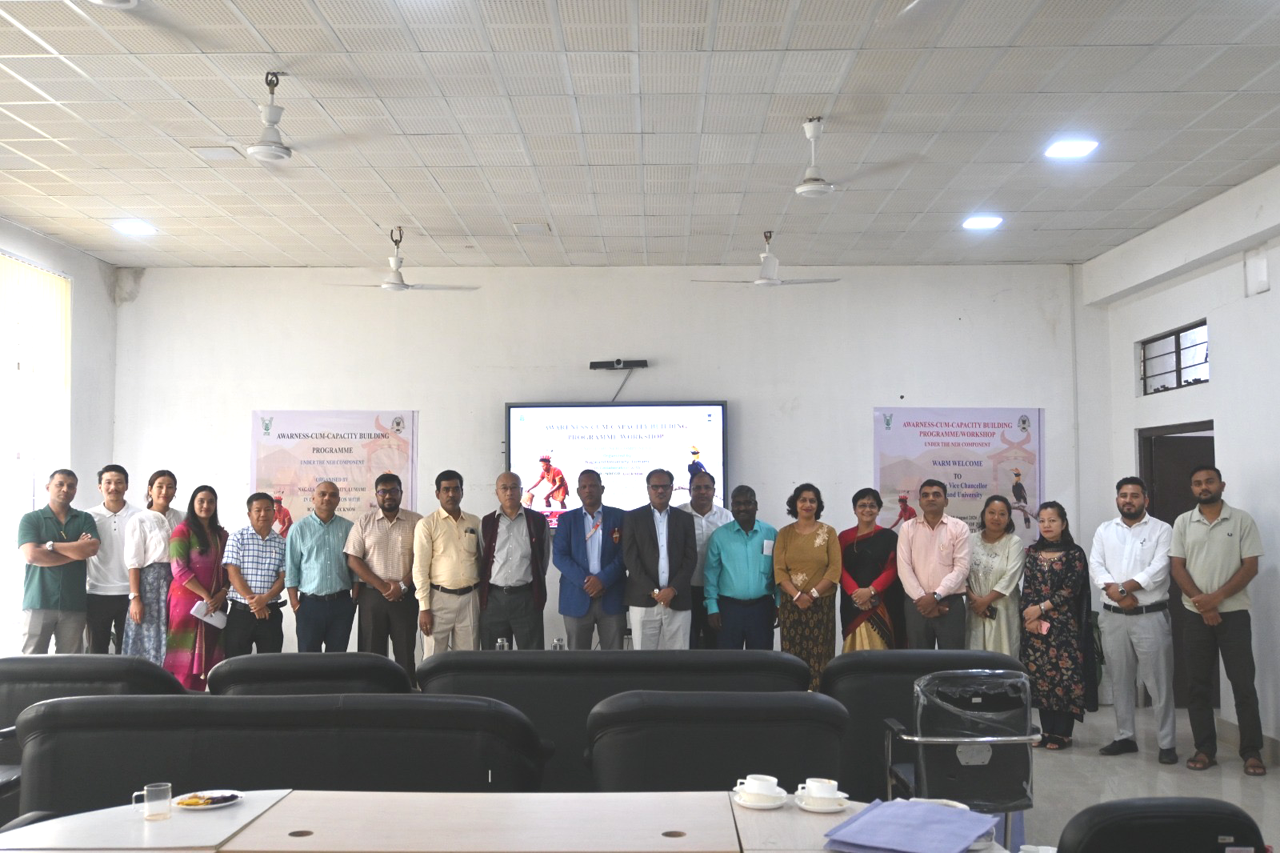
The Department of Zoology, Nagaland University, in collaboration with ICAR-NBFGR, Lucknow, organised the second day of the Awareness-cum-Capacity Building Programme on fisheries development and sustainable aquaculture on August 1 at the Zoology Department, Lumami, Nagaland University.
In the welcome address, Dr. Pranay Punj Pankaj, the organizing secretary of the programme, highlighted the activities conducted during the field visit and community engagement with the fish farmers of Japu village, where researchers and experts interacted with fish farmers, self-help groups, and other stakeholders. During the interaction, fishery inputs were distributed, and discussions focused on improving fish farming practices in the region.
Farmers raised several important concerns related to pond water quality, fish stocking density, feeding practices, disease management, affordable fish feed alternatives, and methods for distinguishing different fish species at their juvenile stage.
Dr Pranay informed that the initiative was launched after Vice-Chancellor Professor Jagadish K Patnaik flagged off the fishery input distribution programme. He emphasised that the initiative aimed not only to provide resources to farmers but also to promote sustainable aquaculture, improve livelihoods, and encourage scientific fish farming practices across Nagaland.
He further observed that, despite the state’s rich biodiversity and abundant water resources, Nagaland continues to depend heavily on fish imported from other states, creating opportunities for local fish farmers and entrepreneurs.
During the lecture, Dr Jaya Kishor Seth commended the Department of Zoology for extending academic activities beyond the university campus and engaging directly with local communities. He stated that the programme aligned with the objectives of the Sustainable Development Goals (SDGs), the Skill India Mission, and the national vision of Viksit Bharat 2047.
He emphasised that academic institutions should contribute to addressing societal challenges while generating employment opportunities through skill and entrepreneurship development. He further pointed out that freshwater ecosystems play a significant role in biodiversity conservation, food security, and economic development. While considerable attention has been devoted to marine ecosystems, he argued that freshwater fisheries deserve equal recognition.
Download Nagaland Tribune app on Google Play


Addressing the gathering, Vice-Chancellor, Professor Jagadish K Patnaik praised the Department of Zoology for effectively implementing the principles of the National Education Policy (NEP) 2020 through community engagement and skill development initiatives. He highlighted the importance of apprenticeship programmes under the National Apprenticeship Training Scheme (NATS), which provides students with practical experience, financial support, and opportunities for future employment.
The Vice-Chancellor encouraged the department to explore apprenticeship-based learning models and emphasised that employment should not be viewed solely in terms of government jobs. Instead, he urged students to develop entrepreneurial skills and establish their own enterprises.
Professor Patnaik also proposed the establishment of a fish pond on the university campus to support research activities, practical learning, and skill development among students. He stressed that such initiatives would create valuable opportunities for students pursuing zoology and related disciplines. Expressing his satisfaction with the increasing number of students enrolling from different parts of the country, he stated that the growing diversity of the student community reflected the university’s expanding reputation.
He further urged researchers and faculty members to pursue their work with dedication, passion, and a strong sense of commitment, emphasising that meaningful research requires both intellectual curiosity and emotional investment.
Professor Patnaik concluded by assuring the department of his continued support in strengthening research collaborations, promoting interdisciplinary studies, and creating new opportunities for students and researchers.
The program was chaired by Dr Neelakshi Verma, with an introductory address given by Prof Ranjit Kumar and Prof Bendang Ao, both from the Zoology Department. The inaugural session of the programme ended with a vote of thanks proposed by Dr Ramita Sougrakpam.
