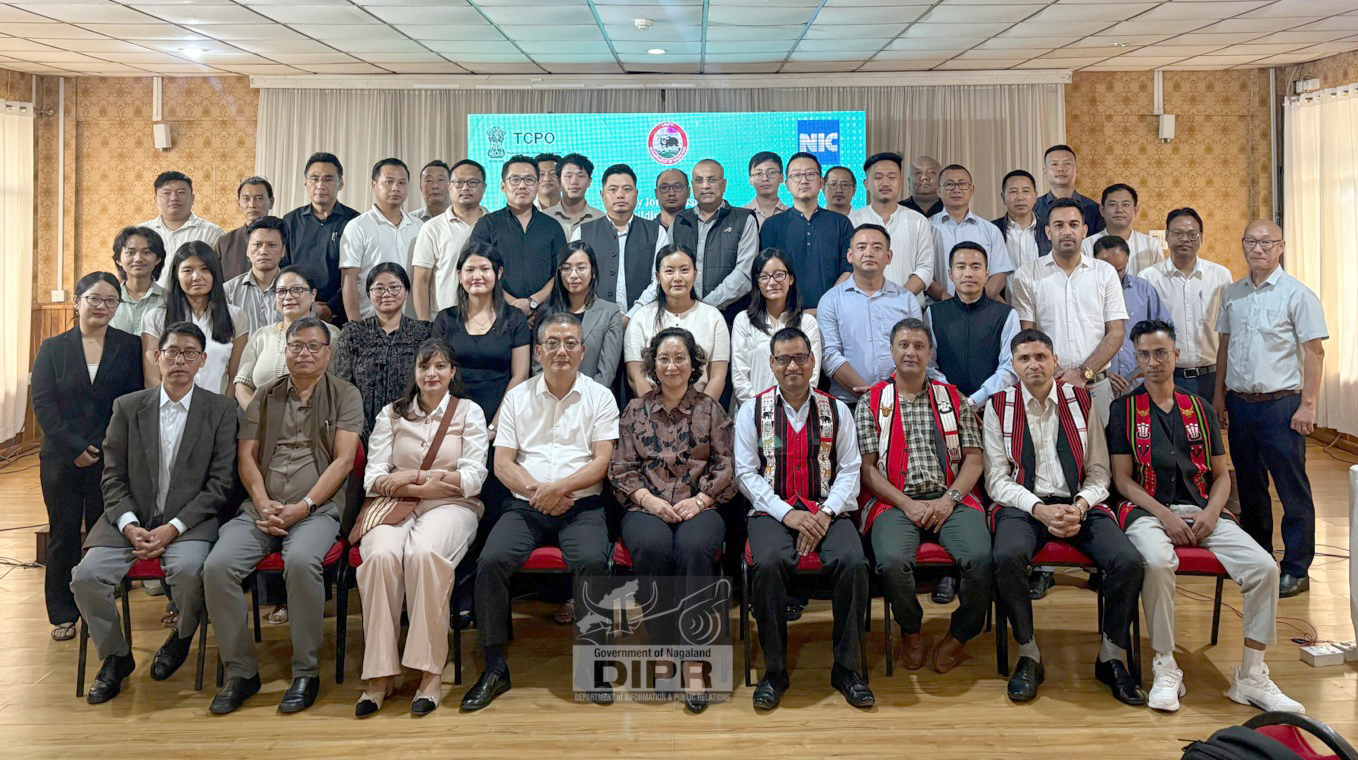
A two-day first Joint Session on the Nagaland Online Building Permission System (OBPS) was held on August 6 and 7 at Hotel de Oriental Grand, Kohima. The programme was organised by the Directorate of Municipal Affairs, Government of Nagaland, in collaboration with the Town and Country Planning Organisation (TCPO), Ministry of Housing and Urban Affairs, and the National Informatics Centre (NIC), Ministry of Electronics and Information Technology, Government of India.
The inaugural session began with a welcome address by Director, Directorate of Municipal Affairs, Temjenrenla Kechu, who set the context for the implementation of the Online Building Permission System in Nagaland. Associate Planner, TCPO, MoHUA, Sudeep Roy, presented on the OBPS, while State Informatics Officer, NIC Nagaland I Lanusungkum Aier, gave an overview of the system.
Technical sessions focused on the Model/State BBL and the mandate for implementing OBPS across States. Experts from the Directorate of Municipal Affairs, Urban Development Department, NIC and TCPO deliberated on synchronising the Draft National Building Bye-Laws 2026 with the proposed e-Development Control Regulations (e-DCR) for Nagaland.
Participants were also taken through the OBPS workflow, including the user interface, process flow, authorisation and control mechanisms, digital certificate integration and online signing procedures. Officials from various line departments joined discussions on departmental roles, service integration and requirements for issuing online building permits through the OBPS platform.
The afternoon technical sessions covered Building Plan Approval (BPA) drawing standards, layer conventions, standardised colour coding, head and sub-occupancy classifications and digital drawing formats.
The second day commenced with a recap of the previous day’s sessions, followed by live demonstrations on CAD layer conventions, standardised colour coding, feature classification and occupancy standards. Hands-on sessions enabled participants to work on digital drawings and understand the practical application of OBPS requirements under the guidance of experts from NIC Meghalaya and TCPO.
Download Nagaland Tribune app on Google Play


Advisor, Urban Development & Municipal Affairs, Zhaleo Rio, IAS (Retd.), attended the official website launch of the Municipal Affairs Department on the second day and also inaugurated the programme.
The Municipal Affairs Department stated that launching of its official website is a significant step for municipal governance in Nagaland and represents a shift towards transparency, easier access to information and better co-ordination between the Department, the urban local bodies and the public.
The website will provide general information on the 39 ULBs, their structure, their activities and important contact information. Various important Rules, Regulations, advisory, etc, will also be available in public platform. This website will enable ULBs to publish audited accounts in public domain, which is mandatory to avail grants recommended under Central Finance Commission grants as well as state Finance Commission Grants.
Zhaleo Rio expressed that all developmental activities need to be properly regulated, based on proper Building Bye-Laws, to ensure proper air and light between buildings, as well as to allow good drainage. He stated that the Nagaland Building Bye-Laws 2026 were presently in the final stages. He also expressed that strict enforcement of the Building Bye-Laws would be necessary for effective implementation.
Associate Planner, TCPO, MoHUA, Sudeep Roy, gave a brief speech under trajectory of advancement of construction regime in building permits in the country and how the MoHUA has assisted the North-Eastern States to adopt advanced practises in establishing NE– OBPS, which is being established for Nagaland.
Subsequent sessions focused on the implementation of the OBPS by the Directorate of Municipal Affairs and the Urban Development Department. Discussions covered testing of drawing lists and system features, rule-engine validation, testing schedules and records, launch preparedness and the timeline for the rollout of the system. Joint consultations were also held to address critical issues and finalise the roadmap for implementation.
The workshop concluded with a compilation of recommendations and deliberations on the next phase of preparedness.
