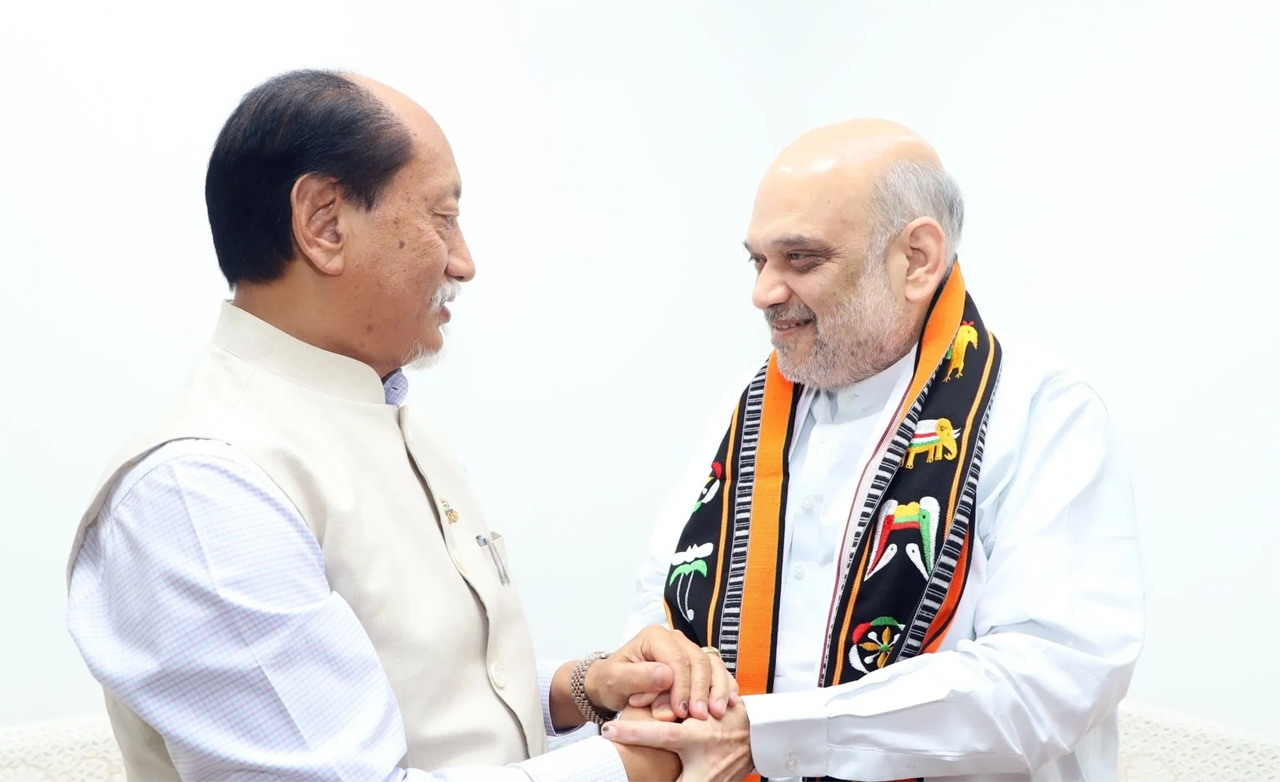
Nagaland Chief Minister, Neiphiu Rio has urged Union Home Minister, Amit Shah to give careful consideration to concerns raised by the Christian community in the State over the proposed amendments to the Foreign Contribution (Regulation) Act (FCRA), and has called for wider stakeholder consultation and greater parliamentary scrutiny of the proposed legislation.
In a letter to Shah, Rio said he had held detailed consultations with Christian leaders in Nagaland and had heard first-hand the difficulties and apprehensions being faced by churches and Christian organisations in the State. He said another round of deliberations was held on August 9 with the leadership and representatives of the Nagaland Baptist Church Council (NBCC) and the Bishop of Kohima, during which concerns over the proposed changes and their possible impact on churches and Christian organisations were conveyed.
Rio noted that the NBCC and the Bishop of Kohima had also submitted representations to the Union Home Minister and requested that their concerns be considered with due sensitivity, particularly in view of Nagaland’s distinctive social, historical and developmental circumstances.
Pointing out that more than 90 per cent of Nagaland’s population is Christian, Rio said Churches have historically played a significant role not only in the spiritual and community life of the people but also in education, healthcare, poverty alleviation, social welfare, livelihood support and assistance to disadvantaged sections.
He said a substantial number of educational, healthcare, humanitarian and social-service programmes, particularly in remote and economically weaker areas, have been supported through legitimate foreign contributions, partnerships and assistance.
According to Rio, increasingly stringent regulatory and compliance requirements under the FCRA have already imposed considerable financial and administrative burdens on churches and charitable organisations. He expressed apprehension that the proposed amendments, if implemented in their present form, could further compound these difficulties and adversely affect ongoing welfare, educational, healthcare and social-service programmes.
The Chief Minister said smaller grassroots institutions could be particularly affected as many operate with limited resources while providing services to remote, underserved and economically disadvantaged communities.
Rio also raised concerns over the rejection of FCRA renewal applications of some church organisations reportedly on grounds relating to alleged use of foreign contributions for religious conversion.
Considering that more than 90 per cent of the population of Nagaland is Christian, he urged that such cases be reviewed individually and objectively, taking into account the actual nature and purpose of the activities undertaken by the organisations concerned.
The cases of such organisations whose renewal has been denied may kindly be reviewed and taken up with all seriousness, with due consideration given to the nature and purpose of the activities actually undertaken by them, he stated.
Download Nagaland Tribune app on Google Play


“Given the distinctive social and demographic context of Nagaland,” Rio said, such cases should be examined on their individual merits so that genuine charitable, educational, healthcare and social-welfare activities are not adversely affected by broad or generalised assessments.
The Chief Minister also highlighted the humanitarian role played byChurches and Christian organisations during natural disasters and emergencies, citing their ongoing relief efforts for people affected by floods and landslides as well as their contribution during the COVID-19 pandemic.
He said Churches and Christian institutions had mobilised their resources, infrastructure and volunteers to support communities and government efforts during the pandemic.
Rio further emphasised the historical contribution of Christian institutions to Nagaland, noting that the Christian faith and the Church in the State have a history spanning more than 150 years.
He pointed to the longstanding international connections of the Baptist movement in Nagaland, including historical links with Baptist communities in the United States, as well as relationships maintained by the Catholic Church and other Christian denominations with institutions and organisations within India and abroad.
According to Rio, Churches, Christian missions and organisations played a significant role in the development of Nagaland even before the attainment of Statehood, particularly when modern public infrastructure and institutions were limited.
He said Christian institutions were among those that reached remote communities and provided education, healthcare and humanitarian assistance, helping expand literacy, modern education and healthcare services across generations.
Extending the argument beyond Nagaland, Rio said the contribution of Christian institutions to India’s nation-building process was “undeniable”, pointing to schools, colleges, universities, hospitals, healthcare facilities, charitable institutions and social-service organisations established and operated by Christian organisations across the country.
He noted that these institutions have served people irrespective of religion, community or social background, with many beneficiaries subsequently contributing to public service, the Armed Forces, education, healthcare, science, business, sports and other fields.
Rio said Churches and Christian organisations continue to supplement government efforts in education, healthcare, humanitarian relief, rural development and care for vulnerable sections, particularly in areas where delivery of public services remains challenging.
He acknowledged the responsibility of the Government of India to ensure transparency, accountability and compliance in the regulation of foreign contributions, as well as to prevent misuse and safeguard national interests.
At the same time, he stressed the need to ensure that genuine charitable, educational, healthcare and humanitarian organisations are not inadvertently affected by regulatory changes.
Against this backdrop, Rio called for wider discussion and consultation with stakeholders likely to be directly affected by the proposed FCRA amendments.
He specifically urged the Union Government to consider referring the proposed legislation to a Joint Parliamentary Committee (JPC) for comprehensive examination, allowing representatives of concerned stakeholders to present their views.
Rio said such a process would help address genuine concerns, remove apprehensions and strengthen public confidence in the proposed regulatory framework.
He expressed confidence that wider consultation would demonstrate an inclusive approach and reaffirm the government’s commitment to India’s constitutional values, secular ethos and the rights and contributions of all communities.
The Chief Minister concluded by placing the concerns before the Union Home Minister with the hope that they would receive his “kind and sympathetic consideration.”