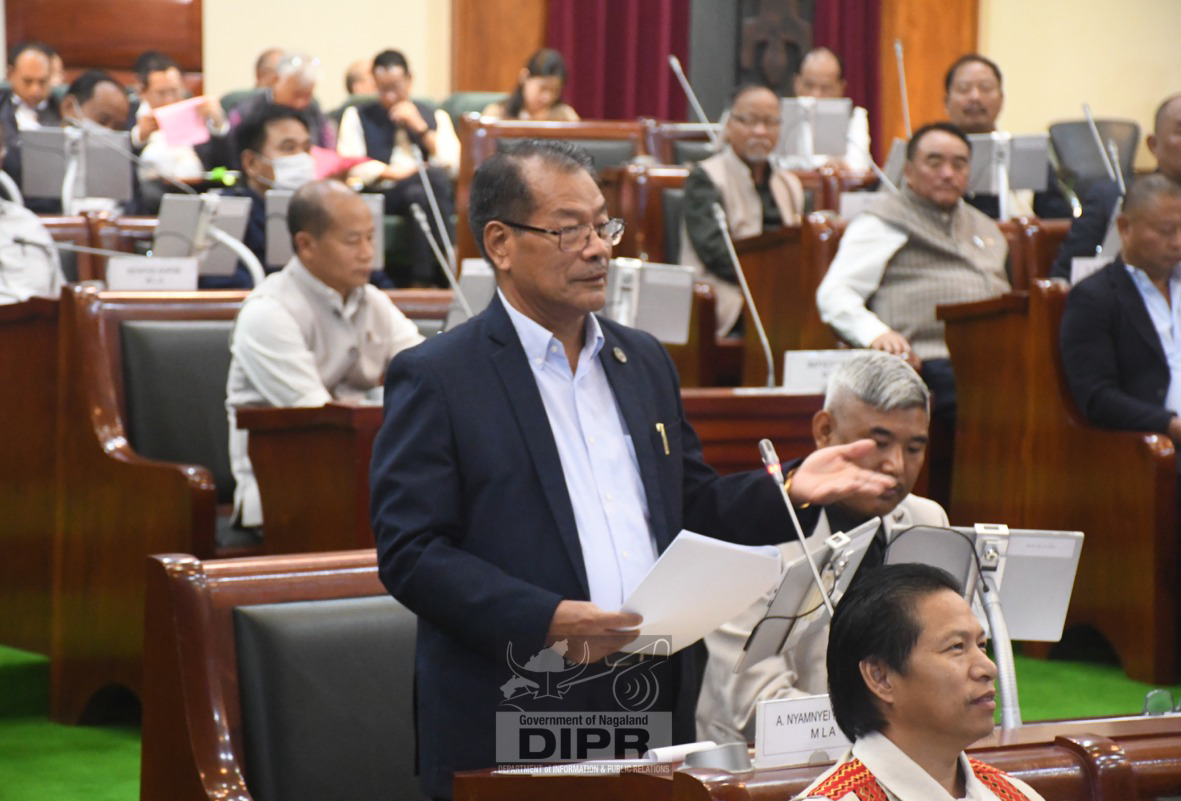
The Nagaland Government has acknowledged concerns over teacher vacancies in Government schools and the uneven distribution of teachers and students across districts, with Chief Minister, Neiphiu Rio and School Education Minister, Imna Along stressing the need to rationalise schools and redeploy teachers based on actual enrolment.
Chief Minister, Rio was responding to a starred question raised by A Nyamnyei Konyak, Member of the Nagaland Legislative Assembly, seeking details of teacher vacancies in Higher Secondary, High, Middle and Primary schools, including district-wise figures.
Describing the issue as a serious concern, Rio said the government and the concerned department were examining the situation, while attributing part of the state’s unusually high teacher-student ratio to population figures derived from the 2001 Census.
Rio explained that following the implementation of the Right to Education framework, population figures were used to create and upgrade schools in different areas. He said Nagaland subsequently witnessed a large expansion of schools, despite concerns over the accuracy of the 2001 Census data.
According to Rio, Nagaland currently has a student-teacher ratio of around 7:1, compared with 24:1 nationally, making the state’s ratio significantly lower than the national level.
He said the high ratio was not necessarily due to an excess of teachers alone, but also because schools had been created or upgraded based on population projections and subsequent requirements.
Rio also pointed to the decline in enrolment in some areas, saying the reduction in the number of schools should not be viewed simply as a shortage of educational infrastructure. In some cases, schools have few or no students despite having teachers.
He suggested that schools, particularly in areas of the Eastern Nagaland People’s Organisation (ENPO) region and Mon district, should be reassessed based on student availability, accessibility and local requirements.
Where schools have fewer than 10 students and another school is located within reasonable reach, Rio said clubbing or consolidation could be considered. At the same time, he stressed that such measures should take into account the accessibility and educational needs of remote and backward areas.
Konyak, while expressing satisfaction with the response of the Chief Minister and the Education Minister, raised concerns over vacancies in Middle English (ME) and Lower Primary (LP) schools.
Download Nagaland Tribune app on Google Play


He said retirements had resulted in teacher shortages in primary and middle schools, but replacement appointments had not kept pace. While Graduate Teachers and Post Graduate Teachers are recruited through the Nagaland Public Service Commission, he sought clarity on when recruitment interviews for ME and LP teachers would be conducted.
Konyak also expressed concern over the reduction in the number of schools in the state, noting that the number had reportedly fallen from 1,939 to 1,881.
He argued that schools in backward areas should be treated differently, considering factors such as educational and economic conditions, communication difficulties and the availability of institutions.
Highlighting the situation in Tobu, Konyak said the Higher Secondary School there lacked a proper building and was functioning with support from local stakeholders, including the Tobu Konyak Union. The school currently has around 97 students in Classes XI and XII, but continues to face a shortage of teachers.
He urged the Government to advertise vacancies in ME and primary schools and ensure that teachers are posted to interior areas where shortages are acute.
Konyak cautioned that further amalgamation of schools could disproportionately affect educationally backward areas and called for a specialised approach when rationalising schools in remote regions.
Responding to the concerns, Education Minister, Imna Along said teacher deployment was not based on a fixed district-wise quota but on the requirements of individual schools.
He said the department assesses requirements across Government Primary Schools (GPS), Government Middle Schools (GMS), Government High Schools (GHS) and Government Higher Secondary Schools.
Along said some areas have schools with very few students but a comparatively high number of teachers, while other locations face shortages. In cases where schools have no students, the department may amalgamate them with nearby schools and redeploy teachers to institutions where students are available.
He clarified that the exercise was not targeted at any particular district, tribe or community, but was being undertaken based on actual educational requirements.
The Minister reiterated that Nagaland’s student-teacher ratio of 7:1 remains substantially lower than the national ratio of 24:1, while the National Education Policy 2020 benchmark is around 30:1.
Along appealed for public understanding of the rationalisation process, stating that schools with students would not be shut down merely as part of the exercise. However, he said schools with no students but continuing to have teachers would require administrative intervention.
The government maintained that the ongoing review is aimed at ensuring that teachers are deployed where students are actually present while safeguarding access to education in remote and educationally disadvantaged areas.