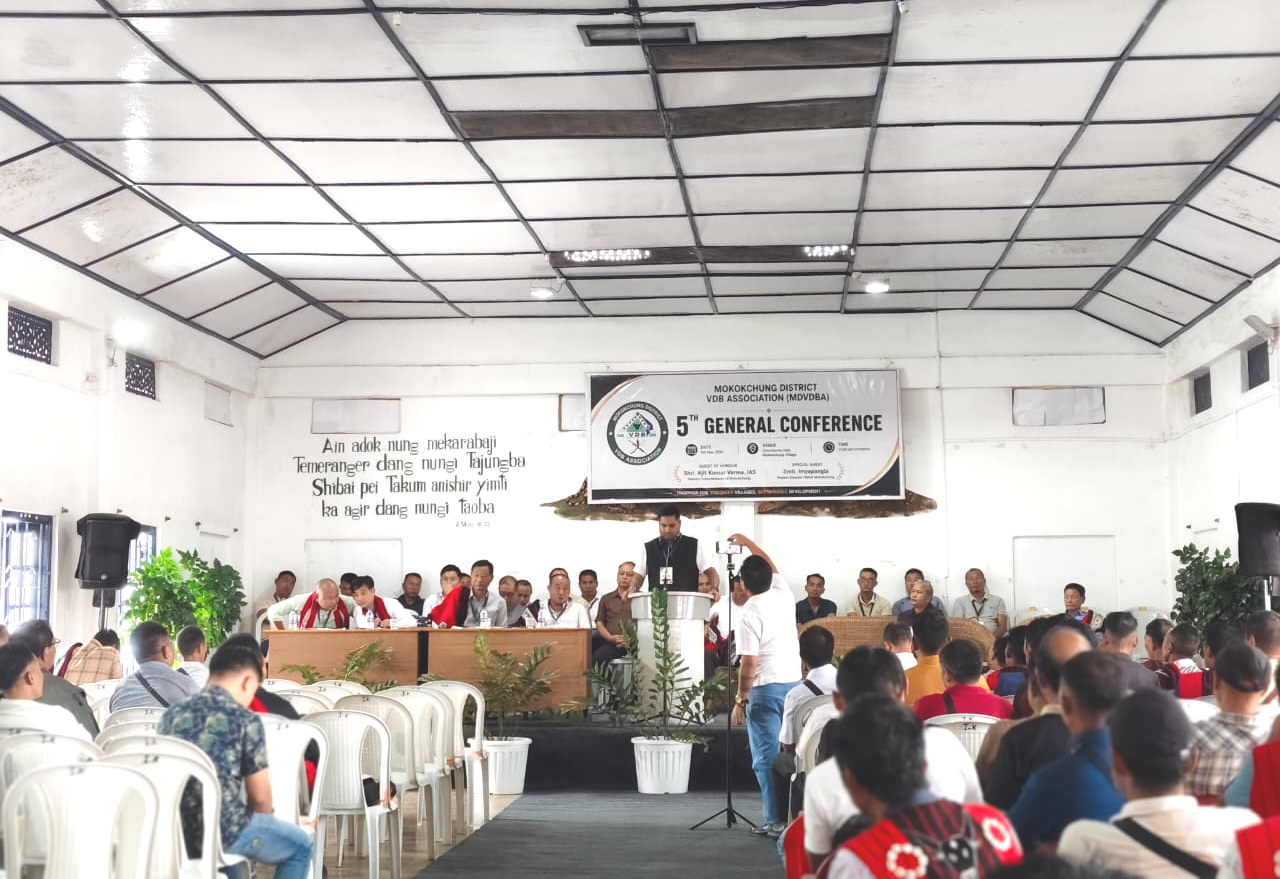
The Mokokchung District Village Development Boards Association (MDVDBA) held its 5th General Conference at the Community Hall, Mokokchung Village, on September 3, with discussions focusing on the future relevance of the Village Development Board (VDB) system, rural development programmes and the responsibilities of VDBs in ensuring inclusive and sustainable development at the village level.
Deputy Commissioner of Mokokchung, Ajit Kumar Verma, IAS, attended the conference as Guest of Honour, while Project Director, District Rural Development Agency (DRDA) Mokokchung, Imtiyapangla, was the Special Guest. Representatives from 88 villages, including two Sumi villages and nine Rural Development (RD) Blocks under Mokokchung district, participated in the conference.
Addressing the gathering, Verma described the VDB system as a distinctive governance institution of Nagaland that provides an interface between customary institutions and modern development programmes while functioning in consensus with Village Councils. He traced the evolution of development planning in the country, noting that planning was initially centralised, with plans and funds being sent from the higher levels without necessarily taking into account the specific circumstances of different regions.
He pointed out that a plan suitable for one part of the country might not necessarily be suitable for another, citing the example that a plan designed for Bihar would not necessarily suit Nagaland. According to him, the shortcomings of centralised planning contributed to regional disparities, leading to subsequent revisions in the country’s approach to development.
He explained that the development approach evolved over time, moving from an initial emphasis on growth to development, followed by inclusive development and, subsequently, sustainable development. In this evolution, he said, the VDB system represents a distinctive model of development in Nagaland, emerging through an interface between customary systems and modern development planning.
Verma said the VDB institution, established in June 1976, is completing 50 years and has made an important contribution to the developmental journey of Nagaland, particularly in rural areas. He expressed appreciation for the institution and its role in the development of villages.
“Sincere appreciation to the VDB as an institution in Nagaland for successfully running the state and villages,” he said, adding that the achievements of the state’s developmental journey involving VDBs cannot be taken away.
He further observed that any history of rural development in Nagaland would not be complete without reference to VDBs, while also cautioning against becoming complacent with the achievements of the past.
“If we want to write a history of rural development, it will not be without VDBs,” Verma said.
At the same time, the Deputy Commissioner stressed that the completion of 50 years should be an occasion not only for appreciation but also for evaluation and forward planning.
He asked VDBs to assess what has been achieved during the past five decades and determine what should be targeted for the next 50 years. He also suggested that Nagaland should learn from the functioning of village institutions in other states rather than limiting itself to its own experience.
“It’s this year we are completing 50 years. What have we achieved in these 50 years, we need to evaluate; for the next 50 years we need to aim. What do we plan to do?” he asked.
On institutional reform, Verma said there was a need to revisit the existing framework governing VDBs. He referred to the rules framed in 1980 and 1987 and said that the present time was appropriate for reviewing and revising them so that the functions and responsibilities of VDBs are clearly defined.
He pointed out that ambiguity regarding the roles of village members and VDB secretaries has resulted in complaints and even court cases, which, he said, need to be addressed.
“The Association needs to strengthen the legal framework and frame operational guidelines for VDBs, incorporating best practices,” he said.
Verma also emphasised that the VDB should remain an institution representing the village as a whole and should not become the preserve of a particular group.
He raised concerns over the level of participation of women in VDB affairs, noting that while women’s participation is officially recognised, there is a need to examine whether women are actually being given adequate space to participate in decision-making and development activities.
“The VDB should not be a property of a group of people,” he said, calling for broader participation and greater inclusiveness within the institution.
He further cautioned that if consensus-based selection of VDB representatives weakens over time, the system could eventually move towards elections, which he said would not necessarily be a healthy development. He therefore called for the integrity and relevance of the institution to be maintained while respecting the customary context in which VDBs function.
Looking towards the future, the Deputy Commissioner urged VDBs to concentrate on village-level self-reliance and economic activity rather than focusing only on individual benefits.
Referring to the Viksit Bharat vision, he suggested that villages should identify their own strengths and develop local economic opportunities, including the concept of “One District, One Product”. He said villages should be able to identify a crop or product suited to their locality and develop a long-term plan around it.
Download Nagaland Tribune app on Google Play


He proposed that such planning should look beyond short-term projects and work towards establishing processing facilities and other local enterprises over a period of 10 to 20 years.
“You should be able to produce one crop. Identify the crop,” he said, stressing that village-level planning should be sustained over a longer period.
Verma also stressed the need to create employment within villages through industries and local entrepreneurship, with the potential to reduce the need for people to leave villages in search of employment.
“We should create jobs in our villages, industries, local entrepreneurs,” he said, adding that Nagaland has the potential to develop such local opportunities.
He called upon VDBs to acknowledge their shortcomings, adapt to changing systems and focus on strengthening the institution itself rather than concentrating only on individual or short-term benefits.
“The integrity of the institution should be maintained,” he said.
He also stressed that development should include investment in basic village institutions and infrastructure, particularly schools, health centres and Anganwadi centres. VDBs, he said, should consider the condition and requirements of these facilities while planning village development.
“We have to invest in important institutions like schools. Invest in schools and health centres,” he said, adding that VDBs should think about the structures of schools, health centres and Anganwadi centres and work towards creating at least one significant asset in every village.
Concluding his address, Verma said VDBs have considerable potential and challenged them to develop models that could serve as examples beyond the state.
“You have lots of potential. Try to make the best model in the country,” he said.
DRDA outlines rural development programmes and VDB responsibilities
Project Director, DRDA Mokokchung, Imtiyapangla, addressed the conference on the topic “Rural Development Programmes and the Role of VDBs in Transforming Our Villages.” She explained the various rural development programmes being implemented through the department and outlined the responsibilities of VDBs, Village Councils and beneficiaries in ensuring that development schemes reach their intended objectives.
She informed the gathering that the Rural Development Department works across nine RD Blocks covering the district’s 88 recognised villages.
Among the programmes highlighted was the state-sponsored Rural Development Grant-in-Aid (GIA), which was started in 1980. Under the programme, Rs 1,000 per household is provided annually, with the allocation structured for different areas of development.
According to the details presented, 55 percent is earmarked for general programmes, 25 percent for women development and 20 percent for youth-led activities.
She also spoke about the VDB Welfare Fund, under which Rs 200 is contributed per family and kept as a fixed deposit for five years. The interest generated from the fund can be utilised for village development, while the principal amount is retained. The department also has a matching cash grant programme, with a minimum fixed deposit amount of Rs 10,000 for VDBs.
Imtiyapangla stated that Mokokchung district has 88 villages covering 25,357 households.
MGNREGA and e-KYC compliance highlighted
On the Mahatma Gandhi National Rural Employment Guarantee Act (MGNREGA), which began in Mokokchung in 2007, the Project Director explained that job cards are issued to eligible persons aged 18 years and above. Only job-card holders are eligible to undertake work under the programme, and only one job card is permitted for a family.
She said the programme focuses on employment and creation of durable assets, with payments made directly to the accounts of job-card holders. Works proposed for villages are to be discussed through the Gram Sabha.
She also referred to the employment guarantee provisions under the Viksit Bharat framework, including the provision of guaranteed employment days and the wage rate of Rs 300 per day mentioned for VDB-related implementation.
The Project Director explained that work availability is affected during peak agricultural periods and identified periods during which work may be stopped or reduced, including portions of April 15 onwards, June-July and December 15 to January.
A major point of concern raised during the presentation was e-KYC compliance among job-card holders. Of the 33,710 job cards linked with Aadhaar, 24,670 had completed e-KYC, representing about 73 percent, leaving approximately 27 percent yet to complete the process.
Imtiyapangla explained that e-KYC compliance is linked to reporting and allocation, making completion important for continued implementation. She asked Village Councils to communicate the requirement to job-card holders and support VDB secretaries in completing the process.
“Only if you work, you will get the allocation,” she said, while stressing that cooperation from job-card holders and Village Councils is necessary for implementation.
She urged Village Councils to relay the information to job-card holders and extend support to VDB secretaries, noting that some RD Blocks have made better progress in e-KYC than others.
PMAY-G implementation and housing targets
The Project Director also outlined the Pradhan Mantri Awaas Yojana-Gramin (PMAY-G), which was introduced in 2016-17 with the objective of providing housing to poor rural households.
She explained that the scheme is intended particularly for households that cannot afford to construct a house on their own and that beneficiaries have to fulfil the prescribed criteria. Assistance is provided in three instalments, with Rs 1.30 lakh mentioned as the assistance amount, along with GI sheets provided under the government provision.
She informed the gathering that 2,900 houses were taken up under the programme in Mokokchung during the earlier phase and that Mokokchung district achieved 100 percent completion under the scheme, making it the only district in Nagaland to achieve that level of completion at the time referred to in her presentation.
On PMAY-G 2, she said the process is being undertaken phase-wise, with the target period extending up to March 31, 2029. She informed that around 9,900 households have been enrolled in Nagaland, while around 9,600 enrolments had been completed in the process referred to during the conference.
She stressed that beneficiaries enrolled under PMAY-G should complete e-KYC and that those who fail to complete the required process may be deleted from the list. She also called upon VDB secretaries to ensure that the information reaches the concerned households.
NSRLM and role of self-help groups
Imtiyapangla also highlighted the Nagaland State Rural Livelihoods Mission (NSRLM) as an important rural development and poverty reduction programme.
She described self-help groups (SHGs) as an important component of rural development and informed that Mokokchung has 1,197 SHGs in general and 1,296 special SHGs covering 8,989 households, comprising both men and women. She said the groups have been active in planning for their villages and contribute to village-level development planning.
She also referred to the provision encouraging 25 percent women’s participation in VDB planning and stressed the importance of Gram Sabhas in ensuring that villagers take ownership of development activities.
“Take ownership in this,” she told the VDBs, urging them to actively participate in the development of their villages.
The Project Director acknowledged the difficulties faced by VDB secretaries in dealing with increasingly digital procedures and appreciated their efforts in carrying out the required work. She particularly sought the support of Village Councils in helping VDB secretaries with e-KYC and other procedural requirements.
She urged VDBs to work diligently in accordance with departmental guidelines so that funds intended for rural development are fully utilised. She also requested Village Councils to extend full support to VDB Management Committees during implementation and ensure that villagers clearly understand the schemes, procedures and benefits available to them.
She further instructed VDBs to submit incident reports in cases where job-card holders are not cooperating with e-KYC and NMM-related exercises.
The conference also featured brief addresses from village representatives. Chairman of Mokokchung Village Council, Mapuyanger, called for VDB secretaries and Council chairmen to work with truth and transparency.
Chairman of Nokpu Village Council, Sashimeren Walling, also spoke on the importance of cooperation between Village Council members and VDB secretaries. Council Chairman, stressed that the Putu menden (Village governing body), Council chairmen and VDB secretaries should maintain a close working relationship, stating that the three should work like friends.
Speakers also noted that development requirements vary from village to village and suggested greater cooperation between Council members and VDB secretaries for better outcomes. A suggestion was also made for comparing the performance of different RD Blocks as a means of encouraging better implementation.
The conference also witnessed the presentation of the General Secretary’s, Audit and Nominating Reports.
Meanwhile, the new office-bearers of the Mokokchung District Village Development Boards Association were announced, with Bendang Walling as President, Imtiyanger as Vice-President, Obangonen as General Secretary, Imchayanger as Assistant General Secretary, Imtimar as Finance Secretary and Wati Kichu as Treasurer, along with nine executive members.
The conference concluded with a vote of thanks and benediction.