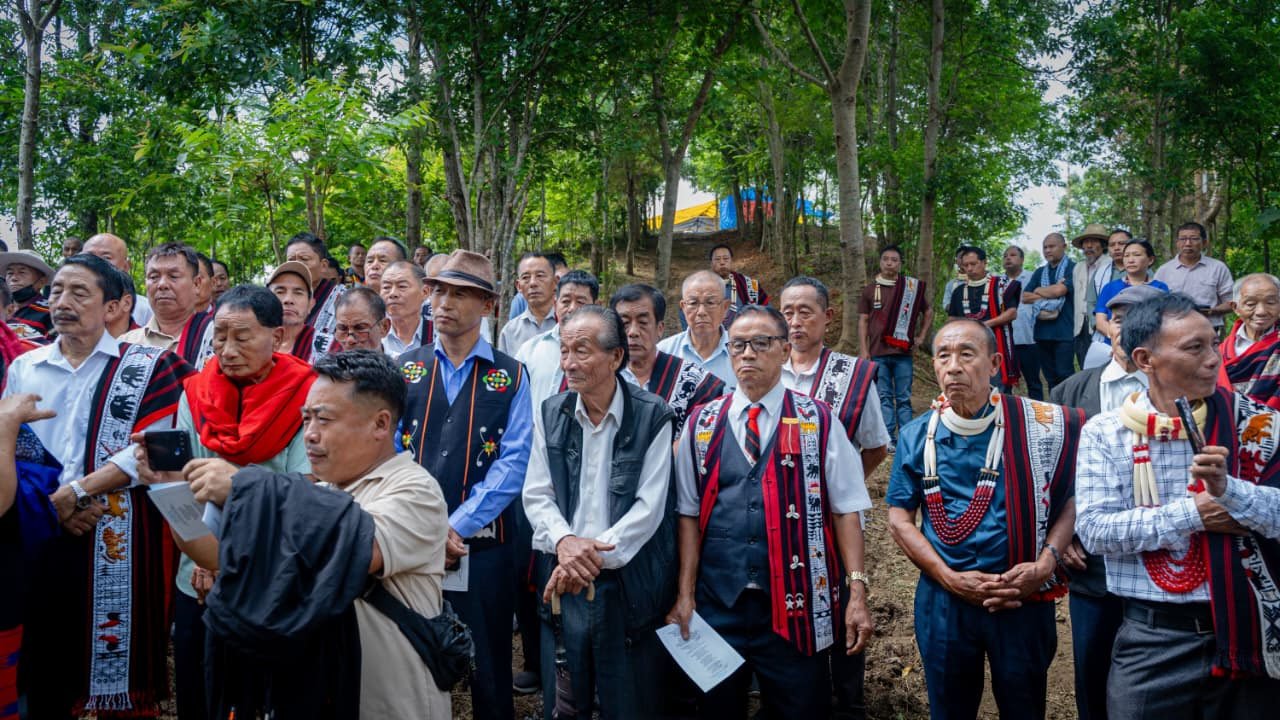
The Naga political question must move towards a just peace through political dialogue, truth, justice, reconciliation and peaceful engagement, Dr Villo Naleo, Secretary, Social Concern, Nagaland Baptist Church Council (NBCC), said on Sunday, stressing that the issue cannot be resolved merely through administration, military strength, economic packages or the passage of time.
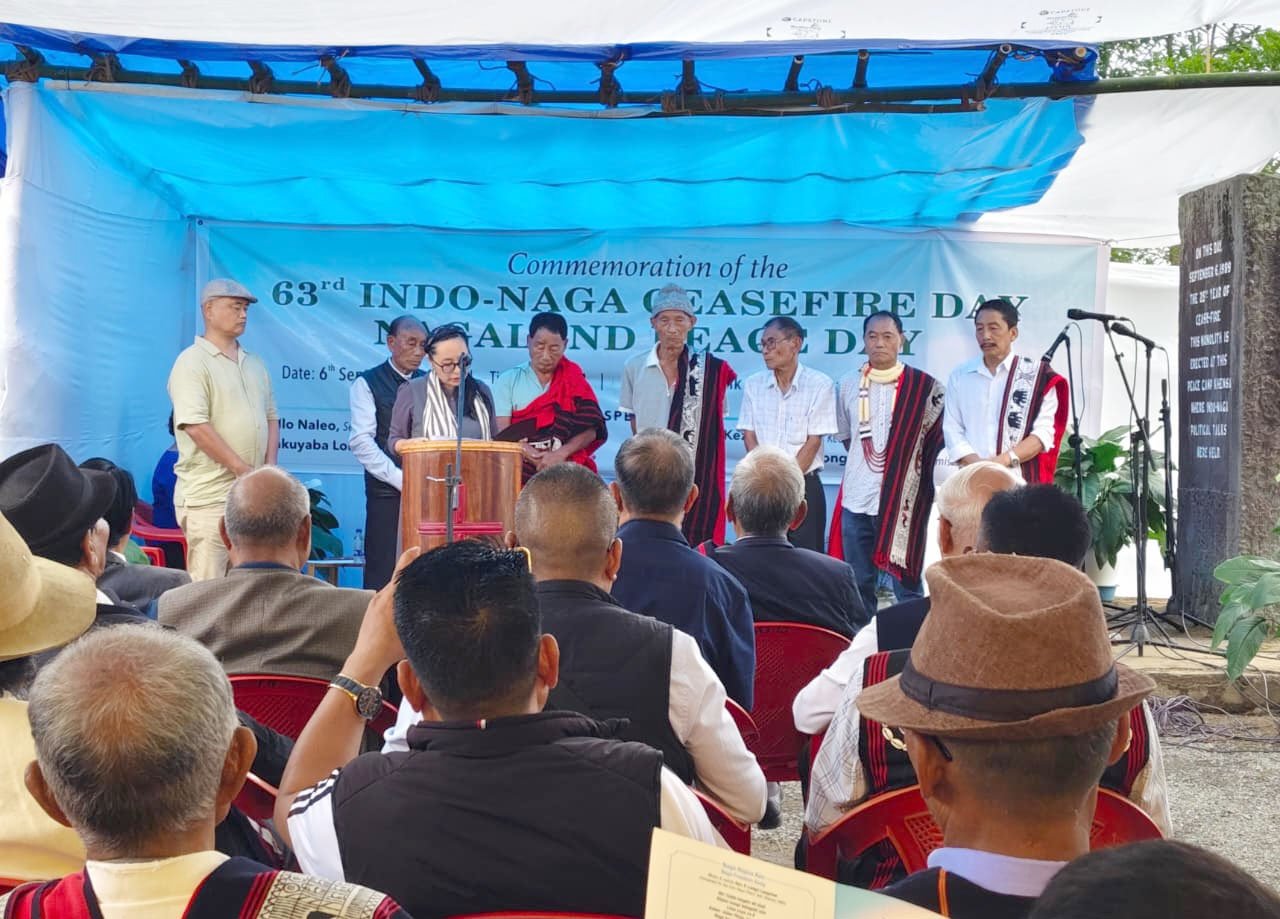
“We must choose the way of peace. We also must work for peace,” Dr Naleo said while delivering the main message on “Church, History and the Indo-Naga 1964 Ceasefire: Taking the Vision Forward” during the commemoration of the 63rd Indo-Naga Ceasefire Day, observed as Nagaland Peace Day at the historic Peace Talk Camp, Yimyu Hilltop, Khensa, Mokokchung.
Dr Naleo said the way forward must be through “political dialogue, truth, justice, reconciliation, and peaceful engagement,” emphasising that a ceasefire must ultimately lead to a just peace.
Addressing the Government of India, he said the Naga political question requires political wisdom and political will, along with active listening to Naga stories, courage and statesmanship, and recognition of the “deep historical and political dimensions” of the issue.
He also addressed Naga national political leaders, saying, “Our common future is greater than our differences.” He called upon leaders to sit together, listen to one another, forgive one another and seek a common path forward, asserting that internal division remains a major political danger.
“Our greatest political weakness is not merely the external opposition. Our greatest danger is the internal division,” he said.
Dr Naleo further called upon Naga church leaders to maintain their prophetic ministry “without fear and favour,” cautioning that the church cannot preach reconciliation while nurturing hatred or preach peace while becoming an instrument of political hatred.
Broadening the call for peace beyond the political question, he said the struggle for peace also exists within the human heart. A person, church or community, he said, cannot meaningfully demand political peace, reconciliation or justice while carrying hatred, remaining internally divided or denying justice to others.
“Therefore, as Christians, the Christian peace must begin within us,” he said, adding that Nagas must have a vision of peace as envisioned by Isaiah.
The commemoration marked the 63rd anniversary of the September 6, 1964 Indo-Naga bilateral Ceasefire Declaration, which was facilitated by the Peace Mission of the Nagaland Baptist Church Council. The programme was held at the historic Peace Talk Camp, the site associated with the peace talks that followed the ceasefire.
Before the formal programme, the Covenant Stone (Azüngashi Long) was inaugurated and dedicated. The formal programme was chaired by Dr. Tsuknunglenla, Associate Professor, Clark Theological College, and began with a dedicatory prayer by Rev. Dr. Akok Amer.
Khensa land gift formally recorded as 63rd Indo-Naga Ceasefire Day observed as Nagaland Peace Day
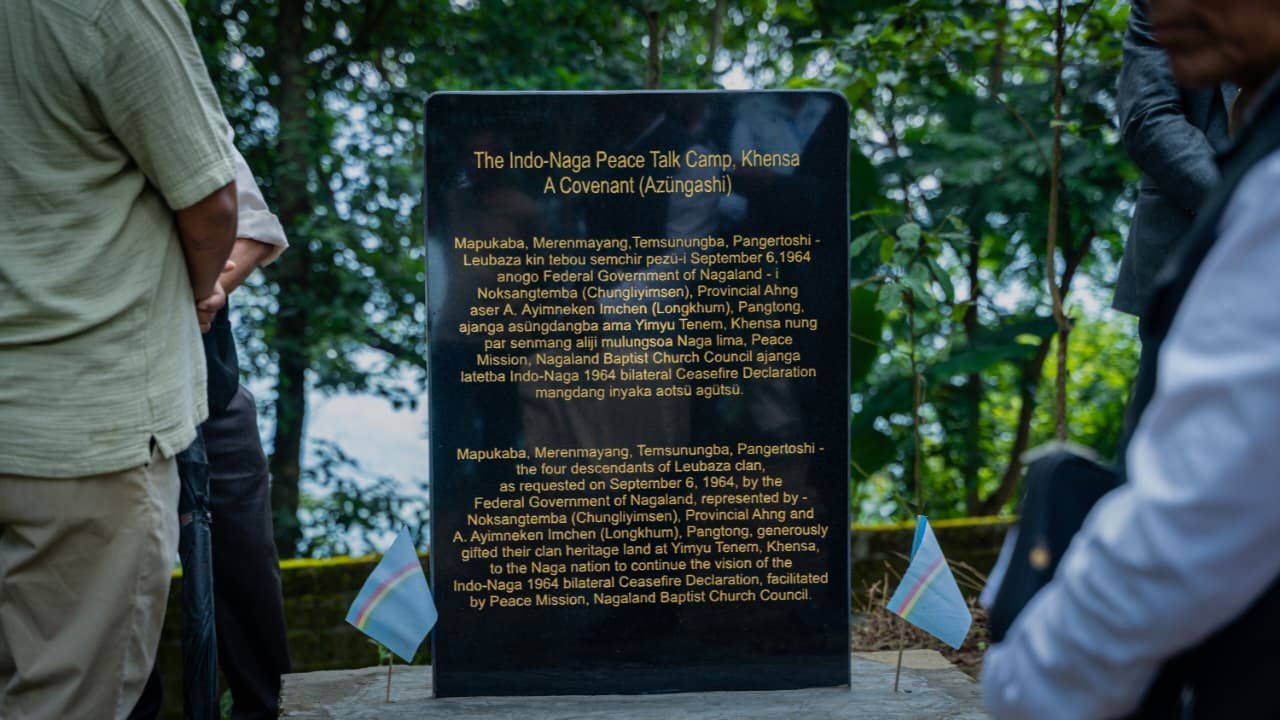
According to the commemoration note, the Peace Talk Camp at Khensa is regarded as a Covenant (Azüngashi). On September 6, 1964, at the request of the Federal Government of Nagaland, represented by Noksangtemba (Chungliyimsen), Provincial Ahng, and A Ayimneken Imchen (Longkhum), Pangtong, four descendants of the Leubaza clan of Khensa village — Mapukaba, Merenmayang, Temsunungba and Pangertoshi — gifted their clan heritage land at Yimyu Tenem (Hilltop) to the Naga nation to continue the vision of the 1964 ceasefire.
The land had been gifted verbally earlier, but it was now formally brought into written record following two meetings involving the descendants of Pangertoshi Leubaza, the Federal Government and the Khensa Village Council, with No Objection from the village council.
Copies of the written record were handed over to the descendants, the President of the Federal Government and the Khensa Village Council. The covenant stone also acknowledges the role of the Peace Mission and the Nagaland Baptist Church Council in facilitating the peace process.
The land documents bear the signatures of NNC and FGN representatives, including Adino Phizo, President of the NNC; Kezha Angami, Kedahge of the FGN; and A. Ayimneken Imchen, former Pangtong of the FGN.
I Alemmeren Longchar, Chairman of the Khensa Village Council, said that while both the Federal Government of Nagaland and the Leubaza clan had maintained that the land was donated, there had been no written documentation to substantiate the account. He described today’s September 6, 2026 documentation as a significant milestone, saying the village had remained in a dilemma over the absence of a written record.
Rev P Longri Longchar, Emissary, in his reflection on “Remembering 1965 Indo-Naga Peace Talk, Khensa,” said the land was given free of cost by the grandchildren of Mapukaba for the peace process. He said a large house was built on the site with contributions from Ao villages. Khensa and Sungratsü villages came together for the construction, while Changki contributed towards the circle of surrounding roads leading to the hilltop camp site. The site later hosted several peace talks and major gatherings connected with the Naga political issue.
Longchar said talks were held at the camp on three occasions and recalled a gathering attended by three members of the Indian Parliament, when around 20,000 Nagas assembled at the site in support of Naga rights. Khensa is among the four villages where Naga peace talks were held – Chedema, Wokha, Longmisa and Khensa.
NNC reiterates position on Naga sovereignty
Speaking on “The Indo-Naga Position,” Takuyaba Longkumer, Central Executive Committee Member, Naga National Council (NNC), reiterated the NNC’s position that Nagas are not seeking independence as a new demand, but that Naga independence had already been declared on August 14, 1947.
Referring to the stated resolution of the period, Longkumer said, “Basing on the stated resolution, the Pakistanis and the Nagas refused to join the Indian Union and both Nations declared independence on 14th August 1947.”
He further argued that the Indian Constitution recognised the declaration, while India declared its independence on August 15, 1947. He described the matter as history and said, “How many times will we get independence,” questioning the basis for any contrary interpretation.
Longkumer cited the Indian Constituent Assembly Resolution No. 2 of January 22, 1947, particularly its provision that the territories comprising British India, the Indian States and other territories willing to constitute an independent sovereign India would form a Union.
On that basis, he stated that “Nagas were not with or under India even for a single second,” describing this as an axiom.
He subsequently referred to the Naga Voluntary Plebiscite of March 16, 1951, conducted within the Naga Hills district by the NNC, with due notice to the United Nations Organisation and the Government of India. According to his account, 99.9 per cent voted in favour of independence, which he described as a confirmation of the August 14, 1947 declaration.
Longkumer also referred to developments involving the Naga territories bordering Burma. He said that in February 1947 the Burmese government attempted to annex the Free Naga territories under the Panglong Agreement, which he said the Free Nagas refused to sign. According to his account, the Burmese government thereafter extended its military regime into Naga territories by force and continued occupation.
He said that during this process, the Eastern Free Nagas formed the Hongking Government, which, together with the NNC, formed the Federal Government of Nagaland in 1956.
Nagaland Tribune app on Google Play


Longkumer stated that from 1955, under the leadership of then Prime Minister Jawaharlal Nehru, the Indian Army invaded Nagaland and that a series of laws were imposed, including the Assam Disturbed Area Act, 1953; Tuensang Frontier Division (Undesirable Persons Regulation) Act, 1962; Armed Forces Special Powers Act, 1958; Nagaland Security Regulation Act, 1962; and Unlawful Activities (Prevention) Act, 1972, among others.
He alleged that under these laws, houses were burnt in villages across Nagaland in 1956 and that security personnel were empowered to shoot suspected persons without trial.
He further alleged that more than one lakh innocent civilians were killed before the ceasefire, and that women were raped and civilians subjected to torture and beatings.
1964 ceasefire and subsequent developments
Against this backdrop, Longkumer said the NBCC’s peace initiative led to a ceasefire agreement between the Government of India and the Federal Government of Nagaland on September 6, 1964, which is being commemorated as Peace/Ceasefire Day.
He stated that the Government of India unilaterally abrogated the ceasefire agreement on August 31, 1972, while asserting that the Federal Government of Nagaland and the NNC continued to uphold the ceasefire.
On the question of Naga sovereignty, Longkumer said the 1964 Ceasefire Agreement remains, in his view, the only valid agreement made by competent authorities, while describing other agreements as “Conflict agreement” or agreements without mandatory authority, which he argued are void under the existing provisions of international law.
He also referred to Article 3 of the United Nations Declaration on the Rights of Indigenous Peoples, 2007, stating that it enshrines the right of indigenous peoples to self-determination and to freely determine their political status and pursue their economic, social and cultural development.
Based on these arguments, he listed the Naga position as recognition of Naga sovereignty through natural justice, the Indian Constituent Assembly Resolution No. 2, the August 14, 1947 declaration of independence, the 1951 plebiscite and Article 3 of the 2007 UN declaration.
He contrasted this with what he described as India’s position, including denial of the Constituent Assembly Resolution No. 2, refusal to recognise the 1951 plebiscite, imposition of what he termed “Draconian Laws,” withdrawal from the September 6, 1964 ceasefire and failure to recognise Article 3 of the 2007 UN declaration.
Concluding his address, Longkumer expressed gratitude to young men and women who, he said, were recently joining the ranks and extending support to the ongoing work and vision of a “FREE NAGALAND.”
He thanked the NBCC for its initiative in bringing the historic 1964 ceasefire into public remembrance and appealed that, from next year, churches under the NBCC umbrella observe September 6 as Peace/Ceasefire Day through proper information and announcements.
He concluded with, “Solution of Naga issue is—PRAYER TO THE LORD. KUKNALIM.”
FGN Kedahge recalls peace talks at Khensa
Kezha Angami, Kedahge, Federal Government of Nagaland (FGN), spoke on “The Naga Vision” and recalled the role of the Peace Mission in facilitating the 1964 ceasefire.
He identified Peace Mission members as B.P. Chaliha, Rev. Michael Scott and Jayaprakash Narayan, along with NBCC Special Committee members Rev. Longri Ao, Keneth Kerhüo, Toniho Chishi, Rev. Kijungluba Ao, Rev Ahamo Patton, Rev HK Lungalang, Dupar Vas, S Litsase Sangtam and Rev Shihoto Sunheto.
According to Angami, rounds of peace talks following the ceasefire were held at Chedema and Khensa. The NNC/FGN delegation was led by Isaac Swu, Jerenkokba, Zashei Huire and Brigadier Thinoseilie, while the Indian delegation included Y.D. Gundevia, Foreign Secretary, Government of India; UN Sharma; Brigadier DM Sen; and NF Suntook.
Angami also recalled the 1965 Indo-Naga Peace Talk at Khensa, during which Khensa students sang the Naga Freedom Song. The song, “Naga Nüjiso Ken,” was presented during Sunday’s commemoration by the Yimyu Ward Executive Committee.
Rev P Longri Longchar, who composed and taught the song, was present at the programme.
Angami paid tribute to Mapukaba as a nationalist and recalled the first Naga Home Guards from Khensa in 1955-Toshimeren, Amakba, Reteyongdang, Merimongba and Rev. Longri – noting that three of them are no longer alive.
He reiterated the 13-point Terms of Agreement for Ceasefire issued by the Federal Government on August 10, 1964, with the guiding principles of cessation of hostilities, lasting peace settlement and creation of a conducive atmosphere of calm and freedom from tension.
He also declared 12 points reaffirming the Federal Government’s commitment to the village republic and the Yezhabo principle that each village is a republic within its own territory, with authority over its own affairs, including land, community organisation, social and cultural matters, religion, customs and practices.
The points also emphasised strengthening Putu Menden and healing the wounds of division.
Church, history and the way forward
The programme included “Remembering 1965 Indo-Naga Peace Talk, Khensa” by Rev P Longri Longchar, a statement on the land gift by Pangertoshi Leubaza, greetings from I Alemmeren Longchar, Chairman, Khensa Village Council, and a message in song by Eastern Nagaland Churches, Mokokchung, led by Rev S Thangpong.
The Yimyu Ward Executive Committee presented the historic Naga Freedom Song “Naga Nüjiso Ken” during the commemoration of the 63rd Indo-Naga Ceasefire Day observed as Nagaland Peace Day.
This was the same song which was sung by Khensa students during the Indo-Naga Peace Talk held at Khensa in 1965.
Rev I Wathy Imchen offered the prayer of intercession before Dr Villo Naleo delivered the main message.
In his concluding appeal, Dr Naleo returned to the central theme of peace, stressing that peace must be pursued not only between India and the Nagas, among Naga political groups, and between communities and tribes, but also within individuals and institutions.