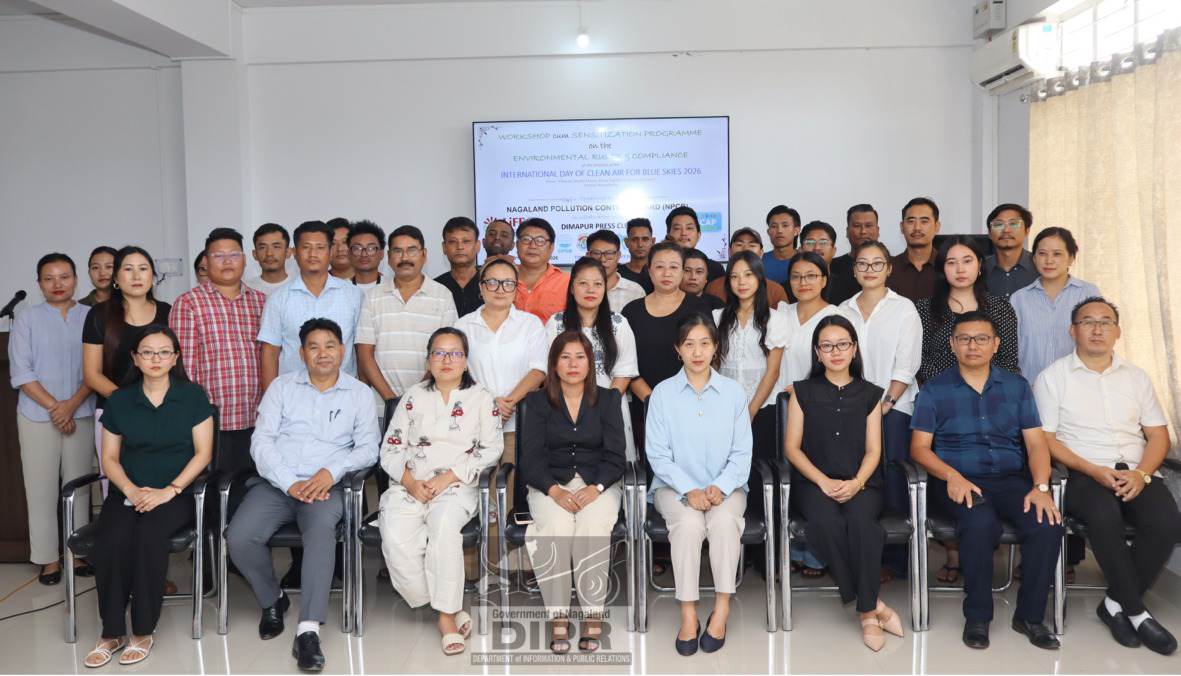
Environmental protection should be treated as a continuous public concern rather than a crisis-driven issue, speakers said at a Workshop-cum-Sensitisation Programme on Environmental Rules and Compliance organised by the Nagaland Pollution Control Board (NPCB) in collaboration with the Dimapur Press Club here on Monday.
The programme, held at the NPCB Conference Hall at Signal, Dimapur, marked the International Day of Clean Air for Blue Skies 2026 on the theme “Clean Air, Healthy Choices: Acting Together for People and Planet”. The workshop aimed to sensitise participants on environmental regulations, pollution control measures and compliance with various waste management rules, besides promoting greater awareness and collective action towards clean air and a healthier environment.
Delivering the keynote address, Senior Environmental Engineer, NPCB, Er Aghali A Swu, highlighted the growing threats posed by air pollution and climate change and stressed that environmental protection was a shared responsibility of the government, media and public.
Citing the World Health Organization’s global air quality report, Aghali said nine out of 10 people worldwide breathe polluted air. She added that air pollution had also emerged as one of the major health risks in India, noting that Dimapur and Kohima have been identified as non-attainment cities for failing to meet National Ambient Air Quality Standards.
She emphasised that air pollution knows no boundaries and can affect health, agriculture and the climate across regions. “The air we breathe today is a shared resource, and protecting it is a shared responsibility,” he said, adding that clean air was essential for healthy living, food security and a sustainable future.
The senior NPCB engineer said the workshop would also focus on air and water quality, their environmental impacts and various waste management rules. She stressed that waste management was directly linked to the quality of air, water and soil.
“Environmental issues are no longer isolated issues. They are all interconnected,” she said.
Drawing attention to the growing impact of climate change, Aghali referred to recent extreme weather events and cited a study by the University of Michigan published in Science Advances, which found that rising temperatures were contributing to increased groundwater withdrawal by farmers in India. He said the study projected that, if the trend continued, the rate of groundwater depletion could triple by 2080, potentially threatening the livelihoods of more than one-third of India’s population.
“Climate change is really happening faster than we ever imagined,” she said, urging collective action before environmental damage becomes irreversible.
She said groundwater depletion was already having serious consequences for farming communities, including inadequate rainfall, crop failures and economic distress.
The problem, she stressed, was not confined to other parts of the country. In Dimapur, she pointed out, there have been reports of borewells being drilled to depths of up to 600 feet without adequate availability of water.
Sharing her personal experience, Aghali said she came from a small hill town in Zunheboto district where she grew up seeing numerous waterfalls and spring wells. “But many have dried up now,” she said.
Having served with the NPCB for the past 17 years and visited all 17 districts of Nagaland, she said she had personally witnessed noticeable changes in the State’s climate.
Recalling her visits to various districts a decade ago, she said she often had to wear warm sweaters and jackets, whereas during recent visits she found herself wearing light summer clothes.
“This is not just a problem of one state or one nation. It is a global issue,” she said, urging all stakeholders to recognise the urgency of the situation and work collectively to protect the environment.
Aghali also highlighted the important role of the media fraternity in creating environmental awareness. She said journalists could contribute significantly by educating the public and disseminating accurate information on issues relating to the environment, health and climate change.
Download Nagaland Tribune app on Google Play


For effective and responsible environmental reporting, she stressed, members of the media should remain updated on environmental Acts, Rules, regulations and emerging environmental challenges.
Vice President of the Dimapur Press Club and Nagaland Post reporter, Bendangchuba Kichu called for stronger and sustained collaboration between environmental authorities and the media, noting that environmental issues often receive less attention than politics, law and order and government programmes.
He observed that environmental concerns frequently become news only when floods, landslides or other disasters occur, resulting in reactive rather than proactive coverage.
“We often report extensively on politics, law and order and government programmes, but when it comes to the environment, our coverage is not enough,” Kichu said, calling for a change in approach.
He identified limited access to easily understandable data, the perception of environmental issues as “soft news” and inadequate training in interpreting environmental laws, pollution data and scientific reports among the factors contributing to limited coverage.
Kichu stressed that journalists should explain how pollution affects people’s everyday lives and health, rather than merely reproducing international studies and reports. He pointed to local concerns such as air pollution in Dimapur, open burning of garbage near residential areas and waste being dumped into drains as issues requiring greater media attention.
Describing the media as both a watchdog and a bridge between authorities and communities, he said journalists must question authorities when environmental concerns are neglected while also holding communities accountable for practices that contribute to environmental degradation.
Kichu proposed regular environmental briefings, periodic reports and field visits for journalists, along with timely access to information on air quality, pollution hotspots, water quality, major environmental violations and basic environmental guidelines.
Such collaboration, he said, would allow journalists to translate technical and scientific information into accessible, human-interest stories for the public.
“Let us not wait for the environment to become a crisis before we make it news,” Kichu said, stressing that governments may change but environmental damage can take generations to reverse.
The first technical session covered ambient air quality and its impact, noise pollution and the Noise Pollution (Regulation and Control) Rules, 2000, and water quality and its impact. The session was followed by a discussion and interaction hour, allowing participants to seek clarification on various environmental concerns.
The second technical session focused on Hazardous and Other Wastes (Management and Transboundary Movement) Rules, 2016, Battery Waste Management Rules, 2022, E-Waste Management Rules, 2016, and Plastic Waste Management Rules, 2016. Officials of the NPCB served as resource persons for the session.
The third technical session dealt with the Bio-Medical Waste Management Rules, 2024, Solid Waste Management Rules, 2026, and consent management and environmental compliance of industries.
The programme concluded with a discussion and interaction session, followed by a vote of thanks proposed by Welunbo, Accounts Officer, NPCB.
The workshop provided an interactive platform for participants to gain a better understanding of environmental regulations and the need for collective responsibility in maintaining clean air and a sustainable environment.