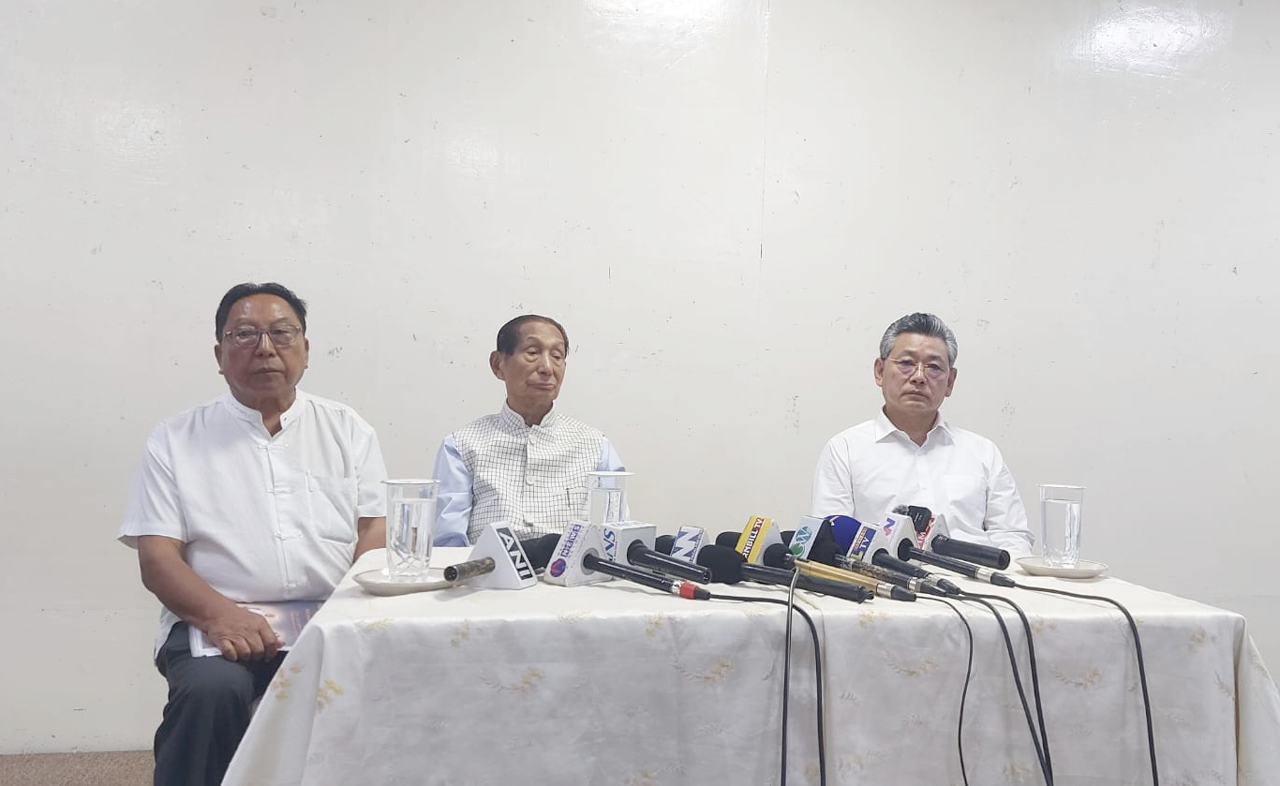
Former Nagaland Governor of Goa, Maharashtra, Gujarat and Odisha and former Nagaland Chief Minister Dr SC Jamir has urged the Rashtriya Swayamsevak Sangh (RSS) and the Government of India to better understand the aspirations and concerns of the Naga people and work towards an early and honourable settlement of the Naga political issue, warning that the prolonged impasse has weakened governance and placed an increasing burden on ordinary citizens.
Addressing a press conference at Hotel Saramati here, after meeting RSS chief Mohan Bhagwat at New Delhi on September 10, Jamir said he had personally approached the RSS leadership to clear what he described as “a lot of confusion” among the people regarding the RSS, BJP and related issues.
He said his discussions with Bhagwat covered the Constitution, India’s constitutional history, the country’s diversity, secularism, Article 371A and the unresolved Naga political issue.
Jamir stressed that India’s strength lay in its “unity in diversity”, saying the country’s different cultures, languages, traditions, food, dress and geographical conditions were integral to its identity.
“If there is only one stick to beat everybody, it will not be possible,” he said, arguing that India’s survival depended on allowing different communities to preserve and practise their cultures, customs and religions without disturbing others.
“If you talk about homogeneity in India, there should be the same language, same dress and same religion. Then how can India survive?” he asked.
“So I told them that this humanity’s survival depends upon respecting the culture, custom, religion of each community. So I said that human survival depends on that. That was second question, a question issue I have raised,” he said.
Jamir said India’s historical strength had been its ability to assimilate different civilisations, cultures and ideas and create a unique civilisation and nation.
He said he had conveyed to the RSS leadership that, from the Naga perspective, secularism represented the epitome of unity in diversity, where different sections of society could live freely and cohesively as members of one family.
Citing Nagaland as an example, 95-year old Jamir said people belonging to different religious communities participated in each other’s festivals, including Durga Puja and Christmas, and maintained that the State’s social fabric had traditionally not discriminated against people on the basis of religion.
“And I told them I am a Naga and I am a Congressman and I am a all timer, not sophisticated Naga. So whatever I have to tell you, I have to tell you from my heart. I will not check life. And therefore Nagaland is a Christian state,” Jamir said.
He also defended the protection of religious practices under Article 371A, saying that in the context of Nagaland, the provision relating to social and religious practices necessarily included Christian practices.
The former Chief Minister said changing times required changing mindsets, both in India and Nagaland. Scientific advancement and increasing knowledge, he observed, had not always been accompanied by corresponding changes in people’s thinking.
“We have to change our thoughts and our minds according to changing times,” he said.
Jamir said the RSS, too, needed to remain in tune with changing circumstances, pointing out that its philosophy and circumstances before Independence were different from those of present-day India. At the same time, he said Nagas must also examine whether they were keeping pace with the modern democratic and scientific age rather than remaining excessively focused on the past.
Turning to the Naga political issue, Jamir said Nagaland had been constitutionally and politically part of India since the creation and formal inauguration of the State on December 1, 1963.
“If this is so, how long are you going to allow our people to suffer?” he asked.
“Nearly 30 years Naga people are suffering, why? Because of unresolved Naga political issue. In the past there was only one NNC, but today after ceasefire it has multiplied into 36, 37. In the past only one group was demanding sovereignty. Now 37 fractions demands, there are 37 Nagaland government and is it a reality or a joke? Yes, they listen to this,” he said.
Jamir alleged that multiple taxation and extortion had caused immense hardship to Naga families and undermined the authority of the elected State Government.
“The State Government has become non-existent, in other words, governance has collapsed because they are helpless,” he said.
He also criticised the issuing of directives and orders to ordinary citizens by non-state authorities, saying such practices were incompatible with democratic governance.
Questioning the interpretation of the Framework Agreement, Jamir argued that the document did not provide for sovereignty or integration in the manner commonly interpreted by some sections. He said the agreement had created a framework for a settlement and questioned why issues he considered internal details continued to remain unresolved after decades of negotiations.
Using an analogy, he said agreeing to a framework was like agreeing to construct a house, while subsequent discussions should concern what would be placed inside it rather than reopening the fundamental framework.
Jamir also referred to the 16-Point Agreement and subsequent Statehood, saying several demands made during the earlier negotiations had been dealt with or altered after Nagaland became a State.
He said the prolonged negotiations had resulted in declining public confidence and urged the Government of India to take decisive steps before public hopes were completely lost.
“The Naga people want settlement, Naga people want it quickly,” he said.
Download Nagaland Tribune app on Google Play


Replying to a query, Jamir said he met Bhagwat to explore every possible avenue for an early settlement and asserted that meeting the RSS did not mean compromising his identity as a Naga, Christian or Congressman.
He said he had no obligation to any political party or organisation and that his primary obligation was towards the Naga people and God.
“In the interest of Naga people, I can meet Communists, I can meet BJP, I can meet RSS, I can meet BSP, anybody,” he said.
Explaining his decision to approach the RSS on a political issue, Jamir said the BJP was the ruling party and there were also perceptions that the RSS exercised influence in matters concerning the government.
“Some say they also solve, some say RSS. So why not RSS then?” he said, adding that his objective was simply to explore every possible avenue for an early settlement.
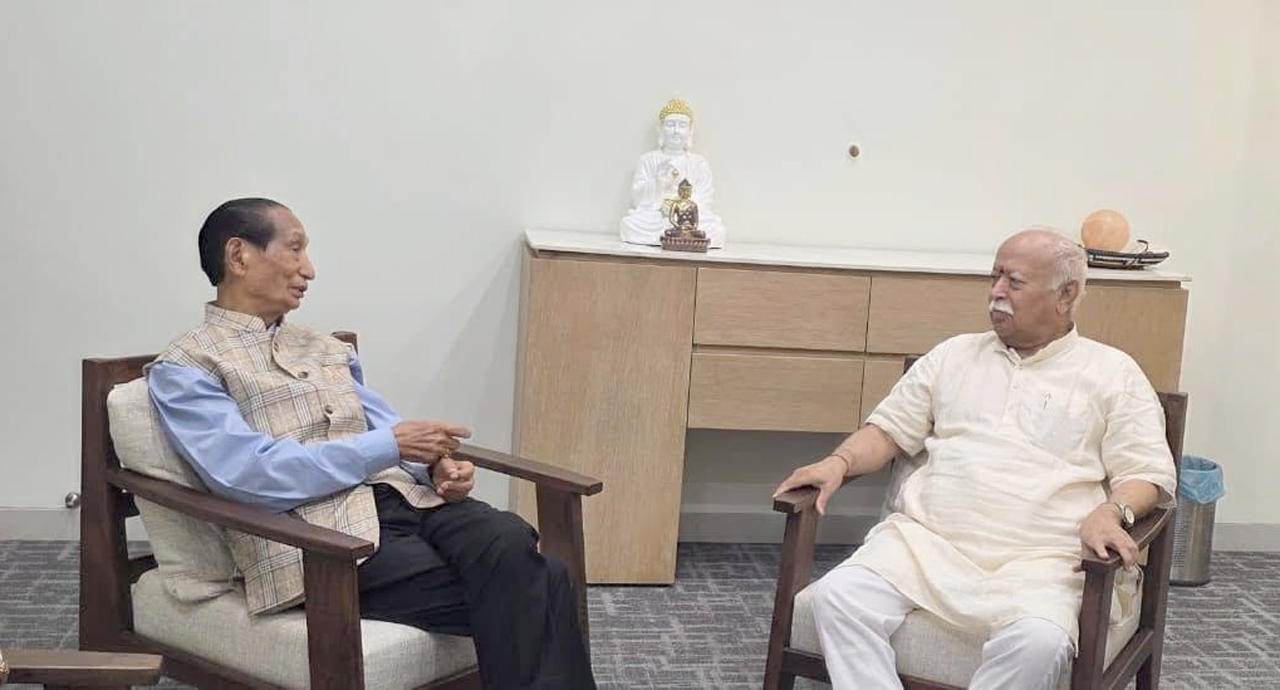
Responding to questions about the participation of his son and Nagaland Pradesh Congress Committee working president, Apok Jamir in the meeting, the former Chief Minister said he had nothing to hide.
“I am a Congressman. I am a Naga. I have nothing to hide,” he said.
Jamir said Bhagwat did not give any specific response to his request for the RSS to put pressure on the Government of India to expedite the Naga settlement. However, he said a comprehensive response could be expected after a month or two.
He said he had handed Bhagwat a written document explaining his views on the Naga issue and several other matters concerning Nagaland and the country.
On the Foreign Contribution Regulation Amendment Bill, 2026 (FCRA), Jamir said he was “totally against” restrictions that could adversely affect organisations and institutions dependent on foreign assistance, particularly in Nagaland and the Northeast.
He said the region continued to face poverty and that Christian institutions had historically played an important role in providing education, healthcare and other services. Foreign assistance, he added, had contributed to the establishment of important institutions in the region. He said he had raised the issue during his interaction with the RSS leadership.
“I only suggested him to put pressure on Government of India to resolve it as soon as possible,” Jamir said.
Jamir also called for a “total overhaul” of the governance system in Nagaland, alleging that multiple taxation and extortion had severely weakened the authority of the State Government.
He cited instances where contractors were allegedly subjected to demands from underground groups in addition to statutory deductions, leaving little of the original project amount.
“Where is the governance?” he questioned, arguing that ordinary people and contractors were bearing the burden of multiple authorities and competing demands.
Replying to a query on elected representatives and their allegiance to the Constitution, Jamir said those who had taken an oath of allegiance were duty-bound to remain faithful to it.
Recalling his own tenure as Chief Minister, he said underground groups had once asked him to boycott elections, but he refused because he had taken an oath in the name of God.
On the broader question of India’s constitutional character, Jamir reiterated that the country’s strength lay in its unity in diversity and warned against any attempt to transform India into a theocratic State.
He said,”If any political party, for that matter, government tries to make India a theocratic state, it will be the beginning of ending Indian Union as a nation.”
“The strength of India lies in her enduring unity in diversity,” he said, stressing that India’s secular character should not be disturbed.
Jamir also expressed support for the concerns raised by the emerging Gen-Z youth movement in Nagaland, particularly over unemployment, insecurity and the lack of opportunities.
“The youth demand should be supported,” he said, urging the State Government to listen to what he described as the “genuine voice” of the younger generation.
He said young people were increasingly frustrated because they felt they had inadequate opportunities in their own State and urged the elected government to address their concerns by ensuring security, employment and opportunities for the future.
On the controversy surrounding the singing or playing of Vande Mataram in government institutions and opposition to it by the Naga Students’ Federation, Jamir said he had not discussed the matter with Bhagwat.
“I don’t have interest in this. I have not given any thought,” he said.
Jamir maintained that his meeting with the RSS chief was primarily aimed at explaining the Naga political issue and other concerns affecting Nagaland. He reiterated his appeal to the RSS and Government of India to respond positively to the aspirations of the Naga people.
“If you take care of Nagaland, I think this will be a milestone in your organisation,” Jamir said he told Mohan Bhagwat.