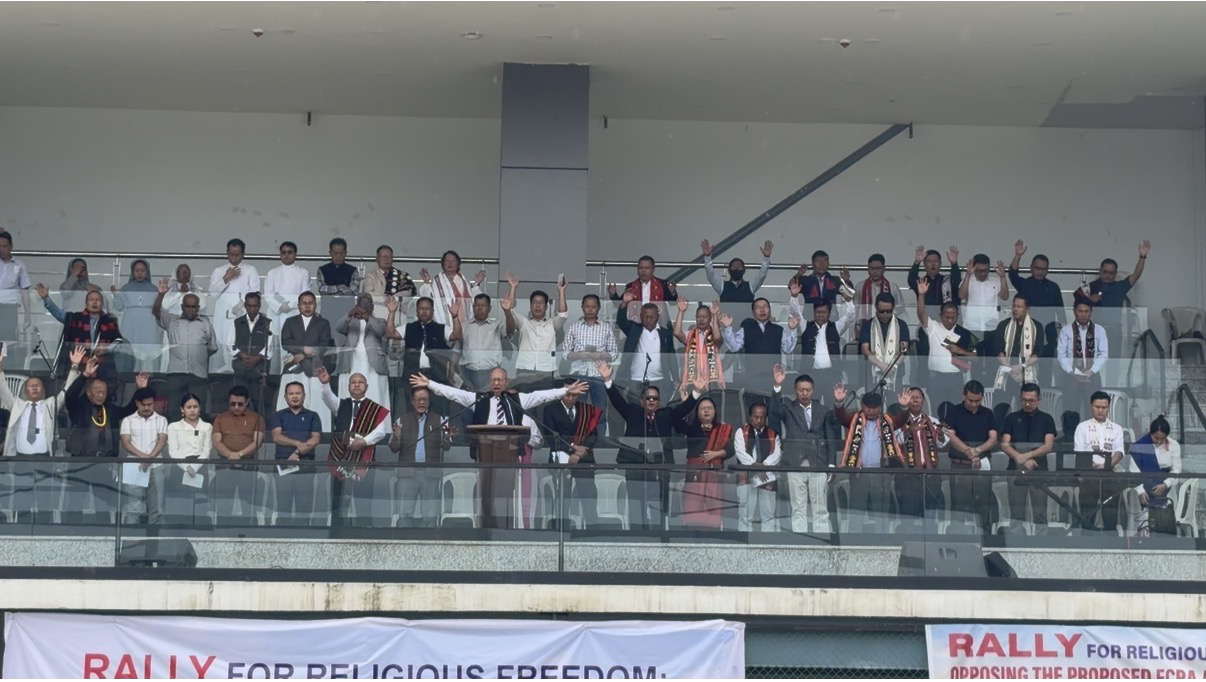
Thousands of people gathered at Khuochiezie (Local Ground), Kohima, on September 12 for a rally organised by the Nagaland Joint Christian Forum (NJCF) against the proposed amendments to the Foreign Contribution Regulation Act (FCRA), with speakers calling for protection of religious freedom, freedom of conscience, secularism and the service mission of the Church.
The “Rally for Religious Freedom: Preserving Freedom of Conscience, Religious Liberty, Secularism and the Service Mission of the Church” brought together representatives of various Christian denominations and members of the public.
Delivering the keynote address, NJCF president Rev Dr N Paphino said the Christian community in Nagaland was not opposed to patriotism or national unity but was asserting its constitutional right to freedom of conscience.
“We believe in the Constitution, in democracy, in freedom of conscience, in religious liberty, and in the dignity of every human person,” Paphino said, stressing that the gathering was intended to raise concerns peacefully, responsibly and constitutionally.
He said Christian faith did not make Nagas “less Indian” and that Naga heritage did not diminish patriotism. Rather, he said, India’s strength lay in its diversity of religions, languages, cultures, traditions and communities.
“India is not strong because everyone is the same. India is strong because people who are different can live together with dignity and mutual respect under one Constitution,” he said.
On the controversy surrounding Vande Mataram, Paphino maintained that individuals should remain free to sing the song voluntarily as an expression of patriotism, while those whose religious beliefs or conscience do not permit participation should not be compelled.
“The question is not patriotism. It is freedom of conscience,” he said.
Paphino also welcomed the earlier statement of Nagaland Deputy Chief Minister and Home Minister, Y Patton that the State government would not force anyone to sing Vande Mataram and that participation should remain a matter of individual choice.
He said the position deserved appreciation as it reflected constitutional maturity, democratic wisdom and respect for diversity. He urged that the principle should be protected in practice so that no student, employee or citizen faced harassment or discrimination for choosing not to participate on the basis of sincere religious belief.
‘No special privilege sought’
On the distinct identity of Nagaland, Paphino said Christianity had profoundly influenced the social, moral, educational and community life of the Naga people for generations.
He pointed out that Churches and Christian institutions had contributed to education, healthcare, social welfare, peacebuilding, youth development, women’s empowerment, rehabilitation and community development.
“Therefore, when we speak about defending our religious freedom, we are not asking for privilege. We are not asking for special treatment. We are asking for what the Constitution provides to every citizen — freedom, equality, dignity and respect,” he said.
Concern over FCRA
Paphino also raised concerns over the Foreign Contribution Regulation Act (FCRA), calling for a responsible and balanced approach to its implementation.
He said the Forum was not opposed to transparency, accountability, national security or lawful regulation, and acknowledged that organisations receiving domestic or foreign funds must maintain proper accounts and comply with the law.
However, he called for greater dialogue and less suspicion, saying India needed more trust and confidence in the Constitution rather than compulsion.
Download Nagaland Tribune app on Google Play


He said the strength of democracy should not be measured only by how loudly the majority speaks, but also by how safely minorities and diverse communities can live together and express their identities.
“Religious freedom cannot exist merely on paper,” he said, adding that freedom of conscience must be respected even when others disagree with a person’s beliefs.
Appeals for peace and unity
Paphino reiterated that the Forum was not against India, the Constitution or any particular faith.
“We stand for an India where every individual is treated with dignity,” he said, adding that the forum stood for constitutional values of liberty, equality and justice and the freedom of all religions.
He also rejected hatred, violence and discrimination against other communities and called for unity in diversity rather than unity through uniformity.
“The future of India will not be secured by forcing anyone to think the same, to pray the same, to sing the same, to live the same. India will become stronger when its citizens learn to respect one another,” he said.
Paphino urged Naga leaders and citizens to preserve the longstanding peace and coexistence among communities in Nagaland and refrain from actions that could create mistrust, division or disunity.
He warned that any disruption of the State’s peace and harmony would carry serious consequences and said those in positions of leadership would have to bear responsibility for the outcome.
He concluded by calling for a nation where every community has the confidence and freedom to retain its identity while contributing to the common good.
Other Speakers during the rally included Bideno Kikon, Secretary, Christian Education, NBCC; Advocate Toshi O Longkumer of the Gauhati High Court; and Rt Rev Dr James Thoppil, Bishop of Kohima, spoke on the concerns raised by the Forum.
The NJCF also submitted a memorandum addressed to the President of India, raising issues concerning constitutional rights, religious freedom, impartial implementation of the FCRA, the mandate on Vande Mataram and the Protected Area Permit and AFSPA regimes in the Northeast.
The Forum called for impartial enforcement of the FCRA, stressing that organisations found violating the law should be penalised, but that enforcement should not selectively target Christian institutions. It also urged greater grassroots consultation by the Joint Parliamentary Committee examining proposed FCRA changes.
On the issue of compulsory chanting of Vande Mataram, the NJCF sought exemptions for individuals with genuine religious objections, citing freedom of conscience and constitutional protections.
The memorandum further called for the repeal of AFSPA and abolition of the Protected Area Permit regime, arguing that these measures have restricted civil liberties and development in the Northeast.
Speaking to the media, Advocate Toshi O Longkumer highlighted the Forum’s constitutional and legal concerns, while Rev Dr Vevo Phesao, Convener of the Organising Committee, stressed the significance of submitting the memorandum and conveying the community’s concerns to the Union government.
In the Governor’s absence, the memorandum was received by the Commissioner and Secretary to the Governor, who assured the NJCF that its concerns would be communicated to the Governor.
The NJCF expressed hope for a positive response from the Government of India on the issues raised.
Earlier , the programme commenced with the opening hymn, “Stand Up, Stand Up for Jesus,” followed by a Bible reading by Thinuohelie Sachü, President of the Baptist Revival Church Council.
Pastor Sunep Jamir of Nagaland Pentecostal Mission offered the invocation, while the Sumi Baptist Church, Kohima, presented a song during the programme.
The programme concluded with the hymn “Onward Christian Soldiers.”
Kumtenzuk Jamir served as the cantor, Molungnenla Longkumer as pianist, while members of the Angami CRC Youth served as stewards.