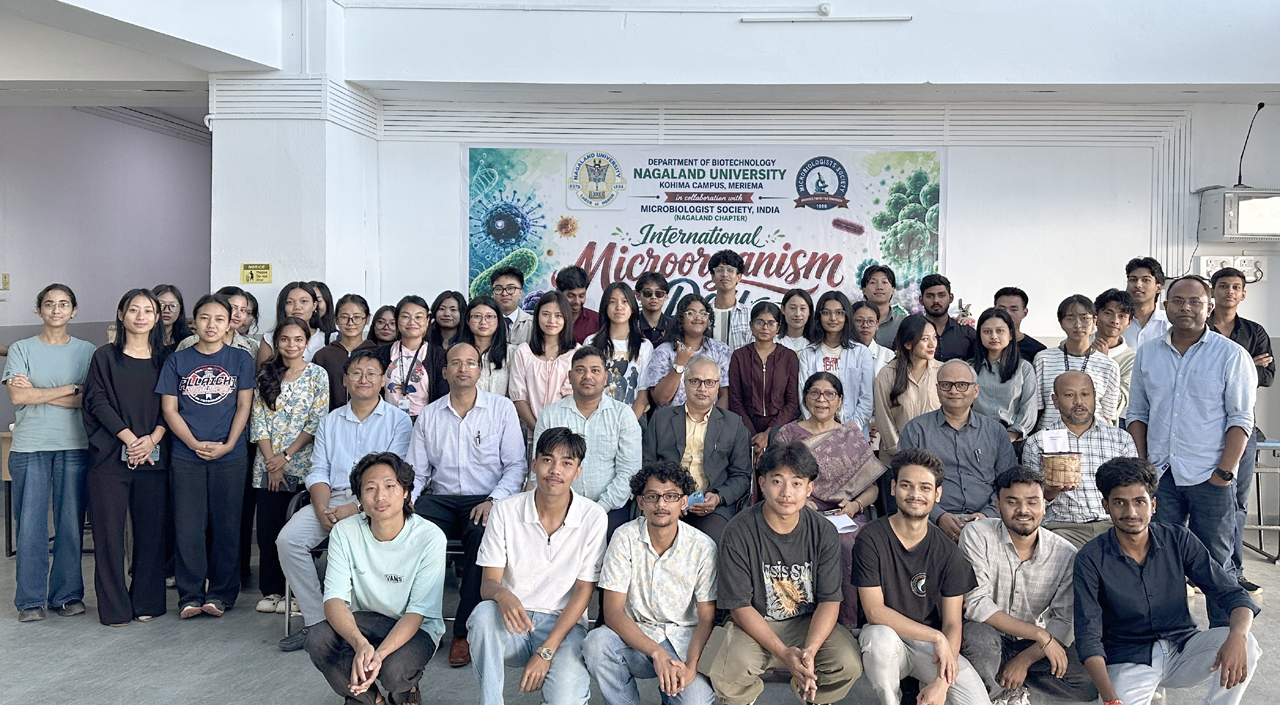
The Department of Biotechnology, School of Engineering and Technology (SET), Nagaland University, Kohima Campus, in collaboration with the Microbiologists Society, India, Nagaland Chapter, celebrated International Microorganism Day 2026 on September 17 through a series of academic, scientific and creative activities aimed at promoting awareness about the importance, diversity and applications of microorganisms.
The programme was organized on the theme “Tiny Organisms, Big Impact: Microbes for a Sustainable Future.” The celebration highlighted the indispensable role of microorganisms in human health, agriculture, food production, biotechnology, environmental sustainability and sustainable development, while providing students with opportunities to communicate microbiological concepts through scientific as well as creative formats.
The Inaugural Ceremony was held at the Department of Biotechnology, Nagaland University, Kohima Campus. Prof. Sujata Dash, Dean, School of Engineering and Technology, Nagaland University, graced the occasion as the Chief Guest, while Dr Rajkrishna Mondal chaired the inaugural programme.
Welcoming the gathering, Prof Pranav Kumar Prabhakar, Professor and Head, Department of Biotechnology, Nagaland University, and State President, Microbiologists Society, India, Nagaland Chapter, who served as the Convener of the event, emphasized the enormous significance of microorganisms despite their microscopic size.
He stated that microorganisms influence almost every aspect of life and play crucial roles in health, agriculture, food production, nutrient cycling, biotechnology and environmental sustainability. He highlighted that the purpose of celebrating International Microorganism Day was not only to increase awareness about microbes but also to encourage students to explore microbiology beyond conventional classroom learning.
Prof Prabhakar further emphasized that the scientific and creative competitions were designed to encourage curiosity, creativity, innovation and science communication among students. He remarked that “the microbial world may be invisible, but its impact is everywhere,” and encouraged students to remain curious, ask scientific questions and explore the enormous possibilities offered by microorganisms for addressing societal and environmental challenges.
Addressing the gathering as the Chief Guest, Prof Sujata Dash, Dean, SET, Nagaland University, appreciated the initiative of the Department of Biotechnology in organizing a programme that combined scientific learning with creativity and student engagement. She highlighted the importance of creating academic platforms where students can go beyond textbooks and develop their ability to observe, think, innovate and communicate science effectively.
She also emphasized the growing relevance of biotechnology and microbiology in addressing challenges related to health, environment and sustainable development and encouraged students to take advantage of such opportunities to broaden their scientific outlook.
Download Nagaland Tribune app on Google Play


The celebration received an encouraging response, with participation from 12 institutions from India and abroad. Of these, 10 institutions were from India, representing different states including Gujarat, Jharkhand, Maharashtra and Nagaland, while two international institutions also participated, giving the programme both national and international representation.
A total of six competitions and activities were organized as part of the celebration: Quiz, Poster Making, Rangoli, Model Making, Reel Making and Microbial Art. The Quiz recorded 28 participants, Poster Making 22 participants, Rangoli 14 participants, Model Making 9 participants, Reel Making 17 participants, and Microbial Art 16 participants. Among the recorded entries, 33 participants were from Nagaland University. The participation figures represent activity-wise entries, as individual participants were permitted to participate in more than one event.
The diverse activities were designed to provide participants with different ways of exploring and communicating microbiological concepts. While the quiz tested scientific knowledge and understanding, poster and model-making activities encouraged visualization and scientific presentation. Rangoli and Microbial Art brought creativity into microbiology, while the Reel Making competition encouraged participants to communicate scientific concepts through concise and contemporary digital media.
During the programme, Dr Hanumant Singh Rathore presented the report of the event, highlighting the participation, activities and overall reach of the celebration. The report reflected the enthusiastic involvement of students and institutions and underscored the multidisciplinary and interactive nature of the programme.
The celebration concluded with appreciation for all the participating institutions, students, faculty members, research scholars, organizing committee members and student volunteers whose collective efforts contributed to the successful organization of the programme.
The International Microorganism Day 2026 celebration at Nagaland University provided a platform where science, creativity and communication converged, enabling participants to appreciate microorganisms not merely as microscopic entities but as important contributors to human well-being, environmental sustainability, biotechnology and the future of society.
The participation of institutions from different states of India as well as from abroad reflected the wider reach of the programme and reinforced its central message—“Tiny Organisms, Big Impact: Microbes for a Sustainable Future.”