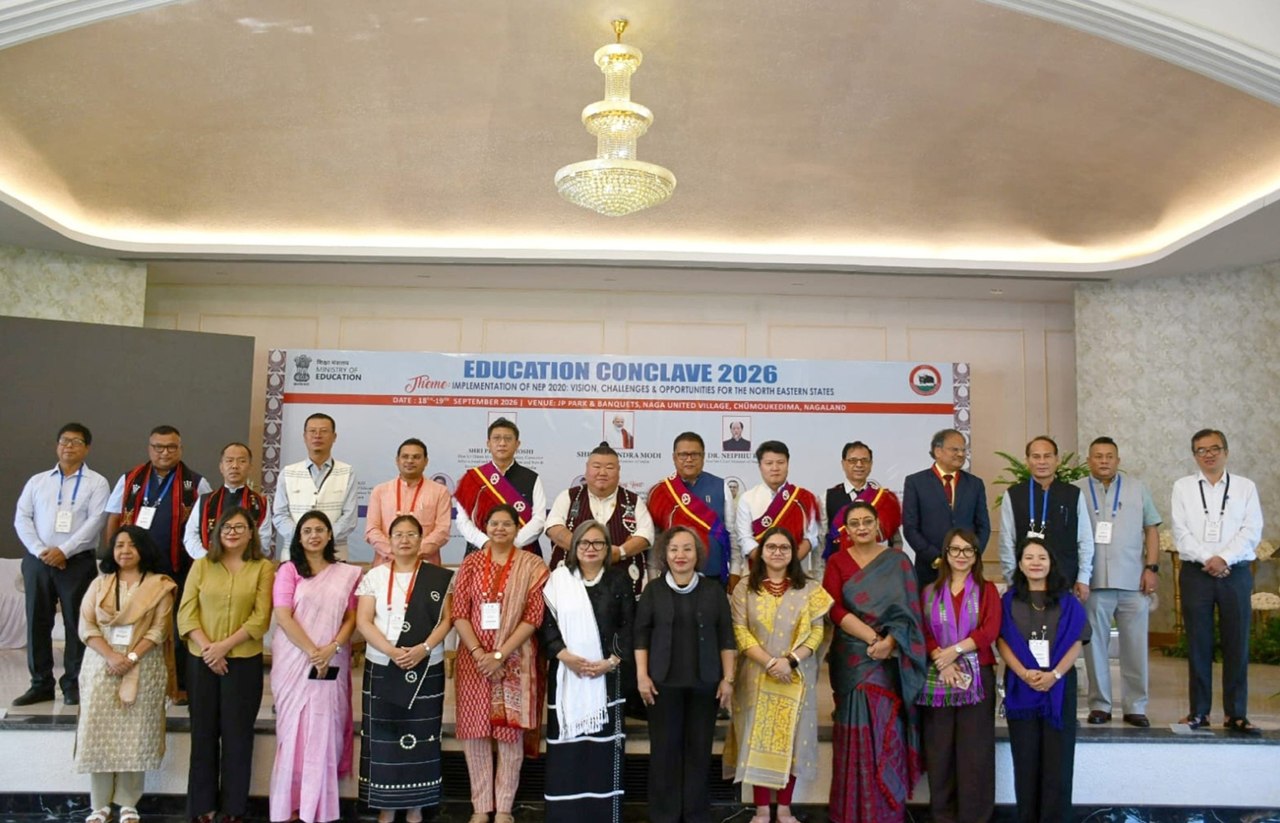
Ministers and policymakers from Northeastern States on Friday called for a region-specific approach to implementing the National Education Policy (NEP) 2020, citing geographical constraints, sparse populations, infrastructure gaps, teacher deployment and declining enrolment in government schools as major challenges.
Speaking at the Northeast Education Conclave in Chumoukedima, Mizoram’s Minister for School Education, Higher and Technical Education Dr Vanlalthlana said the Northeast could not implement education norms designed primarily for the plains without taking into account its terrain, dispersed settlements and demographic realities.
Presenting data from Mizoram and the wider Northeast, he said nearly 80% of schools in some Northeastern States had fewer than 30 students, while access to education declined sharply after the elementary stage. He said government schools were losing students across the region, with government and aided-school enrolment declining in six of the eight States for which comparable data was available.
Dr Vanlalthlana said Mizoram had 3,965 schools, 2,84,270 students and 25,282 teachers, giving a pupil-teacher ratio of about 11.2, compared to the national figure of 24.1. However, he said the State continued to face challenges, including a secondary gross enrolment ratio of 77% against the national 81.5% and a primary dropout rate of 6.35% against the national average of 1.5%.
He said 1,655 of Mizoram’s 2,563 government schools had fewer than 50 students, with some having zero enrolment, while around 45.7% of villages did not have higher secondary schools within prescribed norms.
Calling for greater honesty in assessing the region’s education performance, the Minister said Northeastern States needed to acknowledge their deficiencies while seeking greater support from the Centre.
He proposed a terrain index instead of a distance-radius model for determining educational access in hilly areas, along with separate norms for small and remote schools and hill-area construction. He also called for additional staffing and dedicated support for DIETs and SCERTs.
Dr Vanlalthlana said Mizoram had undertaken reforms in teacher recruitment, with appointments based on merit through statewide advertisements, written examinations and practice teaching. The State has also introduced standardised assessments aimed at developing students’ curiosity and critical-thinking abilities.
He highlighted Mizoram’s entrepreneurship and financial literacy initiative, Project Intodelh, which seeks to prepare students for self-sufficiency rather than merely becoming job seekers.
Download Nagaland Tribune app on Google Play


Assam Minister for School Education, Higher Education, Tribal Affairs (Plain) and Information Technology Dr Ranoj Pegu stressed the need to focus on the employability of students outside the professional education and competitive-examination streams.
Pegu said only around 2.6% of students in Assam pursued medical, engineering and similar professional education, while around 1% entered civil services or other competitive examinations. He questioned what would happen to the remaining students and called for education systems to equip them with relevant skills.
“Knowledge alone cannot make anyone employable. It is skill,” Pegu said, stressing the importance of critical thinking, creativity, collaboration, leadership and problem-solving.
He said Assam had introduced separate skill certificates alongside board certificates and had incorporated areas such as artificial intelligence and soft skills into school education. Bihu dance, he added, had also been introduced as a secondary-level subject, with around 32,000 students enrolled this year.
Pegu also called for skills to be integrated into higher education programmes, suggesting specialised diplomas in areas such as content writing, translation, creative writing, proofreading and copy editing alongside conventional academic disciplines.
Tripura Minister for Panchayat, Higher Education and General Administration Kishore Barman said the real test of NEP 2020 would be its implementation in classrooms rather than its provisions in government documents.
He called for education systems that combined local roots with global aspirations, enabling students to remain connected with their languages, cultures and traditions while acquiring knowledge of artificial intelligence, digital technology, research, innovation, entrepreneurship and emerging skills.
Barman said Northeastern States should share their experiences and best practices and work towards making the region an education hub.
Arunachal Pradesh MLA and Advisor to the HME, Mutсhu Mithi highlighted the financial and geographical challenges faced by Northeastern States. He said the region had enormous educational potential but continued to face constraints related to geography, human resources and finances.
Mithi said States such as Arunachal Pradesh, Nagaland and Tripura had to “race uphill” compared to States with easier geographical conditions, stressing the need to consider these disparities while framing education policies and allocating resources.
He said Arunachal Pradesh was investing heavily in education through its Mission Shiksha programme, with around ₹500 crore expected to be allocated during the current financial year.
Mithi also highlighted the growing challenge of misinformation in the digital age, saying access to information through mobile connectivity had expanded rapidly but did not necessarily ensure access to truth. He called for greater attention to digital literacy and the ability of students and citizens to distinguish reliable information from misinformation.
He cautioned that decisions taken in education today would have consequences for generations, stressing the need for policymakers and educators to carefully consider the long-term impact of reforms.
The speakers broadly agreed that while NEP 2020 provides a framework for transforming education, its implementation in the Northeast would require greater flexibility to accommodate the region’s terrain, small and dispersed schools, linguistic and cultural diversity, infrastructure requirements and emerging employment needs.