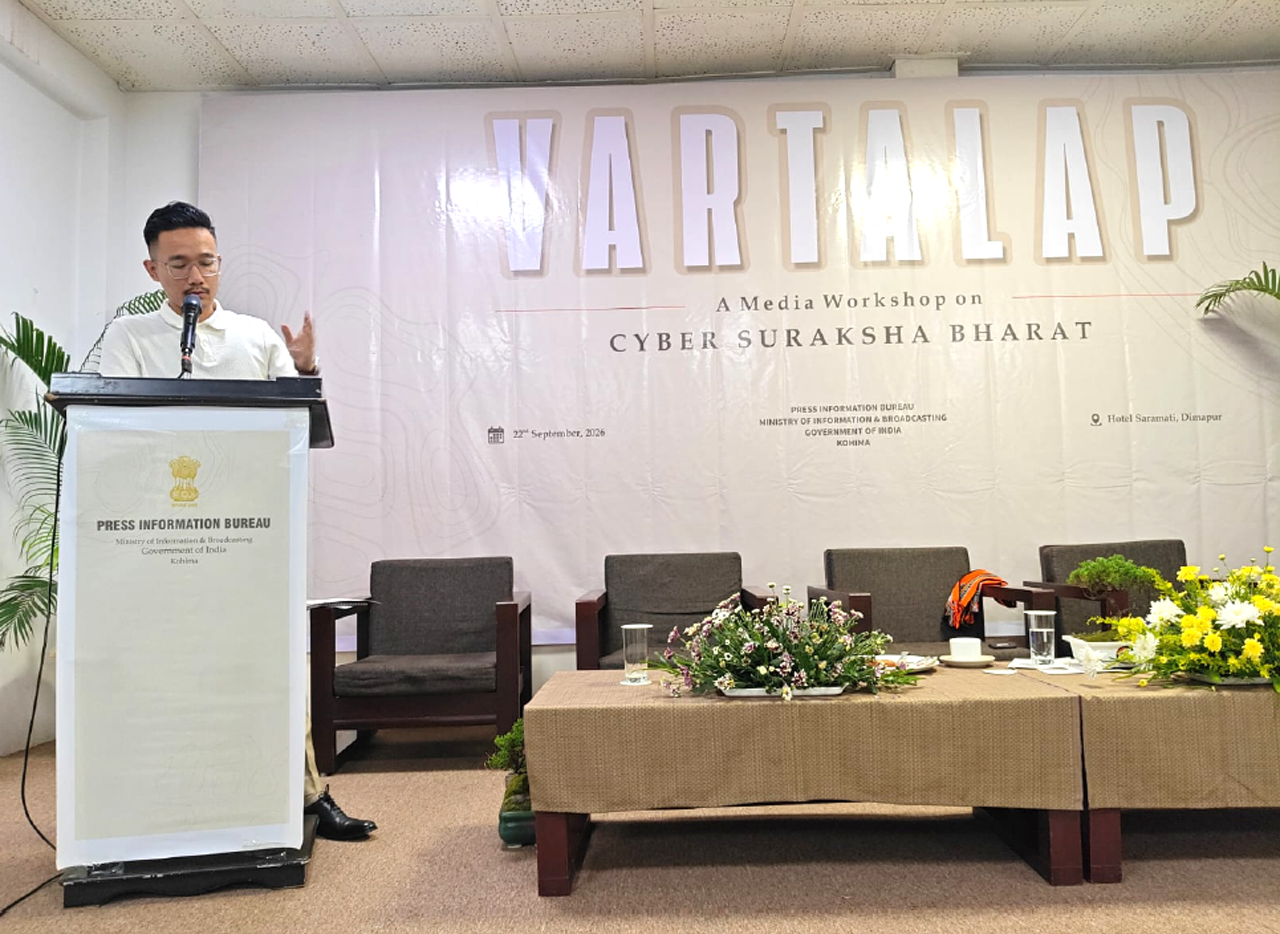
Financial frauds account for the majority of cybercrime cases reported in Nagaland, with around 80–85% of reported cybercrimes coming from Dimapur and Kohima, according to Kihika Chishi, NPS, Officer-in-Charge of the Cyber Crime Police Station at Police Headquarters (PHQ), Nagaland.
Speaking on “An Overview of Cyber Crime in Nagaland”, at a workshop on Cyber Suraksha Bharat, organized by Press Information Bureau Kohima, Chishi said cybercrime in the State primarily involves crimes against individuals, including cheating, impersonation, financial frauds and various forms of scams. Other reported offences include cyberbullying, stalking, defamation, identity theft, violation of privacy and circulation of obscene material.
He said the irony of the Information Age was that despite people having access to vast amounts of information, many continued to fall victim to cybercrime because they failed to verify information. Lack of cyber awareness, trust in authority, fear, greed for quick gains, curiosity, emotional manipulation, overconfidence and familiarity were among the factors making people vulnerable, he said.
According to Chishi, scammers increasingly use social media as the initial point of contact with potential victims. Fraudulent advertisements promising exceptionally high returns, fake profiles, phishing links, impersonation and deceptive phone calls are among the common methods used to gain the trust of victims, he added.
He highlighted several forms of financial fraud being encountered in Nagaland, including cheating by impersonation, fake banking helplines, digital arrest scams, investment frauds, e-commerce scams, gift scams, loan-app frauds and online gaming-related frauds.
Explaining fake helpline frauds, Chishi said scammers can create replicas of bank websites and publish their own telephone numbers as customer-care contacts. He cited the case of an elderly woman who searched online for an SBI helpline number, contacted a fraudulent number and was persuaded to share two OTPs, following which her entire bank account was wiped out.
He also warned about “digital arrest” scams, in which criminals impersonate police, CBI, Enforcement Directorate, Department of Telecommunications or other officials and threaten victims with arrest or legal action. Victims are then pressured to pay money on various pretexts.
Chishi said elderly persons were particularly targeted and some people in Nagaland had lost crores of rupees in such scams.
On WhatsApp account hacking, he said victims often unknowingly share OTPs, enabling criminals to take control of their accounts and subsequently approach their contacts for money. He also described postal and courier scams in which victims are asked to dial codes or pay small amounts for parcel reactivation, which can allow criminals to access calls, SMS messages or banking information.
Chishi cautioned against downloading unverified loan applications, saying malicious apps could access contacts, photographs and other information stored on mobile phones. Such information could subsequently be used for extortion, including threats to circulate manipulated or obscene photographs, he said.
He also warned about investment scams, fake e-commerce websites, gift scams and fraudulent online gaming platforms. He said scammers could exploit online gaming platforms to circulate illicit funds, resulting in innocent users’ bank accounts being frozen.
On frozen bank accounts, Chishi explained that the Ministry of Home Affairs’ National Cybercrime Reporting Portal (NCRP) has a Grievance Redressal Module (GRM). People whose accounts have been frozen in connection with cybercrime elsewhere can approach their bank branch and request the bank manager to upload their grievance through the module rather than physically travelling to another State, he disclosed.
He said another emerging concern was the use of artificial intelligence for impersonation through deepfakes. Although the Cyber Crime Police Station in Nagaland had not received a deepfake case so far, he cautioned that increasingly sophisticated AI tools could make such fraud more difficult to detect.
Chishi also warned people against selling or lending their bank accounts to others.
He explained that “mule accounts” are used by cybercriminals to transfer and layer illicit funds. People who allow their accounts to be used in this manner could subsequently face police investigation or summons if fraudulent money is traced to their accounts, he cautioned.
Download Nagaland Tribune app on Google Play


He stressed that delayed reporting was one of the biggest challenges faced by cybercrime investigators. Unlike traditional crimes where the first 24 hours are considered important, he said the first hour is the “golden hour” in cybercrime, particularly in financial fraud cases.
Victims, he said, often report investment scams only after several months, by which time criminals may have withdrawn the money and disappeared. He urged victims to immediately preserve screenshots, messages, profile details, URLs, transaction records and other digital evidence.
Chishi advised people to avoid clicking suspicious links, answering unknown calls, befriending unknown persons online or believing offers promising unrealistic returns. He also urged people never to share OTPs, PINs, passwords or personal information.
He recommended enabling multi-factor or two-step authentication on WhatsApp and other social media accounts, using strong and regularly changed passwords and PINs, restricting social media privacy settings, setting transaction limits on banking applications and downloading applications only from authentic sources.
In case of financial fraud, Chishi urged victims to immediately call the 1930 National Cybercrime Helpline. He explained that the system connects banks, police, financial intermediaries and payment gateways, allowing suspected fraudulent transactions to be quickly traced and funds to be lien-marked where possible.
Victims can also report cybercrime through the National Cybercrime Reporting Portal, cybercrime.gov.in, or approach the nearest police station. He stressed that evidence should be preserved and reported without delay.
He further highlighted the Department of Telecommunications’ Chakshu facility under Sanchar Saathi for reporting suspected fraudulent communications, while the CEIR facility can be used to report lost or stolen mobile phones and block their IMEI numbers. He also advised people to use TRAI’s Do Not Disturb facility to reduce spam calls.
Chishi said cybercrime was not always dependent on sophisticated technology, but often began with “one careless click”, a shared OTP or a weak password. He urged citizens not to panic or remain silent if they became victims.
“Awareness is the key to mitigate and curb the menace of cybercrimes,” he said, stressing that cybercrime was constantly evolving and that public awareness and prevention remained crucial tools in combating it.
