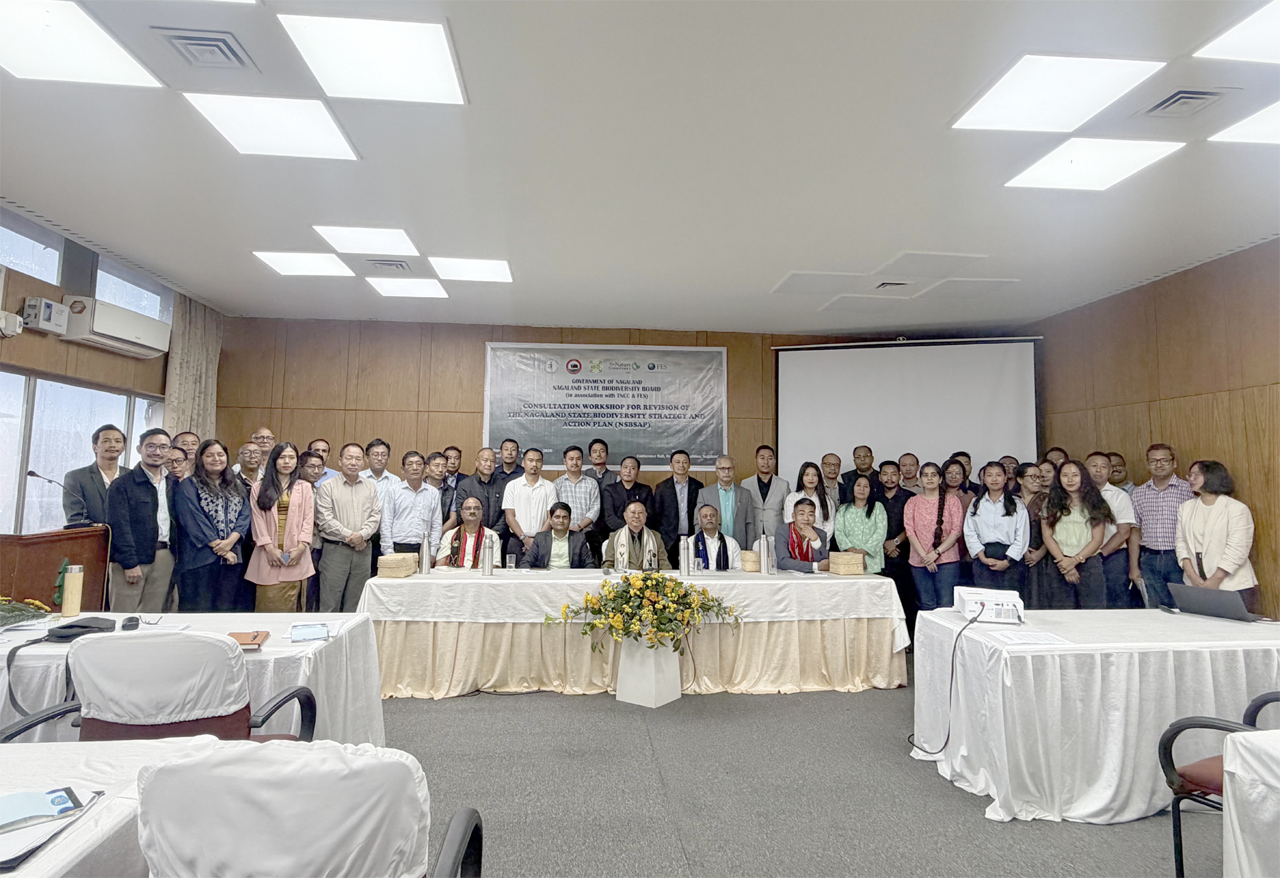
Nagaland Principal Secretary, Department of Environment, Forest and Climate Change (DEFCC), and Chairman of the Nagaland State Biodiversity Board (NSBB), Y Kikheto Sema, on Tuesday called for a state-specific and community-driven approach to biodiversity conservation, stressing that Nagaland’s unique ecological and agricultural systems must be reflected in future planning.
Speaking at a consultation workshop for the revision of the Nagaland State Biodiversity Strategy and Action Plan (NSBSAP) at Hotel Japfu, Kohima, Sema said the revision was a commitment of the state government to align its biodiversity conservation efforts with global priorities.
The workshop was organised by the Nagaland State Biodiversity Board in association with TNCC and FES.
Sema highlighted Nagaland’s high forest cover, which he said stands at around 73 per cent, compared with the national average of about 21–22 per cent. He said Peren has the highest forest coverage among Nagaland’s districts at over 91 per cent, while Tuensang has the lowest at around 51 per cent.
He noted that around 70 per cent of Nagaland’s population lives in rural areas and is largely dependent on agriculture and allied activities. Given the state’s limited scope for large and medium-scale industries, he said agro and allied sectors remain crucial to the state’s economy.
Sema also underlined the importance of Nagaland’s traditional jhum or shifting cultivation, saying it was deeply connected with Naga culture and festivals and therefore could not simply be stopped.
However, he expressed concern that the practice was becoming less economically viable and ecologically sustainable, with fallow periods declining and soil fertility being affected.
“We cannot stop jhum cultivation because it is all related to our culture,” he said, while calling for greater research and efforts to improve the sustainability of the traditional agricultural system.
Sema observed that agricultural education and research often focus on practices followed in mainland India, with limited attention to the distinctive agricultural systems of Nagaland and the Northeast.
He called for greater efforts to understand and strengthen indigenous agricultural practices so that they can better support local farmers.
On biodiversity conservation, Sema stressed that the government alone could not protect the state’s biodiversity, pointing out that the Forest Department owns less than five per cent of the state’s total forest area due to Nagaland’s unique landholding system.
“We need the help of all of you. We need all our people to be involved,” he said.
He urged the workshop participants to identify biodiversity challenges, opportunities and state-specific priorities and develop an actionable strategy based on an integrated approach to conservation.
Sema also called for greater public awareness on biodiversity and waste management, saying issues relating to solid and liquid waste should be discussed at the family level and incorporated into school curricula.
He recalled that during his tenure as Agriculture Production Commissioner in 2022, efforts were made with the Education Department to include the importance of biodiversity in elementary education.
Sema further acknowledged the role of the Nagaland Baptist Church Council (NBCC) in biodiversity conservation, noting that the church had adopted a resolution to protect and promote biodiversity across the state.
He urged the NBCC to uphold the resolution and play a proactive role in addressing both biodiversity conservation and waste management.
Download Nagaland Tribune app on Google Play


Calling Nagaland’s biodiversity an important strength, Sema said the state may have limited financial resources compared to other states but could contribute significantly through ecological services.
He also suggested that Nagaland and other Northeast states could serve as models for biodiversity conservation and called for wider national-level engagement on the issue.
Delivering the keynote address Supongnukshi, IFS APCCF (Terrotrial), O/o PCCF &HoFF, Nagaland, Kohima said Nagaland was among the first states to initiate the revision of its biodiversity strategy following directives from the Ministry and the National Biodiversity Authority.
He said the state’s first biodiversity strategy and action plan was prepared in 2005, while the revised exercise was subsequently undertaken with support from partners including the Foundation for Ecological Security (FES) and GIZ and completed around 2021.
The present consultation, he said, seeks to bring together government departments, academic institutions and organisations working in the field of biodiversity.
Highlighting Nagaland’s distinctive landholding system, Supongnukshi said almost all forests and natural resources in the state were under the ownership of communities and individuals, a system that had existed for generations.
He, however, stressed that ownership also came with the responsibility to assess how natural resources were being utilised amid changing circumstances and increasing population pressure.
“Times change, situations also change,” he said, adding that increased dependence on forests and biodiversity resources had contributed to a gradual decline in flora and fauna.
He pointed to forest degradation and deforestation over the past 10–15 years, claiming that the state had witnessed around a 10 per cent decline in forest cover during the period.
Supongnukshi cautioned that the loss of forest cover inevitably affects biodiversity, as forests provide habitat for animals, plants, insects and other species.
“If the forest cover is losing, that means definitely we have a loss in certain number of population as well as species,” he said.
He also emphasised the importance of documenting Nagaland’s biodiversity, noting that several species in the state were yet to be discovered and scientifically studied.
Academic institutions and scholars participating in the consultation, he said, could contribute to documenting and understanding the state’s biodiversity.
He cautioned that species could disappear before they are even identified, potentially resulting in the loss of resources that could have significance for humanity.
Describing the current revision exercise as an opportunity to take stock of Nagaland’s biodiversity, Supongnukshi called for a comprehensive assessment of the state’s existing resources, the changes taking place and the factors contributing to biodiversity loss.
“This present exercise, I feel, is giving us an opportunity for us to have an assessment where we stand,” he said.
The programme began with an invocation by Evangelist Menuotuolie Chielie of Koinonia Baptist Church, followed by the welcome address delivered by Sidramappa M. Chalkapure, IFS, CCF (D&P) and Member Secretary, Nagaland State Biodiversity Board (NSBB), who also chaired the programme.
Short speeches were delivered by Dr Ishwar Narayan, Executive Director, TNCC, India, and Sanjay Sharma, General Manager, Foundation for Ecological Security (FES).
The programme concluded with a vote of thanks by Savino Kikhi, RFO In-charge, Chiephobozou Range and NSBB.