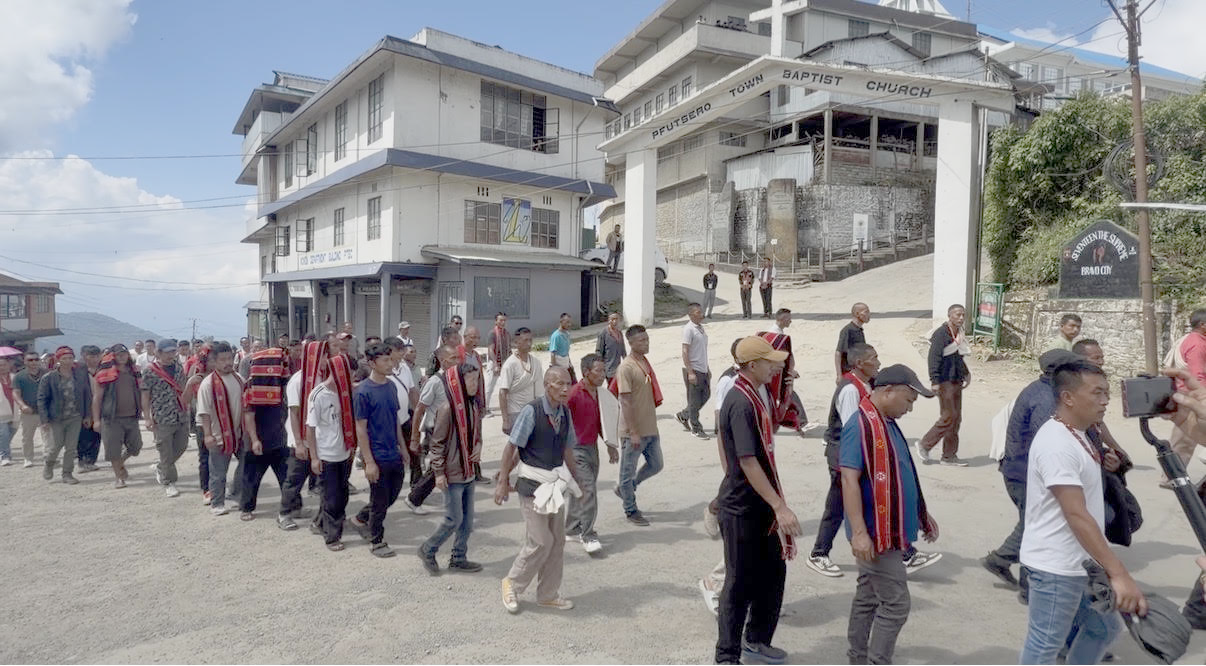
PFUTSERO, September 28: The Centre Chakhesang Youth Organisation (CCYO) on Monday staged a rally in Pfutsero, demanding action over the case involving Vezhoto Hesuh and the seizure of a Great Barbet from Porba village.
The rally began at Rukizu Junction with a brief gathering before thousands of CCYO members and youths marched peacefully to the office of the Additional Deputy Commissioner (ADC), carrying traditional spears and singing folk songs. The organisation subsequently submitted a memorandum addressed to Chief Minister Neiphiu Rio through the ADC, Pfutsero.
The CCYO issued a seven-day ultimatum to the State Government and the Department of Environment, Forest & Climate Change, demanding immediate withdrawal of the case against Hesuh, return of the seized Great Barbet and an independent inquiry into its allegation that ₹1 lakh was demanded for Hesuh’s release.
The Organisation warned that failure to take satisfactory action within seven days would compel it to pursue further courses of action to seek accountability and protect what it described as the dignity, customary interests and rights of the community.
According to the CCYO, Hesuh was telephonically summoned to appear before the Wildlife Crime Control Unit (WCCU), Wildlife Division, Dimapur, on September 11 in connection with photographs and videos uploaded on his Facebook page and was subsequently detained the same day.
The Organisation said the posts included a video of Hesuh offering a sweet to a monkey in Assam, a video showing a caged bird reportedly traditionally reared by a person at Porba village, and a photograph of Hesuh with a bird perched on his shoulder at Porba.
The CCYO maintained that the animals were neither owned nor under the custody of Hesuh and alleged that the material did not depict cruelty, killing, capture or deliberate harm to wildlife.
It further alleged that ₹1 lakh was demanded for Hesuh’s release and that a case was subsequently initiated after he refused to pay the amount.
The Organisation called for an impartial inquiry into the allegation, including identification of officials involved and appropriate action in accordance with law.
The CCYO also expressed concern over the seizure of a Great Barbet from Porba village on September 14. It said the bird had reportedly been cared for by a young boy for six to seven years and that its removal had caused emotional distress to the child and concern among villagers.
The Organisation argued that the matter should not be viewed solely as an enforcement issue, but should also take into account the community’s traditional relationship with birds and the natural environment.
The memorandum also raised the issue of Article 371A of the Constitution, arguing that the constitutional safeguards applicable to Nagaland must be taken into consideration wherever matters involving customary practices, customary law and procedure, and ownership and transfer of land and its resources are concerned.
The CCYO referred to the Supreme Court’s December 16, 2025 judgment in North Eastern Development Finance Corporation Ltd. v. M/s L. Doulo Builders & Suppliers Co. Pvt. Ltd., arguing that ordinary legislation cannot override constitutional protections.
Download Nagaland Tribune app on Google Play


It further maintained that the Wildlife (Protection) Act, 1972, should not be treated as an unlimited source of executive power and called for harmonisation of wildlife conservation measures with the customary and traditional rights of the people.
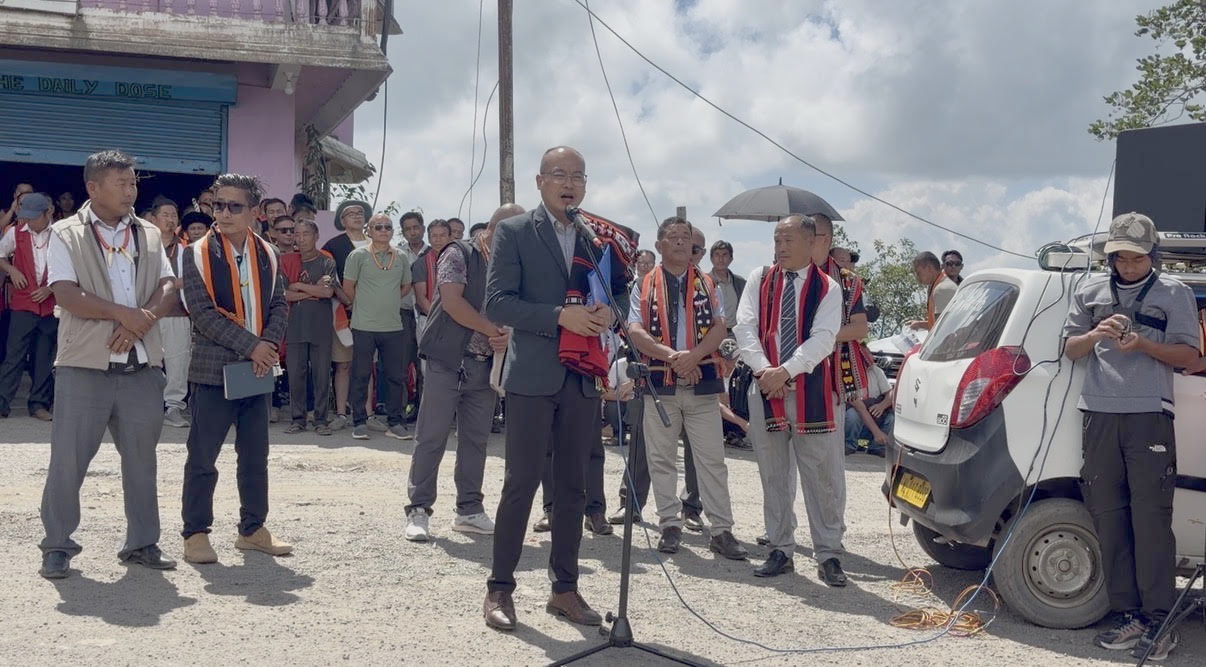
Addressing the gathering, former president of the Chakhesang Students’ Union and Chakhesang Youth Organisation Kohima, Vevoyi W.D. Vadeo, said the rally was historic as people had marched carrying traditional spears and singing folk songs to assert their cultural identity.
Vadeo alleged that the Wildlife (Protection) Act was being used against traditional practices and questioned the circumstances surrounding Hesuh’s detention and the alleged demand for ₹1 lakh.
He said Hesuh had posted videos involving wildlife but had not hunted or captured the animals, and questioned whether such action constituted law enforcement or amounted to an alleged extortion attempt.
On the Great Barbet seizure, Vadeo said the bird had become part of the life of a minor in Porba village and described it as a symbol of the community’s cultural relationship with nature.
He also questioned what he described as an inconsistency between wildlife conservation and the keeping of animals in zoos, while stressing that the CCYO was not opposed to conservation.
“We are not against conservation; rather, our people are the best conservationists,” Vadeo said, asserting that Chakhesang communities had protected forests and wildlife through traditional practices long before the establishment of modern government departments.
Vadeo also referred to the Nagaland Legislative Assembly’s adoption of the Wildlife (Protection) Act in 1981 and called for the government to review its implementation in the context of customary safeguards.
He cited the Assembly’s 2023 resolution opposing the Forest (Conservation) Amendment Act, arguing that the State Government should similarly address concerns arising from the application of wildlife legislation in Nagaland.
The CCYO further demanded an inquiry into Hesuh’s detention and the alleged monetary demand, dropping of charges against him and immediate return of the Great Barbet to Porba village.
It also called for a government white paper clarifying that the Wildlife (Protection) Act would not criminalise genuine Naga customary practices protected under Article 371A and urged a review of its implementation with appropriate customary safeguards.
The Organisation warned that if the government failed to address its concerns, it would consider further action to assert what it described as the customary rights and interests of the Centre Chakhesang area.
The CCYO reiterated that it supports conservation but maintained that conservation measures should coexist with the customary practices and cultural traditions of local communities.